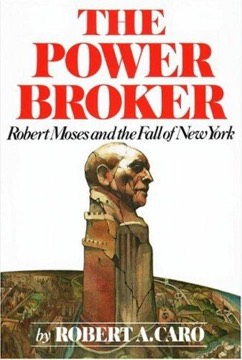
The Power Broker
Robert Caro's biography of Robert Moses — the unelected official who reshaped New York over four decades — and through him, a study of how power is actually accumulated and used in a democracy.
- First published
- 1974
- Publisher
- Knopf
- Pages
- 1263
- Shelf
- History
- Level
- Deep
- ISBN-13
- 9785553887704
Record checked against
Catalogue note
- Reads as
- ReflectiveChanges how you see rather than what you do.
- Level
- Advanced / AdvancedAssumes you have read around the subject already.
- Approach
- Theoretical
- Written for
- Readers of history, Specialists and serious readers
Saved in this browser only — no account, nothing sent anywhere. My library
Read this if
- You want a life told honestly, at full length.
- You want to understand how power is taken, kept and lost.
- You want to understand a place, or what we are doing to one.
- You want a book that changes how you see things rather than what you do tomorrow.
- You have read around this already and want a book that assumes it.
What it is really about
Caro has said that he wrote it not because he was interested in Moses but because he wanted to understand political power, and Moses was the clearest available case.
The question the book answers is how a man who was never elected to anything came to control the physical development of the largest city in the country for forty-four years, and why nobody could stop him.
The subject is power. Moses is the case study, chosen because he had more of it than anyone who was elected.
Devmark’s reading — not a quotation from the book
The idealist
The first section covers a reformer who entered public service determined to end patronage and merit-test appointments, and whose first major proposal was destroyed by the political system he had refused to accommodate.
Caro's argument is that the failure taught him a lesson he applied for the rest of his life: idealism without power accomplishes nothing, and acquiring power requires methods idealism forbids.
How the power was built
The book's core analytical contribution. Moses drafted his own enabling legislation, and legislators approved language whose implications they did not read.
The authority structure — public bodies with bond revenue, insulated from elections, whose contracts with bondholders could not be impaired by the legislature — gave him an independent income and a legal shield. He built a machine that could not be dismantled by anyone who had not read the paperwork as carefully as he had.
The bridges and the parks
Caro is scrupulous about the achievement. Moses built an enormous quantity of parks, beaches, bridges, playgrounds, pools and roads, much of it well designed and a great deal of it still in use.
The Jones Beach material in particular shows a public servant of real vision. The book is not a demolition of a man with no accomplishments; it is an account of what accompanied them.
Who paid
The other half. Neighbourhoods destroyed for expressways, roughly a quarter of a million people displaced, communities in East Tremont eliminated for a route Caro argues could have been shifted a few blocks.
His chapter on East Tremont is the emotional centre of the book, and it works because he interviewed the people who lived there and traced what happened to them afterward.
Race
Caro documents Moses's treatment of Black and Puerto Rican New Yorkers: pool locations and temperatures, bus access to beaches, and the siting of expressways.
The low-bridge allegation — that parkway overpasses were built too low for buses, limiting access to the beaches — rests on a single source and has been disputed by later historians. A reader should know the claim is contested and that the broader documented pattern of discriminatory decisions does not depend on it.
The low-bridge story rests on one source and is disputed. The wider documented pattern does not depend on it.
Devmark’s reading — not a quotation from the book
Cars over transit
His argument that Moses's decisions committed the region to automobile dependence for generations: highways built and rail excluded from bridge designs that could have accommodated it.
The consequences are structural and irreversible in any practical sense, which is the book's most durable point about infrastructure — decisions about physical form outlast the people and politics that produced them.
The method of the book
Seven years of work, hundreds of interviews, and Caro's practice of going to the places and talking to the people affected rather than only reading the records.
His decision to interview those displaced, and to spend enough time in a neighbourhood to understand what was lost, is what makes the human cost concrete rather than statistical. It became the model for a particular kind of investigative biography.
The length
It is over a thousand pages and considerably more was cut. This is a real barrier and a legitimate complaint.
The counter-argument is that the accumulation is the argument. The reader has to experience the duration of forty-four years and the repetition of the pattern for the scale of it to register, and a shorter version would make the case without demonstrating it.
What it established
That power in a democracy does not necessarily follow election, that institutional design determines who can be removed, and that the person who writes the legislation has an advantage over the person who votes on it.
It is widely regarded as one of the best biographies written in English, and its influence on how journalists and historians approach institutional power has been considerable.
What to take away
- 01Power can be built without electionAuthorities with independent bond revenue and contractual protection are insulated from the vote entirely.
- 02Whoever drafts the legislation winsLegislators approved language whose implications they had not read, repeatedly, for decades.
- 03Infrastructure decisions outlast their politicsExcluding rail from bridge designs committed a region to cars for generations.
- 04The achievement and the cost are both realThe parks and beaches are genuine, and so are the quarter of a million displaced people.
- 05Length is the argumentThe repetition over forty-four years is what a shorter book would assert rather than demonstrate.