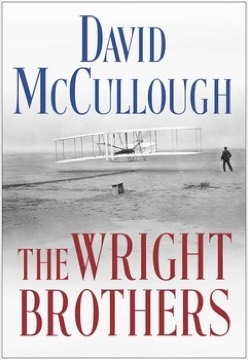
The Wright Brothers
David McCullough's account of two bicycle mechanics from Dayton who solved the problem of powered flight — working from their own funds, without formal training, while better-resourced competitors failed.
- First published
- 2016
- Publisher
- Simon & Schuster
- Pages
- 432
- Shelf
- History
- Level
- Entry
- ISBN-13
- 9781471159114
Record checked against
Catalogue note
- Reads as
- ReflectiveChanges how you see rather than what you do.
- Level
- Accessible / FoundationalNo prior reading assumed.
- Approach
- Theoretical
- Written for
- Readers of history, Newcomers to the subject
Saved in this browser only — no account, nothing sent anywhere. My library
Read this if
- You want a life told honestly, at full length.
- You are building something new and want to know why most new things fail.
- You want to know how we got here.
- You want a book that changes how you see things rather than what you do tomorrow.
- You are starting from scratch here and want a way in that assumes no prior reading.
Who they were
Wilbur and Orville Wright ran a bicycle shop, neither attended college, neither married, and they lived with their father and sister for most of their lives.
McCullough's portrait emphasises the household: a father who encouraged argument and supplied books, a sister whose role in the enterprise was substantial, and a family culture of self-education that produced two people willing to distrust published authority.
A household that encouraged argument produced two men willing to distrust the published authorities entirely.
Devmark’s reading — not a quotation from the book
The problem as they defined it
Their key insight was about which problem to solve. Others focused on propulsion, assuming that sufficient power would produce flight.
The Wrights concluded that control was the unsolved problem — that a machine which could not be balanced and steered in three axes would kill its operator regardless of its engine — and they worked on control before they worked on power.
Learning from birds and from gliding
Their observation of soaring birds, particularly the way a buzzard recovered balance by twisting its wingtips, which led to wing-warping.
Their decision to learn to fly before attempting powered flight — hundreds of glider flights at Kitty Hawk, accumulating actual piloting experience — distinguished them from competitors who built a machine and then attempted to fly it.
The wind tunnel
Their most important technical work, and the part McCullough handles best. Discovering that the published lift and drag coefficients everyone was using were wrong, they built their own tunnel and tested over two hundred wing shapes.
The willingness to conclude that the authoritative data was simply incorrect, and to spend a winter generating replacement data themselves, is the decisive moment in the story.
Kitty Hawk
His account of the conditions: the isolation, the sand, the insects, the weather, the repeated seasons of returning to a place with no facilities and no assistance.
The choice was made for wind and soft landing ground, identified through correspondence with the weather bureau. The practical hardship of the location is the part McCullough renders most vividly.
December 1903 and the silence after
His account of the first powered flights, witnessed by five people, and of the almost complete absence of press interest.
The contrast with Langley's publicly funded, widely covered and unsuccessful attempts weeks earlier is the story's irony, and the years of disbelief that followed — including a press that continued to doubt the claims for years — are a substantial part of the book.
Langley's failure was covered nationally; the Wrights' success was witnessed by five people and largely ignored.
Devmark’s reading — not a quotation from the book
Europe and recognition
His account of Wilbur's demonstrations in France in 1908, where flights of a quality nobody had seen converted sceptics immediately and made the brothers internationally famous.
The French reaction — that the machine was so far beyond what anyone had achieved that the prior scepticism looked absurd — is the story's turn, and McCullough gives it the space it deserves.
Katharine
Their sister, a college graduate and teacher, who managed the shop, handled correspondence, travelled to Europe, and was central to the family enterprise.
McCullough gives her more attention than earlier accounts did, though some reviewers have argued still not enough, and her later estrangement from Orville after her marriage is handled briefly.
What the book does not cover
It ends largely with recognition and does not dwell on the patent litigation that consumed the following decade, on the commercial difficulties, or on Wilbur's early death from typhoid.
This is a choice consistent with McCullough's approach — he is writing an achievement narrative — and readers wanting the harder later history will need another source.
Why it is a useful story
Because it is a well-documented case of outsiders solving a problem that funded institutions could not, by identifying a different problem and by distrusting the published data.
The brothers kept detailed correspondence and notebooks, which McCullough uses extensively, so the reasoning is recoverable rather than inferred.
What to take away
- 01They chose a different problemControl rather than propulsion, which is why their machine could be flown and others' could not.
- 02The published data was wrongThey concluded the authoritative coefficients were incorrect and spent a winter generating their own.
- 03Learn to fly before adding an engineHundreds of glider flights gave them piloting experience nobody else had accumulated.
- 04Success can go unnoticedThe funded public failure was covered nationally; the actual first flight had five witnesses.
- 05The reasoning is recoverableTheir notebooks and letters mean this is a documented process rather than a reconstructed legend.