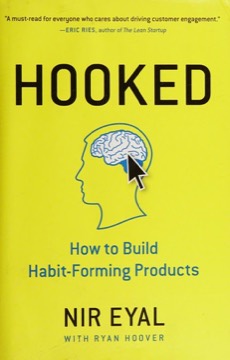
Hooked
Nir Eyal's model of how products build habits — a four-stage cycle of trigger, action, variable reward and investment — written as a design manual and accompanied by the author's own argument about when it should not be used.
- First published
- 2014
- Publisher
- Penguin Books, Limited
- Pages
- 242
- Shelf
- Design
- Level
- Entry
- ISBN-13
- 9789089652706
Record checked against
Only one source carried a publication date for this work, so the year is uncorroborated.
Catalogue note
- Reads as
- PracticalWritten to be applied, not only understood.
- Level
- Accessible / FoundationalNo prior reading assumed.
- Approach
- Practical
- Written for
- Designers and makers, Newcomers to the subject
Saved in this browser only — no account, nothing sent anywhere. My library
Read this if
- You are building something new and want to know why most new things fail.
- You want to change what you do repeatedly, not just what you intend.
- You want something to apply, not only something to think about.
- You are starting from scratch here and want a way in that assumes no prior reading.
The model
Eyal's Hook is a four-phase loop: an external or internal trigger prompts use, a simple action follows, a variable reward is delivered, and the user makes some investment that loads the next trigger.
Repeated cycles are meant to shift the trigger from external — a notification, an email — to internal, where an emotion or situation prompts the behaviour without prompting.
The endpoint is the internal trigger: an emotion prompts the behaviour, and no notification is needed.
Devmark’s reading — not a quotation from the book
Triggers
His distinction between external triggers, which are in the environment, and internal ones, which are associations with existing emotions, particularly negative ones — boredom, loneliness, uncertainty.
His observation that the most effective internal triggers attach to discomfort rather than to positive states is the model's most commercially significant and most ethically loaded claim.
Action and the Fogg model
His use of B.J. Fogg's behaviour model: behaviour occurs when motivation, ability and a trigger coincide. Since motivation is hard to raise, the lever is ability — make the action easier.
His catalogue of what makes an action easy — time, money, physical effort, cognitive effort, social deviance, routine — is a practical checklist for reducing friction.
Variable reward
His central mechanism, drawn from the well-established finding that intermittent reinforcement sustains behaviour more durably than predictable reward.
His three categories — rewards of the tribe, of the hunt, and of the self — map onto social validation, resource acquisition and mastery, and they describe most consumer products accurately enough to be useful as a diagnostic.
Investment
His fourth stage, and the one that distinguishes the model from a simple reinforcement loop: the user puts in something of value — data, content, followers, configuration, reputation — which both increases the product's value and loads the next trigger.
His point that stored value accumulates while attention does not is the explanation for why some habit products persist and others burn out.
The manipulation matrix
His own ethical framework, presented in the book rather than added later: plot whether the maker uses the product and whether it materially improves the user's life. The quadrants are facilitator, peddler, entertainer and dealer.
Including it was a genuine choice, though critics reasonably note that a self-assessment tool is weak protection, and that almost every maker believes they occupy the favourable quadrant.
The criticism
It is substantial and deserves stating plainly. The book packages persuasive techniques that are effective regardless of whether the product serves the user, and it was published into an industry with strong incentives to use them badly.
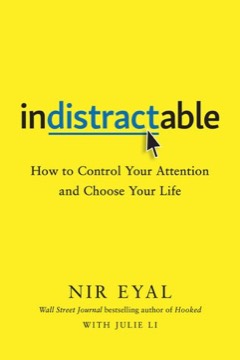
Eyal's later book on resisting distraction reads to some as a response to this and to others as an author selling the problem and the antidote. Both readings are defensible from the texts alone.
Some read the later book on distraction as a correction, others as selling the problem and the cure.
Devmark’s reading — not a quotation from the book
What is well supported and what is not
The underlying psychology — intermittent reinforcement, the Fogg model, effort and behaviour — is established research.
The four-stage Hook itself is a synthesis proposed by the author, not a tested model, and the case studies are retrospective accounts of successful products, which cannot distinguish the mechanism from the many other reasons those products succeeded.
Reading it usefully
It is most defensible as a diagnostic rather than a blueprint: a way to see what a product is doing to you, and to notice which stage a design is exploiting.
Used that way it is genuinely clarifying about the software people find difficult to put down.
What to take from it
The trigger progression from external to internal, which explains why notification-dependent products are fragile and why habit-formed ones survive removing them.
And the investment stage, which is the honest answer to why accumulated data and social graphs are more durable moats than engagement mechanics, since the value a user has deposited does not decay when their enthusiasm does and cannot be copied by a competitor.
What to take away
- 01Motivation is hard, ability is easyThe practical lever in behaviour design is reducing effort, not increasing desire.
- 02Variable reward sustains, predictable reward fadesThe underlying reinforcement research is solid, whatever one thinks of applying it commercially.
- 03Investment loads the next triggerStored value compounds where attention does not, which is why some habit products persist.
- 04Internal triggers attach to discomfortThe most effective associations are with boredom, loneliness and uncertainty, which is the ethical crux.
- 05The Hook is a synthesis, not a tested modelThe components have research support; the four-stage loop and its case studies do not.