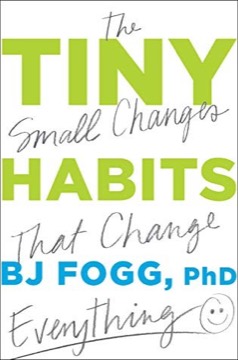
Tiny Habits
BJ Fogg's behaviour-design method from his Stanford research lab — built on a model in which behaviour occurs when motivation, ability and a prompt converge, and on the argument that shrinking the behaviour is more reliable than raising motivation.
- First published
- 2019
- Publisher
- Audible Studios on Brilliance
- Pages
- 320
- Shelf
- Habits
- Level
- Entry
- ISBN-13
- 9781713508212
Record checked against
Catalogue note
- Reads as
- PracticalWritten to be applied, not only understood.
- Level
- Accessible / FoundationalNo prior reading assumed.
- Approach
- Practical
- Written for
- Anyone changing how they work, Newcomers to the subject
Saved in this browser only — no account, nothing sent anywhere. My library
Read this if
- You want to change what you do repeatedly, not just what you intend.
- You want something to apply, not only something to think about.
- You are starting from scratch here and want a way in that assumes no prior reading.
The Fogg Behaviour Model
His formulation: behaviour happens when motivation, ability and a prompt arrive at the same moment. If a behaviour does not occur, exactly one of those three was missing.
The diagnostic value is immediate. Instead of "I lack discipline", the question becomes which of the three failed — and the answer is usually ability or prompt, both of which are designable.
Three things must coincide. When a behaviour fails, one of them was missing, and it is usually not motivation.
Devmark’s reading — not a quotation from the book
Motivation is unreliable by design
His central strategic claim: motivation fluctuates for reasons outside your control, so any behaviour that requires high motivation will fail on the days motivation is low.
His conclusion is to design for the worst day rather than the best one — making the behaviour small enough that it survives fatigue, illness and disruption, because those days are when habits actually break.
Make it tiny
His signature move: shrink the behaviour until it is almost absurd. Two push-ups. One page. Flossing a single tooth.
The reasoning is precise rather than motivational — a tiny behaviour requires so little ability that the prompt alone can trigger it, which is the condition his model says is necessary. Growth comes afterwards and naturally, but is not the goal.
Anchors
His solution to the prompt problem: attach the new behaviour to an existing routine that already happens reliably, using the formula "after I [existing habit], I will [tiny behaviour]".
His insistence on specificity is what distinguishes this from vaguer advice. The anchor must be a discrete completed action, not a time or a general intention, because a time is not a prompt the body notices.
Celebration
His most distinctive and most contested contribution: immediately after performing the behaviour, generate a genuine feeling of success — a fist pump, a phrase, a smile.
His claim is that this emotion is what wires the habit, and that repetition alone without positive affect is far slower. He explicitly argues that emotions create habits rather than frequency, which reverses the conventional account.
His claim is that emotion wires the habit, not repetition. It is the part of the method people skip and then wonder why.
Devmark’s reading — not a quotation from the book
The behaviour swarm and focus mapping
His method for choosing what to work on: generate many possible behaviours that would serve a goal, then plot them against impact and feasibility, and pick from the high-impact, high-feasibility corner.
The step matters because people typically choose the behaviour that sounds most virtuous rather than the one they are actually able to do, and then attribute the failure to themselves.
Stopping habits
His approach to unwanted behaviours: rather than resisting, work backwards through the same model — remove the prompt first, which is easiest, then make the behaviour harder, and only then address motivation.
The ordering is the useful part, and it is the inverse of what most people attempt, which is to start with motivation and never touch the prompt.
Where the evidence is thinner
The model is a practitioner framework rather than a tested theory, and the supporting evidence is largely from Fogg's own coaching programme with self-reported outcomes.
The celebration claim in particular is plausible and under-tested. The broader habit-formation literature supports cue-based repetition robustly; the specific role of immediate positive affect is less established than the book suggests.
How it compares with Clear
Substantial overlap — Clear cites Fogg — with different emphases. Fogg is stronger on the diagnostic model and on the emotional mechanism; Clear is stronger on systems, identity and environment design.
Fogg is also more clinical and less narrative. Readers who found Clear's anecdotes thin often prefer this; readers who want a framework for the whole of behaviour change usually prefer Clear.
What to take from it
The three-factor diagnostic, which converts a character judgement into a design question with three checkable answers.
And the tiny-behaviour discipline: pick the version small enough that you would do it on your worst day, because that is the only version that survives to become a habit.
What to take away
- 01Diagnose which factor failedMotivation, ability or prompt. It is almost never motivation, and the other two are designable.
- 02Design for your worst dayHabits break on the bad days, so the behaviour must be small enough to survive one.
- 03Anchor to a completed actionA time is not a prompt the body notices; a finished existing routine is.
- 04Celebrate immediatelyHis claim is that the emotion wires the habit, and it is the step everyone skips.
- 05Remove the prompt firstFor unwanted behaviour, work the model backwards — prompt, then ability, then motivation last.