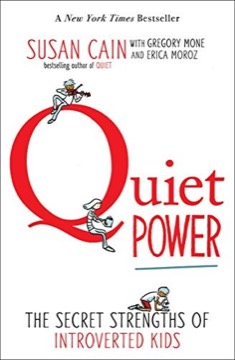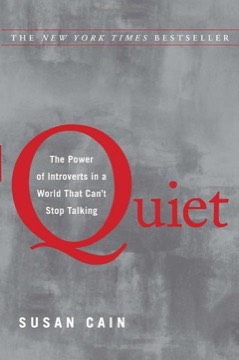
Quiet
Susan Cain's examination of introversion — what the trait actually is, what the research says about it, and how Western institutions came to be built around an assumption that the extroverted temperament is the healthy default.
- First published
- 2012
- Publisher
- Crown Publishing Group
- Pages
- 368
- Shelf
- Mind
- Level
- Entry
- ISBN-13
- 9780141029191
Record checked against
Catalogue note
- Reads as
- ConceptualExplains how something works before what to do about it.
- Level
- Accessible / FoundationalNo prior reading assumed.
- Approach
- Theoretical
- Written for
- Curious general readers, Newcomers to the subject
- Ideas
Saved in this browser only — no account, nothing sent anywhere. My library
Read this if
- You want evidence about why people behave as they do, not folklore.
- You want to understand how it works before deciding what to do about it.
- You are starting from scratch here and want a way in that assumes no prior reading.
What introversion is and is not
Cain is careful with the definition, which is where casual discussion of the trait usually goes wrong. Introversion is about preferred level of stimulation, not about shyness, social skill or misanthropy.
Introverts tend to function best at lower levels of arousal and extroverts at higher ones. Shyness is fear of social judgement and is a separate trait that can appear in either.
Introversion is about optimal stimulation. Shyness is fear of judgement. They are different and often confused.
Devmark’s reading — not a quotation from the book
The Extrovert Ideal
Her historical argument: American culture shifted during the early twentieth century from a culture of character, which valued inner qualities, to a culture of personality, which valued projection and charm.
She traces this to urbanisation, the rise of large corporations, and the self-help and sales literature that accompanied them — arguing that a temperamental preference became a moral standard.
The biology
She draws on Jerome Kagan's longitudinal work on high-reactive infants, which found that babies who reacted strongly to novel stimulation more often became quiet, careful children.
The finding reframes the trait as partly constitutional rather than learned, though Cain is reasonably careful that temperament sets a range rather than a destiny, and that environment does substantial work within it.
Groupthink and the open office
Her most practically consequential chapter reviews evidence that brainstorming in groups produces fewer and poorer ideas than the same people working alone and pooling afterwards.
She extends this to open-plan offices and mandatory collaboration, arguing that institutions have adopted formats that suit one temperament and assumed they suit everyone. The underlying research on brainstorming is well established and widely ignored.
Free trait theory
Brian Little's idea, which Cain treats as the book's resolution: people can act out of character in service of things they care about — an introvert can be genuinely outgoing for a project that matters.
The cost is real, and Little's concept of restorative niches is the practical consequence: someone operating out of temperament needs recovery time built in deliberately rather than hoped for.
You can act out of character for something you care about. You cannot do it continuously without a recovery plan.
Devmark’s reading — not a quotation from the book
Leadership
She reviews research suggesting introverted leaders can outperform extroverted ones specifically when leading proactive employees, because they are more likely to let good ideas from the team develop rather than imprinting their own.
The finding is conditional and she presents it as such, which is more careful than the popular rendering of "introverts make better leaders".
Culture and the comparative material
Her chapters comparing attitudes to quietness across cultures — particularly between American and East Asian educational norms — are among the most interesting and the most generalising.
They are also where a reader should be most cautious, since the material leans on broad national characterisations that the underlying research supports less confidently than the prose suggests.
Where the science is contested
The introvert/extrovert distinction is a real and well-replicated dimension of personality, usually measured as a continuum rather than a type. Cain's presentation frequently reads as typological, which the research does not support.
Some of the specific studies she draws on, particularly in social psychology, come from areas affected by the replication debates, and the book's confident register predates that scrutiny.
Where it is valuable
Its real contribution is permission and vocabulary. A great many readers report recognising themselves and discovering that a preference they had treated as a deficiency is a documented temperament with advantages.
The institutional argument is also solid where it rests on the brainstorming and open-office research, which is stronger than most of what popular books cite.
What to take from it
The stimulation framing, which is genuinely clarifying: ask what level of input you perform best at rather than whether you like people.
Then the practical ones — pool individual work rather than brainstorming, build restorative time around periods of acting out of character, and stop treating a preference for depth over breadth as something to correct.
What to take away
- 01Stimulation, not sociabilityThe trait is about optimal arousal level, which is why it is so often confused with shyness.
- 02A temperament became a standardThe shift from a culture of character to one of personality turned a preference into a virtue.
- 03Group brainstorming underperformsThe same people working alone and pooling afterwards produce more and better ideas. This is well established.
- 04Acting out of character has a costIt is possible for things you care about, and requires deliberately built recovery, not hoped-for recovery.
- 05It is a continuum, not a typeThe research measures a dimension; the book frequently reads as though there were two kinds of person.