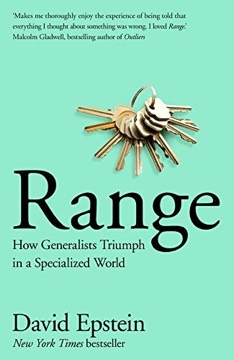
Range
David Epstein's argument that in most domains breadth of experience beats early specialisation — and that the ten-thousand-hours story, drawn from chess and golf, describes a narrow class of activity that resembles very little of the modern world.
- First published
- 2019
- Publisher
- Riverhead Books (US) Macmillan (UK)
- Pages
- 352
- Shelf
- Mind
- Level
- Entry
- ISBN-13
- 9780593189573
Record checked against
Catalogue note
- Reads as
- ConceptualExplains how something works before what to do about it.
- Level
- Accessible / FoundationalNo prior reading assumed.
- Approach
- Theoretical
- Written for
- Curious general readers, Newcomers to the subject
Saved in this browser only — no account, nothing sent anywhere. My library
Read this if
- You want to learn things that stay learned.
- You are asking what you should be doing with your working life.
- You want to understand how it works before deciding what to do about it.
- You are starting from scratch here and want a way in that assumes no prior reading.
The core argument
Epstein's claim is that the celebrated cases of early hyper-specialisation come from what psychologists call kind learning environments: rules that are stable, patterns that repeat, and feedback that is fast and accurate. Chess, golf, classical performance, firefighting.
Most consequential domains are wicked: rules are unclear or change, patterns do not repeat cleanly, and feedback is delayed, noisy or absent. In those, he argues, breadth and the ability to transfer between domains outperform accumulated repetition.
The ten-thousand-hours evidence comes from chess and golf. Very little of adult life resembles chess or golf.
Devmark’s reading — not a quotation from the book
Kind and wicked learning environments
The distinction, from Robin Hogarth, is the book's load-bearing concept and the thing most worth extracting.
Its diagnostic value is immediate: before deciding whether experience should be trusted, ask whether the environment gave it accurate feedback. Expertise built in a wicked environment can be confident and entirely unreliable, which explains a great deal about forecasting, management and medicine.
Sampling periods
Against the early-start narrative, Epstein assembles evidence that many elite performers in sport had a sampling period — trying many activities before specialising — and that late specialisers often catch and pass early ones.
He pairs this with research on career match quality: that switching to better-fitting work usually improves outcomes, and that the apparent cost of starting late is often outweighed by the gain from fitting better.
Analogical thinking
The mechanism Epstein proposes for how breadth pays. Novel problems are solved by recognising deep structural similarity to something in a different domain, and the ability to do that depends on having material from several domains available.
His treatment of research showing that multiple distant analogies outperform a single close one is the most practically useful section, and it argues directly for the habit of deliberately looking outside a problem's own field.
Desirable difficulties
A section on learning that runs against intuition. Practice that feels productive — massed repetition, immediate hints, blocked practice on one type of problem — produces fast gains that fade.
Practice that feels worse — spacing, interleaving, testing yourself before you have been taught, and generating wrong answers first — produces slower gains that last. Epstein's point is that the feeling of fluency during practice is a poor guide to what is actually being learned.
The practice that feels most productive is usually the practice you will retain least of.
Devmark’s reading — not a quotation from the book
Dropping familiar tools
His account of organisational failure, drawing on Karl Weick's analysis of wildland firefighting deaths, is the book's most sobering material.
The pattern is that trained professionals under pressure retain the tools and procedures that define their identity even when those tools are what is killing them. Epstein extends this to engineering decisions and to institutional cultures that cannot hear an objection expressed in unfamiliar terms.
Where it is vulnerable
The central methodological criticism is symmetrical with the one Epstein makes of Gladwell: he selects cases that support breadth and the sample is not random. Late-specialising failures are not in the book.
The argument is also less opposed to the specialisation literature than its framing suggests. Ericsson's work on deliberate practice concerns how to improve within a domain; Epstein's concerns which domain and when. They answer different questions, and the rivalry is partly constructed.
Where it gets misread
It is not an argument against expertise or depth, and Epstein says so repeatedly. His case is against *premature* specialisation and against assuming the chess model generalises.
The second misreading is comforting and wrong: that having many shallow interests is itself an advantage. His generalists mostly have real depth in something, acquired after sampling, plus range around it.
How it reads
It is well constructed narrative non-fiction with a wide evidence base, and Epstein is a careful writer who flags uncertainty more often than the genre requires.
The chapters are somewhat loosely connected — several could stand alone — and the book is more a case assembled from many angles than a tight argument. That is a genre property rather than a fault.
What to take from it
Ask what kind of environment produced any expertise you are relying on, including your own. Treat the feeling of fluency during practice with suspicion. Look for analogies from outside a problem's field before searching harder inside it.
And treat a sampling period, in a career or a skill, as an investment rather than a delay — which is the book's most reassuring and best-supported conclusion.
What to take away
- 01Ask if the environment was kindExpertise built where feedback is delayed or absent can be confident and entirely unreliable.
- 02Fluency during practice is misleadingSpacing, interleaving and testing feel worse and retain far better than massed repetition.
- 03Reach for distant analogiesMultiple structurally similar cases from other fields beat one close case from the same field.
- 04Sampling is investment, not delayMatch quality gains usually outweigh the apparent cost of specialising later.
- 05Trained people keep the tool that is killing themFamiliar procedures are identity, and dropping them under pressure is what training makes hardest.