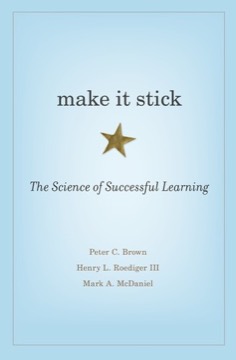
Make It Stick
Peter Brown, Henry Roediger and Mark McDaniel's account of what cognitive science has established about learning — written by two research psychologists and a novelist, and organised around the finding that the techniques which feel most effective are usually the least.
- First published
- 2014
- Publisher
- Harvard University Press
- Pages
- 336
- Shelf
- Habits
- Level
- Core
- ISBN-13
- 9780674419384
Record checked against
Only one source carried a publication date for this work, so the year is uncorroborated.
Catalogue note
- Reads as
- PracticalWritten to be applied, not only understood.
- Level
- Core / BuildingAssumes general familiarity with the subject.
- Approach
- Practical
- Written for
- Anyone changing how they work, Readers with some grounding
- Ideas
Saved in this browser only — no account, nothing sent anywhere. My library
Read this if
- You want to learn things that stay learned.
- You want something to apply, not only something to think about.
- You know roughly how the subject works and want the fuller account.
The central paradox
Their organising finding: the strategies that produce fluency during study — rereading, massed practice, highlighting — produce poor long-term retention, while strategies that feel difficult and error-prone produce much better retention.
The mechanism is that ease of processing is mistaken for learning. Familiarity with a text feels like knowing it, and that feeling is what people use to decide they are done.
Fluency during study feels like learning and predicts the opposite. That single confusion explains most bad studying.
Devmark’s reading — not a quotation from the book
Retrieval practice
Their best-supported recommendation: testing yourself produces substantially better retention than reviewing, and the effect is large, robust and repeatedly replicated.
Their explanation is that retrieval is not a neutral readout — the act of reconstructing a memory strengthens and reconsolidates it, so testing is a learning event rather than a measurement of one.
Spacing
Their second core finding: distributing practice over time produces better retention than the same total time massed together, even though massed practice produces better immediate performance.
The trade-off is explicit and uncomfortable — spacing feels worse during study, performs worse on an immediate test, and performs substantially better weeks later, which is the interval that actually matters.
Interleaving
Their third: mixing different problem types during practice outperforms blocking them, again while feeling worse and producing poorer immediate results.
Their explanation is that blocked practice lets you apply a procedure without selecting it, whereas real situations require choosing which approach applies. Interleaving trains the selection, which is the part that transfers.
Desirable difficulties
The unifying concept, from Robert Bjork: difficulties that slow acquisition but improve retention and transfer.
Their catalogue includes generation — attempting an answer before being taught — and reflection, and their point is that these feel like inefficiency because the cost is immediate and the benefit is delayed and invisible.
The cost of a desirable difficulty is immediate and the benefit is delayed. That asymmetry is why nobody chooses them.
Devmark’s reading — not a quotation from the book
Illusions of knowing
Their treatment of metacognition: learners are poor judges of their own learning, and the cues they use — fluency, familiarity, recency — are systematically misleading.
Their practical remedy is to replace self-assessment with testing, since the only reliable way to know whether you can retrieve something is to try to retrieve it.
Against learning styles
They address the visual/auditory/kinaesthetic framework directly and report that the evidence does not support matching instruction to a preferred style.
Their treatment is careful: people do have preferences, and those preferences are real. What has not been demonstrated is that teaching to them improves outcomes, and a number of well-designed studies have failed to find it.
What does predict learning
Their alternative to styles: structure-building — the tendency to extract and organise underlying principles rather than accumulate details — and rule-versus-example learning both show more evidence than style matching.
They also emphasise elaboration, connecting new material to what you already know, and generation over passive reception.
Where it is limited
The research base is strongest for factual and conceptual material assessed by testing, and the evidence for transfer to complex creative or professional skills is considerably thinner.
The book is also repetitive by design — the authors practise what they preach and space and interleave their own content — which some readers find clever and others find tiresome.
What to take from it
Stop rereading. Close the book and try to recall, then check. The effect is large and it is free.
And expect the good methods to feel worse. If a study technique feels efficient and comfortable, that is the strongest available signal that it is not working.
What to take away
- 01Ease is mistaken for learningFluency with a text feels like knowing it, and that feeling is what people use to decide they are finished.
- 02Retrieval is a learning eventTesting does not measure memory; reconstructing it strengthens and reconsolidates it.
- 03Spacing hurts now and helps laterBetter retention weeks on, worse immediate performance, which is why it loses to intuition.
- 04Interleaving trains selectionBlocked practice lets you apply a method without choosing it; reality requires choosing.
- 05Learning styles do not hold upPreferences are real; matching instruction to them has repeatedly failed to improve outcomes.