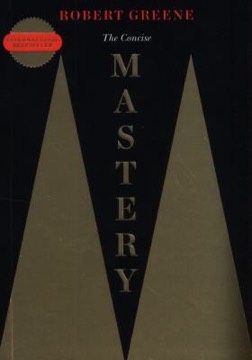
Mastery
Robert Greene's study of how exceptional practitioners across fields developed their capability — organised as a life-stage progression from calling through apprenticeship to creative independence, and illustrated with historical and contemporary figures.
- First published
- 2012
- Publisher
- Viking Adult
- Pages
- 344
- Shelf
- Habits
- Level
- Core
- ISBN-13
- 9780670026302
Record checked against
Catalogue note
- Reads as
- PracticalWritten to be applied, not only understood.
- Level
- Core / BuildingAssumes general familiarity with the subject.
- Approach
- Practical
- Written for
- Anyone changing how they work, Readers with some grounding
Saved in this browser only — no account, nothing sent anywhere. My library
Read this if
- You make things, and want to understand the work rather than wait for inspiration.
- You want to learn things that stay learned.
- You want a life told honestly, at full length.
- You want something to apply, not only something to think about.
- You know roughly how the subject works and want the fuller account.
The claim about mastery
Greene's position is that mastery is not a matter of innate genius but of a process available to anyone willing to submit to it — a long, unglamorous sequence that most people abandon at a predictable point.
His framing is deliberately counter-romantic: the figures he studies are presented as having worked through the same stages rather than as having been differently constituted.
The argument is that the sequence is available and that most people leave it at the same predictable point.
Devmark’s reading — not a quotation from the book
The Life's Task
His first stage: identifying an inclination that was present early and was usually overridden by practical pressure or by others' expectations.
His practical instruction is archaeological — look for what absorbed you before anyone was watching — rather than aspirational. He is explicit that this is recovery of something rather than selection of something.
Apprenticeship
The book's most substantial and most useful section. Greene argues for a long period of deliberate submission: choosing a position for what can be learned rather than for salary or status, observing before acting, and tolerating tedium and subordination.
His three modes — deep observation, skills acquisition, experimentation — are sequenced, and his warning is that people attempt the third far too early and never acquire the second properly.
The mentor dynamic
His treatment of mentorship is more realistic than most: mentors are acquired by being useful rather than by being asked, the relationship is transactional as well as personal, and it must eventually be outgrown.
His insistence that the apprentice must eventually break with the mentor's framework is the part usually omitted, and it is what separates apprenticeship from permanent imitation.
Social intelligence
An unusual inclusion for a book about craft, and characteristic of Greene: a long section arguing that technical excellence is routinely defeated by an inability to read people and navigate institutions.
His claim is that the naive perspective — assuming people are as they present and that merit is self-evident — is the commonest way capable people stall, and that this is a skill rather than a temperament.
Technical excellence gets defeated by institutional naivety more often than by better competitors.
Devmark’s reading — not a quotation from the book
The creative-active phase
His third stage: after sufficient apprenticeship, deliberately departing from received methods, combining fields, and tolerating the discomfort of working without a template.
His emphasis on conceptual recombination across domains — bringing a method from one field into another — is the mechanism he identifies for original work, and it aligns with Epstein's later argument about range.
Mastery itself
His final stage is described as a kind of intuitive fluency: enough accumulated experience that the practitioner perceives the whole situation directly rather than reasoning through components.
This is essentially Ericsson's mental-representations finding described in different language, and it is the least developed part of Greene's account despite being the title.
Where it is methodologically weak
The evidence is biographical and selected on outcome, with no comparison group — the people who followed the same path and remained obscure are not in the book.
Greene also reads the lives of historical figures with considerable confidence about their internal states, which is a narrative choice rather than a documented one.
The Greene register
His style is grandiose, aphoristic and occasionally mystical, particularly around intuition and the final stage. Readers who found *The 48 Laws of Power* distasteful will find the same voice here, applied to a more constructive subject.
The book is also very long, and the biographical material substantially outweighs the argumentative.
What to take from it
The apprenticeship material is the genuinely valuable part: choose early roles for what they teach, subordinate ego to learning for longer than feels comfortable, and resist the urge to be original before you are competent.
And the social-intelligence argument, which is the most under-discussed reason capable people plateau.
What to take away
- 01Look backwards for the inclinationWhat absorbed you before anyone was watching, rather than what you would like to be drawn to.
- 02Choose roles for what they teachSalary and status are poor selection criteria during a period whose purpose is acquiring capability.
- 03Originality comes after competenceThe common failure is attempting the experimental phase before the skills phase is complete.
- 04Institutional naivety stalls careersReading people and navigating organisations is a skill, and capable people routinely treat it as beneath them.
- 05The sample is selected on outcomeThe people who followed the same path and remained obscure are not in the book.