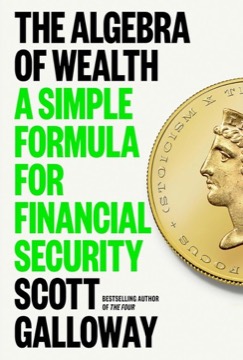
The Algebra of Wealth
A Simple Formula for Financial Security
Scott Galloway's blunt guide to building financial security, organised around four elements: stoicism, focus, time and diversification.
- First published
- 2024
- Publisher
- Portfolio
- Pages
- not established
- Shelf
- Money
- Level
- Entry
- ISBN-13
- 9780593714027
Record checked against
Only one source carried a publication date for this work, so the year is uncorroborated. No page count is recorded, so no reading estimate is shown for the book itself.
Catalogue note
- Reads as
- PracticalWritten to be applied, not only understood.
- Level
- Accessible / FoundationalNo prior reading assumed.
- Approach
- Practical
- Written for
- Investors and savers, Newcomers to the subject
Saved in this browser only — no account, nothing sent anywhere. My library
Read this if
- You want to think clearly about risk before you think about returns.
- You are asking what you should be doing with your working life.
- You want something to apply, not only something to think about.
- You are starting from scratch here and want a way in that assumes no prior reading.
The argument
Galloway, a marketing professor and serial founder, argues that financial security is mostly a function of controlling spending, choosing a career with real economics, starting early enough for compounding to work, and not concentrating risk.
His formula is deliberately unglamorous: wealth equals focus times stoicism times time times diversification, and the multiplication means a zero anywhere is fatal.
It is a multiplication, so a zero in any term produces a zero overall.
Devmark’s reading — not a quotation from the book
Where he is most useful
The career chapters are the strongest. His position — follow your talent rather than your passion, because mastery produces passion and also produces income — is argued more concretely than the usual version.
He is also specific about the economics of sectors, about the cost of living in expensive cities early in a career, and about the compounding effect of decisions made in one's twenties.
The character of the book
Galloway writes personally, including about his own bankruptcies and divorces, and the register is profane and confident.
He is also unusually direct about luck and about the structural advantages he had, which distinguishes it from most books in the category.
He is also writing for an audience he knows from teaching — students facing a considerably worse asset market than the one he entered — and the book is noticeably angrier about that than its genre usually permits.
He is candid about luck and inherited advantage, which is rare in this category.
Devmark’s reading — not a quotation from the book
Limits
American in its tax and account specifics. The advice assumes a professional career path and is less applicable to readers whose constraint is income level rather than allocation.
Some of the cultural commentary is loosely evidenced and the tone will irritate readers who do not enjoy the persona. The financial core is sound and conventional.
Four variables
Galloway organises the book around focus, stoicism, time and diversification, and treats wealth as the output of a formula rather than an event. The framing is deliberate: it removes the single decision or windfall from the picture and replaces it with a set of habits maintained over decades.
Follow your talent, not your passion
His most repeated and most contrarian argument is that being told to pursue your passion is bad advice, usually issued by people who became wealthy in something dull. His alternative is to find what you are genuinely good at, become exceptional at it, and let the passion follow the mastery and the rewards.
Passion follows competence. The advice to chase it first is usually given by the already rich.
Devmark’s reading — not a quotation from the book
Stoicism as a budget
He treats character as a financial variable: the capacity to defer, to resist status spending, and to avoid the lifestyle inflation that absorbs every income increase. His observation that most high earners are not wealthy because their spending scaled with their salary is the book's sharpest practical point.
Time and compounding
The chapters on investing itself are entirely conventional and entirely correct: start as early as you possibly can, use low-cost diversified index funds rather than picking anything, understand that time in the market is the one variable you can never recover once it is spent, and treat compounding as the only genuinely reliable force available to somebody without inherited capital or extraordinary luck.
Where he is honest about himself
Galloway is unusually candid about his own failures: businesses that collapsed outright, substantial money lost, and decisions he now recognises were driven by insecurity and by the desire to be seen as successful rather than by judgement. He has been financially wiped out more than once and says so plainly, which gives the advice considerably more weight than an unbroken success narrative ever could.
What is missing
It is written for an American reader with a professional income and assumes that condition throughout: the tax structures, the account types and the career advice do not translate, and there is little for someone whose problem is that the income is not there. The register is also brash in a way some readers find tiring.
What to take away
- 01A multiplicationFocus, stoicism, time and diversification; a zero anywhere is fatal.
- 02Talent before passionMastery generates passion, and income, in that order.
- 03Time is the largest termDecisions in your twenties dominate the outcome.
- 04Candid about luckUnusually direct about structural advantage.
- 05Conventional coreThe financial advice is sound and standard; the delivery is not.