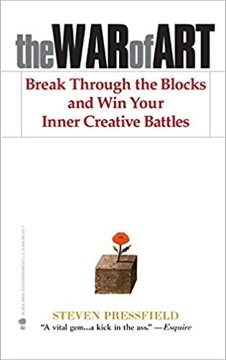
The War of Art
Break Through the Blocks and Win Your Inner Creative Battles
Steven Pressfield's short, aphoristic book about the internal force that prevents creative work from being done — which he names Resistance and treats as an active, intelligent antagonist rather than a mood.
- First published
- 2002
- Publisher
- Rugged Land
- Pages
- 165
- Shelf
- Habits
- Level
- Entry
- ISBN-13
- 9781936891023
Record checked against
Catalogue note
- Reads as
- PracticalWritten to be applied, not only understood.
- Level
- Accessible / FoundationalNo prior reading assumed.
- Approach
- Practical
- Written for
- Anyone changing how they work, Newcomers to the subject
Saved in this browser only — no account, nothing sent anywhere. My library
Read this if
- You make things, and want to understand the work rather than wait for inspiration.
- You want to change what you do repeatedly, not just what you intend.
- You want something to apply, not only something to think about.
- You are starting from scratch here and want a way in that assumes no prior reading.
Resistance, named
Pressfield's central move is to personify the thing that stops people starting. Resistance, capitalised throughout, is presented as a force with consistent characteristics: it is invisible, internal, insidious, implacable, and strongest as you approach work that matters.
The naming is the method. Treating procrastination as an opponent with recognisable tactics makes it something to notice rather than something you simply are.
Naming it as an opponent turns procrastination from an identity into something with recognisable tactics.
Devmark’s reading — not a quotation from the book
Its most useful diagnostic
His sharpest practical observation: Resistance is strongest in proportion to how important the work is to your growth.
This inverts the usual reading of reluctance. The project you feel most avoidance toward is, by his rule, the one most worth doing — which converts the feeling from a warning into a compass.
The forms it takes
He catalogues its disguises: procrastination, self-medication, drama, victimhood, the need for support, self-doubt, criticism of others, and the particular trap of preparing endlessly instead of starting.
His treatment of rationalisation is the most useful — Resistance does not announce itself but supplies reasonable-sounding arguments, which is why it is so rarely recognised in the moment.
Turning pro
The book's central prescription and its second section. An amateur works when inspired; a professional shows up on schedule regardless, treats the work as a job, does not take failure personally, and does not wait for permission.
His list of professional qualities — showing up daily, staying all day, committing over the long haul, accepting remuneration, mastering technique, not identifying with the work — is the most concretely useful content.
Not identifying with the work
His most psychologically acute point. The professional does not confuse the work with themselves, which is what makes criticism survivable and makes it possible to discard something that is not working.
The amateur's identification is precisely what makes starting dangerous: if the work is you, then a bad draft is a verdict, and avoiding the draft is rational self-protection.
If the work is you, a bad first draft is a verdict on you. That is why starting feels dangerous.
Devmark’s reading — not a quotation from the book
The third section, and the warning about it
The final part turns to muses, angels and a territory/hierarchy distinction, framed in explicitly mystical terms.
Readers divide sharply here. Pressfield is sincere about it; a secular reader can take the territory/hierarchy idea — working for the intrinsic satisfaction of the activity rather than for position relative to others — and leave the metaphysics, which loses nothing.
Territory versus hierarchy
Worth extracting because it survives translation. Hierarchy orientation evaluates everything by rank relative to others and is unstable because the rank keeps moving.
Territory orientation is the activity that returns something to you when you do it, regardless of how it compares. His argument that artists must operate from territory is the book's most durable non-mystical idea.
Where it is weak
There is no evidence, no method beyond showing up, and no acknowledgement that material circumstances — caring responsibilities, financial pressure, illness — differ enormously in how much they permit.
The framing that anything preventing the work is internal Resistance is useful as self-diagnosis and unkind as a general theory, and the book does not distinguish the two.
The tone question
It is written in short, declarative, frequently macho fragments, with military metaphor throughout. Some readers find it bracing; others find it posturing.
It is also very short — an hour's reading — which means the cost of finding out which kind of reader you are is low.
What to take from it
Two things. That avoidance intensity is a signal about importance rather than about suitability. And the professional/amateur distinction, which relocates creative work from inspiration to schedule.
Read it when stuck rather than when working. It is a book for the specific moment of not starting, and it does that job better than anything else of its length.
What to take away
- 01Avoidance points at what mattersResistance is strongest toward the work most important to your growth, which makes reluctance a compass.
- 02It supplies reasonable argumentsResistance does not announce itself; it rationalises, which is why it is so rarely caught in the moment.
- 03Do not identify with the workIf the work is you, a bad draft is a verdict, and avoiding it becomes rational self-protection.
- 04Show up on scheduleThe amateur waits for inspiration; the professional treats it as a job with hours.
- 05Work from territory, not hierarchyRank is unstable and keeps moving. The activity that returns something when you do it does not.