Big Magic
Creative Living Beyond Fear
Elizabeth Gilbert's book about living a creative life without being destroyed by it — an argument against the myth of the tortured artist and for curiosity, permission and persistence as the working conditions of creative work.
- First published
- 2014
- Publisher
- AGUILAR-ALTEA-TAURUS-ALFAGUARA
- Pages
- 312
- Shelf
- Design
- Level
- Entry
- ISBN-13
- 9788378187738
Record checked against
Catalogue note
- Reads as
- PracticalWritten to be applied, not only understood.
- Level
- Accessible / FoundationalNo prior reading assumed.
- Approach
- Practical
- Written for
- Designers and makers, Newcomers to the subject
Saved in this browser only — no account, nothing sent anywhere. My library
Read this if
- You make things, and want to understand the work rather than wait for inspiration.
- You want evidence about why people behave as they do, not folklore.
- You want something to apply, not only something to think about.
- You are starting from scratch here and want a way in that assumes no prior reading.
What it argues against
Gilbert's target is the romantic model of creativity in which suffering is the price and the artist is a martyr. She regards it as both historically recent and practically destructive, and she notes that it has killed a great many people who could have kept working.
Her alternative is a relationship with creative work that is affectionate, undramatic and long. The argument is more substantial than its cheerful tone suggests, because the tortured-artist model is still the default assumption of most people who feel they are not creative enough.
The tortured-artist model is recent, not eternal — and it has ended more careers than it has produced.
Devmark’s reading — not a quotation from the book
Courage and the fear conversation
Her opening section on fear, and specifically her refusal to promise it goes away. Her position is that fear is a permanent passenger and the only available move is to deny it any control.
Her monologue addressed to fear — welcoming it along on the condition that it does not choose the route or touch the controls — is the book's best-known passage and is a genuinely useful reframe, because it stops the reader waiting for a confidence that never arrives.
Ideas as entities
Her most contested proposition: that ideas are a kind of disembodied energy seeking a human collaborator, and that an idea will leave if neglected and find someone else.
She is explicit that she does not require the reader to believe this literally and that she holds it because it makes her work better rather than because she can defend it. Read as a working metaphor it is useful — it makes ideas time-sensitive and depersonalises rejection — and read as a claim it is unfalsifiable. She says so herself.
Permission
Her argument that nobody is going to authorise a creative life and that waiting for credentials, for a degree, for someone's approval, is a way of never starting.
Her related claim that creative work does not need to be important to be worth doing is aimed at a specific paralysis — the belief that if the work is not significant it is self-indulgent — and it is the section most readers report as the one that moved them.
Persistence and the job problem
Her insistence on not asking your creative work to support you financially, framed as protecting the work from a burden it did not agree to carry.
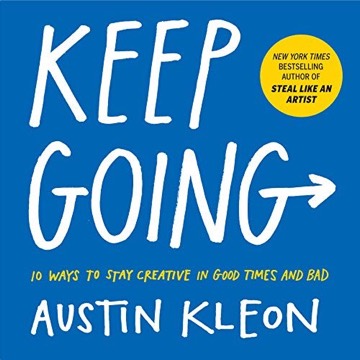
She held other jobs long after commercial success, and her argument is that the pressure to monetise distorts what gets made and turns a refuge into an employer. This is the same conclusion Kleon reaches from a different direction, and it is one of the more reliably good pieces of advice in the creative-life literature.
Trust, and the rejection of the tortured artist
Her direct treatment of the mythology: she names writers who were destroyed and argues that the work did not require the destruction and was not improved by it.
Her alternative is what she calls a stubborn gladness — continuing to work without demanding that the work justify itself through suffering or success. It is the book's actual thesis and everything else supports it.
Divinity: doing it anyway
Her closing argument that creative work is worth doing regardless of outcome, audience, quality or recognition, because of what it does for the person doing it.
She is careful to distinguish this from a claim that quality does not matter. The claim is about motivation rather than standards: the work should be done well and should not be required to deliver anything in return.
Do it well, and do not require it to deliver anything in return. Those are separate commitments.
Devmark’s reading — not a quotation from the book
Where the criticism lands
Two objections have force. The first is class: advice to keep a day job and trust the process is easier from a position of security, and the book does not seriously engage with readers for whom time itself is the scarce resource.
The second is that the mystical framing of ideas, however hedged, invites a passive relationship with work — waiting for inspiration rather than building a practice. Readers who need discipline more than permission will find Lamott or Pressfield more useful.
Who it is for
It is written for people who already want to make something and are stopped by fear, by a sense of not being entitled, or by the belief that creative work must be exceptional to be justified.
For readers with a working practice and a discipline problem it will read as encouragement they do not need. The match between reader and obstacle determines almost entirely whether the book lands.
What to take from it
The fear arrangement, which is the most portable idea in the book: expect fear permanently and deny it any decision-making authority.
And the refusal to let creative work carry a financial burden, which protects both the work and the relationship with it, and which is one of the few pieces of creative-life advice that survives contact with a career.
What to take away
- 01Fear rides along but does not driveIt is a permanent passenger, so waiting for confidence is waiting for something that is not coming.
- 02Nobody issues permissionCredentials and approval are not forthcoming, and waiting for them is a way of never starting.
- 03Do not make the work pay the rentThe pressure to monetise distorts what gets made and converts a refuge into an employer.
- 04Suffering is not the priceThe tortured-artist model is recent and the work was not improved by what it cost.
- 05The mystical framing is a working metaphorGilbert says so herself, and readers needing discipline rather than permission should look elsewhere.