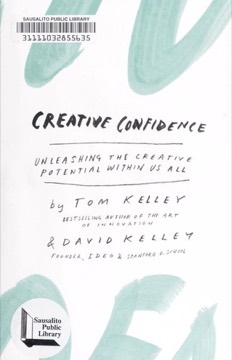
Creative Confidence
Unleashing the Creative Potential Within Us All
Tom and David Kelley's argument from inside IDEO that creativity is not a fixed trait possessed by some people, but a capability that can be developed — and a set of methods for developing it in individuals and organisations.
- First published
- 2013
- Publisher
- Books on Tape
- Pages
- 295
- Shelf
- Design
- Level
- Entry
- ISBN-13
- 9780385349369
Record checked against
Catalogue note
- Reads as
- PracticalWritten to be applied, not only understood.
- Level
- Accessible / FoundationalNo prior reading assumed.
- Approach
- Practical
- Written for
- Designers and makers, Newcomers to the subject
Saved in this browser only — no account, nothing sent anywhere. My library
Read this if
- You make things, and want to understand the work rather than wait for inspiration.
- You care why some things are obvious to use and others are not.
- You want something to apply, not only something to think about.
- You are starting from scratch here and want a way in that assumes no prior reading.
The central claim
The Kelleys argue that the division of people into creative and non-creative types is false, self-imposed and expensive, and that most adults who describe themselves as uncreative are describing a fear of judgement rather than an absence of ability.
Their evidence is their teaching experience at the Stanford design school and at IDEO, where they claim to have repeatedly moved people from that self-description to a working practice. It is observational rather than experimental, and they present it as such.
Most people who call themselves uncreative are describing a fear of judgement, not an absence of ability.
Devmark’s reading — not a quotation from the book
Self-efficacy and guided mastery
Their theoretical anchor is Bandura's work on self-efficacy and on treating phobias through graduated exposure — approaching a feared thing in increasing steps until it is manageable.
Their application is direct: fear of creative judgement responds to the same treatment, which is small successes in low-stakes conditions accumulating into a changed self-assessment. This is the most research-grounded part of the book and the part that best justifies its central claim.
From blank page to insight
Their treatment of how to start: choose a specific problem rather than a broad ambition, go and observe real people in context, and look for the gap between what people say and what they do.
Their emphasis on direct observation over abstract ideation is the methodological core of the whole design-thinking tradition, and their examples — including their well-known work on a hospital patient experience — show it producing insights that no amount of conference-room discussion would have reached.
From planning to action
Their bias toward doing: build something rough immediately, test it, and treat the artefact as a way of thinking rather than a conclusion.
Their argument that a rough prototype produces better feedback than a polished one — because people criticise something that looks unfinished and admire something that looks done — is a specific and testable claim and matches most practitioners' experience.
Creative confidence in organisations
Their chapters on making this possible at scale: leadership tolerance for failed experiments, physical space that supports making, and the removal of the approval structures that punish visible early attempts.
Their honest observation is that individual creative confidence dies quickly in an organisation that penalises it, which is a more uncomfortable claim than the book's optimistic tone suggests.
Creative teams
Their guidance on group work: diverse composition, explicit norms that defer judgement during generation, and the use of constraints to force specificity.
Their treatment of brainstorming is where the book is most vulnerable, as the research on group idea generation consistently favours individual generation followed by group selection. Their rules mitigate the problem without acknowledging that it has been measured.
Creative courage in a career
Their final section on applying the same capability to one's own path: treating a career as a series of prototypes, running small experiments rather than making irreversible decisions, and tolerating the ambiguity that follows.
This is the least novel material in the book and overlaps substantially with the design-your-life literature that followed from the same school.
Where the evidence is thin
The book's method is consistent throughout: a claim, then a story from IDEO or a Stanford course illustrating it. The stories are engaging and the selection problem is total — failures are absent.
The self-efficacy foundation is genuinely well supported. The claim that IDEO's specific methods are what develop it is not tested against alternatives, and readers should hold those two things at different levels of confidence.
The self-efficacy research is solid. The claim that these particular methods are what builds it is not tested.
Devmark’s reading — not a quotation from the book
Its place in the design-thinking canon
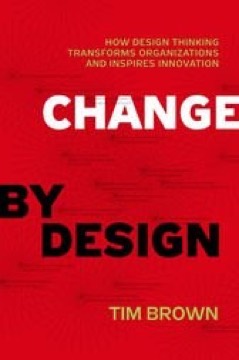
It sits alongside Tim Brown's *Change by Design* as the other primary statement from IDEO, with Brown addressing the organisational argument and this book the individual one.
Read together they are the fullest account of the position; read critically, they share the same evidential weakness and the same absence of engagement with the criticism the approach later attracted.
What to take from it
Guided mastery applied to creative fear, which is a concrete and well-grounded technique rather than encouragement: smallest possible attempt, low stakes, repeat until the fear no longer governs.
And the rough-prototype principle, which is the fastest way to get honest reactions and the easiest of their practices to adopt without changing anything organisational.
What to take away
- 01Creative confidence is built, not possessedGraduated exposure to low-stakes creative acts changes the self-assessment that blocks the work.
- 02Observe rather than ideateThe gap between what people say and what they do is where insights are, and no meeting will reveal it.
- 03Rough prototypes get honest feedbackPolished artefacts are admired; unfinished ones are criticised, which is what you actually need.
- 04Individual confidence dies in punishing organisationsThe capability is real, but it does not survive structures that penalise visible early attempts.
- 05Hold the evidence at two levelsBandura's self-efficacy work is well supported; the claim that IDEO's methods are what develop it is not.