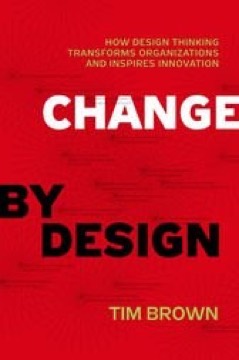
Change by Design
Tim Brown's statement of design thinking as an organisational method — the argument that designers' way of working can be applied to business, services and social problems, not only to objects.
- First published
- 2009
- Publisher
- HarperCollins Publishers
- Pages
- not established
- Shelf
- Design
- Level
- Core
- ISBN-13
- 9780061937774
Record checked against
Only one source carried a publication date for this work, so the year is uncorroborated. No page count is recorded, so no reading estimate is shown for the book itself.
Catalogue note
- Reads as
- PracticalWritten to be applied, not only understood.
- Level
- Core / BuildingAssumes general familiarity with the subject.
- Approach
- Practical
- Written for
- Designers and makers, Readers with some grounding
Saved in this browser only — no account, nothing sent anywhere. My library
Read this if
- You care why some things are obvious to use and others are not.
- You are building something new and want to know why most new things fail.
- You want something to apply, not only something to think about.
- You know roughly how the subject works and want the fuller account.
The argument
Brown's claim is that design's value has been confined to making things attractive at the end of a process, and that the way designers actually work — observing people, generating options, prototyping, iterating — is a general problem-solving method.
His proposal is to move design upstream, from styling a decided product to determining what should be built, which is an argument about where in an organisation design sits as much as about what it does.
The proposal is to move design upstream — from styling a decided thing to deciding what should exist.
Devmark’s reading — not a quotation from the book
Inspiration, ideation, implementation
His three overlapping spaces, which he is careful not to call stages. The distinction matters to his argument, since he explicitly rejects a linear process in favour of iteration between them.
This framing has been widely reduced to a five-step linear diagram in subsequent teaching, which is precisely what he was arguing against, and much of the criticism design thinking later attracted was aimed at that reduction rather than at his version.
Desirability, feasibility, viability
His three-lens test: what people want, what is technically possible, and what is commercially sustainable. Innovation lives at the intersection and design's contribution is to hold the first lens when the other two dominate by default.
It is a clean framework and it is the book's most durable export, appearing in product organisations that have no other connection to design thinking.
Insight from observation
His methodological core: watch real people in real contexts, pay attention to extreme users and workarounds, and treat the gap between stated and actual behaviour as the richest source of information.
His attention to extremes rather than averages is the most transferable technique here, because the person struggling most with a task reveals the design's assumptions more clearly than the median user ever will.
Prototyping to think
His position that prototypes are a mode of reasoning rather than a demonstration: build rough, build early, build to answer a specific question, and expect to discard.
His extension of prototyping to services and experiences — role-play, walkthroughs, staged environments — is where the book goes beyond product design and is the part most useful to anyone working on something without a physical form.
Storytelling and the new social contract
His chapters on communicating design work, on the role of narrative in making an abstract proposal concrete, and on designing for participation rather than consumption.
His argument that people increasingly want to participate in what they use rather than receive it finished was prescient about several later developments, though he did not anticipate how commercially that participation would be extracted.
Design thinking for social problems
His most ambitious section, covering IDEO's work on public health, water access, education and financial inclusion in low-income contexts.
This is also the most criticised. The charge is that a method developed for consumer products was exported to complex social problems where the constraints are political and structural, and where a workshop produces prototypes that cannot address the actual obstacles. Several of the initiatives described did not achieve durable outcomes.
A method built for consumer products was exported to problems whose constraints are political, not design ones.
Devmark’s reading — not a quotation from the book
The backlash
Design thinking attracted serious criticism in the years after this book: that it flattens design into a workshop format, that it promises transformation while delivering sticky notes, that it strips the craft and keeps the vocabulary, and that its consultancy origins make it a product to sell rather than a discipline.
Much of this is a critique of the watered-down corporate version rather than of Brown's book, but the book is where the version being criticised originates, and that is a fair charge.
Where the evidence stands
As with *Creative Confidence*, the support is case studies from the author's own firm, selected for success and described by a participant.
The underlying practices — direct observation, prototyping early, generating multiple options before converging — have independent support in the design and problem-solving literature. The claim that they constitute a method transferable to any problem does not.
What to take from it
The three lenses, which are genuinely useful as a standing check on any proposal and which survive detachment from everything else in the book.
And the practice of designing from extremes rather than averages, which costs nothing to adopt and consistently produces information that aggregate research conceals.
What to take away
- 01Desirability, feasibility, viabilityThe most durable export: three lenses, with design responsible for holding the first one.
- 02Design belongs upstreamThe argument is about where design sits in an organisation, not only about what designers do.
- 03Prototype to think, not to demonstrateBuild rough, build to answer one question, and expect to throw it away.
- 04Design from extremesThe person struggling most reveals the design's assumptions better than the median user ever does.
- 05The social-problems claim is the weakestA consumer-product method applied where the constraints are political produced prototypes and few durable outcomes.