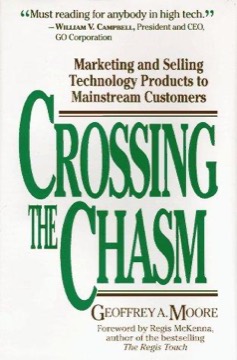
Crossing the Chasm
Geoffrey Moore's account of why technology products that succeed with early enthusiasts so often stall before reaching a mainstream market — and why the gap between those two groups is a chasm rather than a step.
- First published
- 1991
- Publisher
- Harper Business Essentials
- Pages
- 234
- Shelf
- Business
- Level
- Core
- ISBN-13
- 9780887307171
Record checked against
Catalogue note
- Reads as
- StrategicAbout choosing between options under uncertainty.
- Level
- Core / BuildingAssumes general familiarity with the subject.
- Approach
- Applied
- Written for
- Founders and operators, Readers with some grounding
Saved in this browser only — no account, nothing sent anywhere. My library
Read this if
- You are starting or growing a company and want the unglamorous parts.
- You want to understand what technology is doing to how we live.
- You are building something new and want to know why most new things fail.
- You are weighing options and want a way to think about the trade-offs.
- You know roughly how the subject works and want the fuller account.
The adoption curve, amended
Moore starts from Rogers's diffusion model — innovators, early adopters, early majority, late majority, laggards — and makes one modification that is the whole book: the transitions are not smooth.
The largest discontinuity sits between early adopters and the early majority, because the two groups want incompatible things and, crucially, do not take advice from each other.
The early majority does not ask early adopters for references. That single fact is the chasm.
Devmark’s reading — not a quotation from the book
Why the two groups are incompatible
Early adopters are visionaries buying a change agent; they accept incompleteness, expect to do integration work, and want advantage over their peers.
The early majority are pragmatists buying a productivity improvement; they want a proven whole product, references from people like themselves, and low risk. A pitch tuned for the first group actively repels the second.
The chasm itself
A company crossing the chasm loses its existing reference base without yet having a new one, because pragmatists will not accept visionary references. Revenue growth flattens while costs continue, and the organisation typically misreads this as a sales-execution problem.
Moore's contribution is the diagnosis: this is a structural transition, not a performance failure, and the remedies for a performance failure make it worse.
The beachhead
His central prescription is counter-intuitive: to cross, a company must narrow drastically, dominating a single carefully chosen niche completely before expanding.
The reasoning is about references. Pragmatists trust others in their own segment, so credibility is only transferable within a segment. Fifty customers spread across twenty segments produces no reference base; ten customers in one produces a strong one.
The D-Day analogy and bowling pin expansion
Moore frames the beachhead as an invasion: concentrate overwhelming force on a narrow front, secure it, then expand into adjacent segments that share either the same application or the same buyer.
The bowling-pin metaphor is the useful part — each segment won knocks over neighbouring ones, so the choice of first segment should be made with the adjacencies in mind, not only its own attractiveness.
Choose the first segment for what it knocks over next, not only for how attractive it is on its own.
Devmark’s reading — not a quotation from the book
The whole product
Pragmatists buy a complete solution to their problem, not a component. Moore distinguishes the generic product — what you ship — from the whole product, which includes everything else required for the customer to get the promised result.
For a narrow beachhead a company can actually assemble the whole product, often through partners. Across a broad market it cannot, which is another reason narrowing is the mechanism rather than merely a tactic.
Positioning and the competitive claim
Moore argues that pragmatists cannot evaluate a product with no competitors because they have no frame of reference, and that a company crossing the chasm must therefore *create* a competitive set to be positioned within.
His market-alternative and product-alternative construction — name what the buyer uses today and name the technology that makes yours different — is a practical answer to positioning a genuinely new category.
Organisational consequences
The later chapters cover what the transition does internally: the salespeople who thrived selling to visionaries often cannot sell to pragmatists, the pricing model changes, and the distribution channel must change with it.
Moore is unusually direct that the people who got a company to the chasm are frequently not the people who take it across, which is the least comfortable part of the book.
How it has aged
The vocabulary — chasm, beachhead, whole product — is standard in technology marketing and much of it is used by people who have never read the book.
What has dated is context: the examples are enterprise-software and hardware from the 1980s and 1990s, and the model assumes a considered B2B purchase with a long sales cycle. Product-led and consumer adoption follow different dynamics, and Moore's framework maps onto them awkwardly.
What to take from it
The central diagnostic is durable: when growth stalls after early success, ask whether you are trying to sell a visionary's product to a pragmatist, and whether your references come from people your prospect considers comparable to themselves.
And the discipline of narrowing when the instinct is to broaden, which remains among the hardest things to persuade a growing company to do.
What to take away
- 01References do not cross segmentsPragmatists trust people like themselves, so credibility is only transferable inside a segment.
- 02Narrow to crossTotal dominance of one small segment builds the reference base that scattered customers never will.
- 03Sell the whole productPragmatists buy a complete solution; a component plus homework is a visionary's purchase.
- 04Create a competitive setA buyer with no frame of reference cannot evaluate you, so name what they use today.
- 05A stall here is structuralTreating it as a sales-execution problem and pushing harder makes it worse.