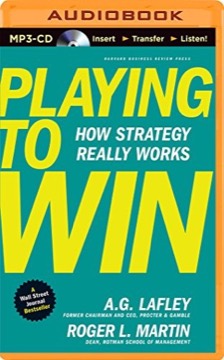
Playing to Win
Roger Martin and A.G. Lafley's account of the strategy method used at Procter & Gamble, reduced to five linked choices that have to be made together and have to be answered specifically.
- First published
- 2014
- Publisher
- Brilliance Audio
- Pages
- not established
- Shelf
- Business
- Level
- Core
- ISBN-13
- 9781491528921
Record checked against
Only one source carried a publication date for this work, so the year is uncorroborated. No page count is recorded, so no reading estimate is shown for the book itself.
Catalogue note
- Reads as
- StrategicAbout choosing between options under uncertainty.
- Level
- Core / BuildingAssumes general familiarity with the subject.
- Approach
- Applied
- Written for
- Founders and operators, Readers with some grounding
Saved in this browser only — no account, nothing sent anywhere. My library
Read this if
- You have to choose what not to do, and want a way to think about it.
- You are starting or growing a company and want the unglamorous parts.
- You are weighing options and want a way to think about the trade-offs.
- You know roughly how the subject works and want the fuller account.
Strategy as choice
Their definition is deliberately narrow: strategy is an integrated set of choices that positions a firm to win. Not a plan, not a vision, not a set of aspirations — a small number of decisions that rule things out.
The book's opening argument is that most organisations avoid strategy because choosing is uncomfortable, and produce instead a document that commits to nothing while appearing thorough.
If it does not rule anything out, it is not a choice, and without choices there is no strategy.
Devmark’s reading — not a quotation from the book
The five questions
What is our winning aspiration? Where will we play? How will we win? What capabilities must be in place? What management systems are required?
The insistence that matters is that these are answered together and checked for consistency. A where-to-play choice that the capabilities cannot support is not a strategy; it is a wish with a location attached.
Winning aspiration
Martin and Lafley are firm that the aspiration must be about winning — a specific definition of what winning means for this business and against whom — rather than about participating, growing, or being excellent.
Their point is practical rather than motivational: an aspiration that does not name a competitor or a standard cannot be used to evaluate a subsequent choice.
Where to play
The choice of playing field: geography, product category, consumer segment, channel, and stage of production. The discipline is that every one of these is a choice and each excludes something.
Their most useful observation is that where-to-play choices are usually inherited rather than made — a company plays where it has historically played, and nobody has asked recently whether that is still where it should be.
How to win
The choice of how you will win *on that specific field* — which for them means either cost leadership or differentiation, borrowed from Porter and applied per playing field rather than per company.
The pairing is the point: where-to-play and how-to-win must be decided together, because a field is only attractive if you have a way to win on it, and a way of winning only matters somewhere.
Where to play and how to win are one decision made twice. Answered separately, they produce incompatible answers.
Devmark’s reading — not a quotation from the book
Capabilities and systems
The fourth choice is the small set of mutually reinforcing activities that must be done exceptionally well for the how-to-win to be real. Martin stresses reinforcement: capabilities that support each other are hard to copy, while a list of individually strong capabilities is not.
The fifth — management systems — is the one most often skipped, and the reason most strategies do not survive contact with the organisation. If nothing measures or reviews the choice, the choice does not exist.
Reverse-engineering the decision
Martin's methodological contribution, drawn from his work on integrative thinking. Rather than arguing about which option is right, the team asks of each possibility: what would have to be true for this to be a great choice?
This converts an argument about preferences into a list of testable conditions, and then tests the condition the group is least confident about. It is the most transferable technique in the book.
Why it reads differently from other strategy books
It is unusually specific about process — how the conversation should be run, who is in the room, what artefacts are produced — because Lafley was running a large company while Martin was advising it.
The consumer-goods examples are concrete and sometimes granular to the point of tedium for readers outside the sector, but they demonstrate the method rather than illustrating it.
Where it is limited
Its evidence is essentially one company over one period, told partly by the chief executive who ran it. There is no comparison group and no way to separate the method from the circumstances.
The how-to-win options are also narrower than the world — cost or differentiation, per Porter — which sits awkwardly with platform and network businesses that were not the authors' subject.
What to take from it
The five-question cascade is the clearest short framework for checking whether a strategy document actually contains a strategy. Running an existing plan through it is usually uncomfortable and always informative.
And the what-would-have-to-be-true question, which is worth using well beyond strategy — anywhere a group is arguing about options and accumulating opinions rather than tests.
What to take away
- 01Five choices, answered togetherAspiration, where to play, how to win, capabilities, systems — inconsistent answers mean no strategy.
- 02Name who you are beatingAn aspiration that does not specify winning against something cannot evaluate any later choice.
- 03Where-to-play is usually inheritedMost companies play where they always have, and nobody has asked recently whether they should.
- 04Capabilities must reinforce each otherA list of individually strong capabilities is copyable; a mutually supporting set is not.
- 05Ask what would have to be trueIt turns a clash of preferences into a list of testable conditions, then tests the shakiest one.