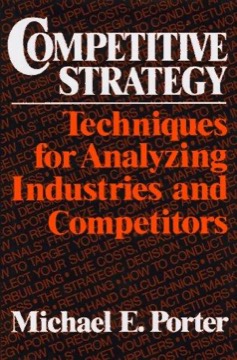
Competitive Strategy
Michael Porter's 1980 book, which took the tools of industrial economics and turned them into a method a company could use — establishing that profitability is determined largely by industry structure, and that structure can be analysed.
- First published
- 1980
- Publisher
- The Free Press
- Pages
- 396
- Shelf
- Business
- Level
- Deep
- ISBN-13
- 9780029253601
Record checked against
Only one source carried a publication date for this work, so the year is uncorroborated.
Catalogue note
- Reads as
- StrategicAbout choosing between options under uncertainty.
- Level
- Advanced / AdvancedAssumes you have read around the subject already.
- Approach
- Applied
- Written for
- Founders and operators, Specialists and serious readers
Saved in this browser only — no account, nothing sent anywhere. My library
Read this if
- You have to choose what not to do, and want a way to think about it.
- You want to see the incentives underneath the headlines.
- You are weighing options and want a way to think about the trade-offs.
- You have read around this already and want a book that assumes it.
What it changed
Before Porter, strategy teaching was largely case-based and idiosyncratic. This book imported the structure–conduct–performance framework from industrial organisation economics and made it operational for a firm rather than a regulator.
The claim underneath is that average profitability differs systematically and durably between industries, that the difference is explained by structure, and that a company's position within that structure is a choice.
Profitability is not mostly about how well you execute. It is about the structure of the game you are in.
Devmark’s reading — not a quotation from the book
The five forces
Industry profitability is determined by rivalry among existing competitors, the threat of new entrants, the threat of substitutes, the bargaining power of suppliers, and the bargaining power of buyers.
The framework's value is that it locates where profit is being competed away. A business losing margin to supplier power needs a different response from one losing it to substitutes, and without the analysis both look like "competition is tough".
Entry barriers
Porter's treatment of the second force is the most detailed: economies of scale, product differentiation, capital requirements, switching costs, access to distribution, cost advantages independent of scale, and government policy.
His important qualification is that what matters is the *expected* retaliation as much as the barrier itself — an incumbent with a history of fighting deters entry that the structural barriers alone would not.
Three generic strategies
Porter argues a firm must choose: overall cost leadership, differentiation, or focus on a narrow segment pursuing one of the first two.
The claim that made this controversial is his warning about being stuck in the middle — that a firm attempting both cost leadership and differentiation achieves neither, because the activities required are mutually inconsistent.
Stuck in the middle, and the objection to it
This is where Porter has been most contested. Critics point to companies that appear to achieve low cost and high differentiation simultaneously, particularly where technology changes the cost of variety.
Porter's defence is that such cases usually involve a competitor operating at a genuinely superior productivity frontier rather than occupying a middle position — a distinction between being better and being undifferentiated. The argument is live and worth knowing on both sides.
Being both cheaper and better is not a middle position. It is a different frontier — and much rarer than claimed.
Devmark’s reading — not a quotation from the book
The value chain and competitor analysis
The book's less-quoted second half is its most practically useful. Porter provides a structured method for analysing a competitor: future goals, current strategy, assumptions about itself and the industry, and capabilities.
The assumptions component is the sharpest idea in it. Competitors act on beliefs about the industry that may be wrong, and identifying a blind spot is often more actionable than measuring a capability.
Industry evolution and structural change
Porter treats industry structure as changeable rather than given, and devotes substantial attention to how it evolves — through learning curves, demographic shifts, product innovation and scale changes.
The strategic implication is the book's most ambitious: a firm can act to shape the structure of its own industry in its favour, not merely position itself within it.
Where it is hard going
It is a dense, formal, example-heavy book written for an academic and consulting audience, and it reads that way. There is no narrative, and the industry illustrations are largely American and of the 1970s.
Most readers encounter the five forces second-hand and never open the book. That is defensible for the framework and a loss for the competitor-analysis material, which is not well summarised anywhere.
What the framework misses
Two structural blind spots. It is largely static — a snapshot of an industry's structure, poorly suited to industries reconfiguring rapidly. And it says little about complements, network effects or platform dynamics, which were not prominent when it was written and are central now.
Critics also note it underweights firm-specific capabilities; the resource-based view of strategy developed partly in response to that gap.
Why it is still taught
Because it gave strategy a shared analytical vocabulary and a defensible claim: that the profitability of a business is substantially determined by forces outside the firm, which can be identified and acted on.
Even where the generic-strategies argument is disputed, the diagnostic habit — asking *where* profit is leaking and to whom — remains one of the most useful things a manager can do with an afternoon.
What to take away
- 01Structure determines average profitabilityWhich industry you are in explains more of your returns than how well you run the company.
- 02Locate where profit is leakingSupplier power and substitution look identical as 'tough competition' until you separate them.
- 03Expected retaliation is a barrierAn incumbent's history of fighting deters entry that the structural barriers alone would not.
- 04Read competitors' assumptionsWhat a rival wrongly believes about the industry is more actionable than what it can do.
- 05Structure can be shapedPorter's most ambitious claim: a firm can change the forces acting on it, not only its position among them.