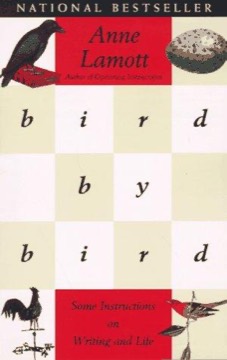
Bird by Bird
Some Instructions on Writing and Life
Anne Lamott's book on writing and on the life around it — part craft instruction, part honest account of what it costs, built on the principle that the only way through a large task is one small piece at a time.
- First published
- 1994
- Publisher
- Knopf Doubleday Publishing Group
- Pages
- 239
- Shelf
- Design
- Level
- Entry
- ISBN-13
- 9781411474147
Record checked against
Only one source carried a publication date for this work, so the year is uncorroborated.
Catalogue note
- Reads as
- PracticalWritten to be applied, not only understood.
- Level
- Accessible / FoundationalNo prior reading assumed.
- Approach
- Practical
- Written for
- Designers and makers, Newcomers to the subject
Saved in this browser only — no account, nothing sent anywhere. My library
Read this if
- You want to be understood the first time.
- You make things, and want to understand the work rather than wait for inspiration.
- You want a life told honestly, at full length.
- You want something to apply, not only something to think about.
- You are starting from scratch here and want a way in that assumes no prior reading.
The title
It comes from a story about her brother, aged ten, overwhelmed by a school report on birds due the next day, surrounded by books and paralysed. Their father's advice was to take it bird by bird.
The anecdote does a great deal of work because it names the actual mechanism of paralysis: the problem is not the difficulty of the writing but the size of the object being contemplated. Reducing the unit of attention is the remedy, and she returns to it throughout the book whenever a chapter threatens to become advice about ambition.
The problem is not difficulty. It is the size of the thing being contemplated at once.
Devmark’s reading — not a quotation from the book
Short assignments
Her practical version of the same idea. She describes keeping a one-inch picture frame on her desk as a reminder that the assignment for today is whatever fits inside it — one scene, one exchange, one recollection.
Her argument is that a writer who sits down to write a novel writes nothing, and a writer who sits down to describe what a character sees when they open a particular door writes something. The scale of the daily commitment is the only variable most people can actually control, and she treats it as the foundational discipline rather than a beginner's crutch.
First drafts
Her most quoted chapter, and one whose frank title has entered common use among writers. Her claim is that all first drafts are bad, that professionals produce bad ones too, and that the belief that good writers produce good prose immediately is the single most destructive idea an aspiring writer can hold.
The permission is the point. A draft written to be fixed can be written quickly and badly; a draft written to be good cannot be written at all. She is describing a sequencing problem rather than offering reassurance.
Perfectionism
Her direct attack on it as an obstacle rather than a standard. She characterises it as a fear dressed as a virtue, and argues that it keeps a writer tidying the first paragraph instead of discovering what the piece is about.
Her framing is that the mess is where the material is, and that a writer who cannot tolerate mess will only ever produce work they already knew how to make. It is the same argument designers make about exploratory sketching and it applies with equal force.
Character, plot and dialogue
The craft chapters, and they are more substantial than the book's conversational tone suggests. Her position is that plot emerges from character rather than being imposed on it, that dialogue must be listened for rather than composed, and that a writer should know far more about a character than ever appears on the page.
Her advice to read dialogue aloud, and her observation that most written dialogue fails because it is too complete and too grammatical, are specific and immediately testable against one's own work.
The writing life, unglamorised
Her chapters on jealousy, on rejection, on the disappointment of publication, and on the fact that finishing a book does not resolve anything about the writer's life.
The jealousy chapter is unusually honest — she describes envying a friend's success in detail rather than gesturing at it — and its value is in removing the shame around a feeling that is near-universal and rarely admitted. She is careful not to present the writing life as a reward, and that refusal is why the book has aged well.
She refuses to present the writing life as a reward. That refusal is why the book has lasted.
Devmark’s reading — not a quotation from the book
Radio station KFKD
Her name for the internal broadcast running in a writer's head: self- aggrandisement in one ear and self-loathing in the other, simultaneously.
Naming it is the technique. She argues that the noise cannot be silenced but can be recognised as noise, which reduces it from a verdict on the work to a condition of doing the work. Anyone who has stared at their own draft will recognise the description immediately, which is why the coinage has outlasted the chapter.
Community and readers
Her advice on finding people who will read honestly, on what to ask them for, and on how to receive a response without either capitulating or defending.
Her point that the useful reader is the one who tells you where they stopped caring, rather than the one who offers line edits, is the most transferable piece of feedback advice in the book and applies well beyond writing.
Where it is limited
It is a book of essays rather than a system, and a reader wanting a structured course in craft will find it discursive. The spiritual and religious register in the later chapters is sincere and will not suit every reader.
Its context is also literary fiction and personal essay, and someone writing technical documentation, marketing copy or screenplays will have to extract the general principles from examples that assume a different form entirely.
Why it transfers beyond writing
The central mechanisms — reduce the unit, permit a bad first attempt, separate making from judging, recognise the internal commentary as noise — are descriptions of creative work in general.
Designers, engineers and anyone who has to produce something original on a schedule will recognise their own obstacles in it, which is why it appears on reading lists that have nothing to do with literature.
What to take away
- 01Take it bird by birdParalysis comes from the size of the object contemplated, so reduce the unit of attention rather than the ambition.
- 02First drafts are supposed to be badA draft written to be fixed can be written; a draft written to be good cannot be started.
- 03Perfectionism is fear dressed as a standardIt keeps you polishing the opening instead of finding out what the work is about.
- 04Useful readers tell you where they stopped caringLine edits are easy to give and rarely the information you need.
- 05Name the internal noiseRecognising the running commentary as noise demotes it from a verdict to a condition of working.