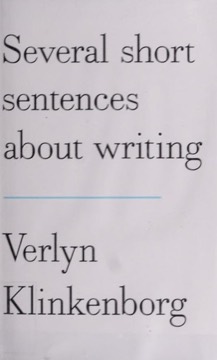
Several Short Sentences About Writing
Verlyn Klinkenborg's unusual instruction book, set out as short lines rather than paragraphs, arguing that the sentence is the only unit that matters and that most writing education teaches the wrong thing.
- First published
- 2012
- Publisher
- Blackstone Audiobooks
- Pages
- 203
- Shelf
- Communication
- Level
- Core
- ISBN-13
- 9780307279415
Record checked against
Only one source carried a publication date for this work, so the year is uncorroborated.
Catalogue note
- Reads as
- PracticalWritten to be applied, not only understood.
- Level
- Core / BuildingAssumes general familiarity with the subject.
- Approach
- Practical
- Written for
- Writers and speakers, Readers with some grounding
Saved in this browser only — no account, nothing sent anywhere. My library
Read this if
- You want to be understood the first time.
- You make things, and want to understand the work rather than wait for inspiration.
- You want something to apply, not only something to think about.
- You know roughly how the subject works and want the fuller account.
The argument
Klinkenborg's position is that writers are taught to think in paragraphs and transitions and flow, and that this produces prose assembled from habit rather than made deliberately.
His alternative is to work sentence by sentence: every sentence short enough to hold in the head entire, tested on its own, and only then placed next to another.
Write one sentence. Make it good. Then find out what the next one is.
Devmark’s reading — not a quotation from the book
The form
The book is set as short lines with white space between them, which looks like verse and is not. The form enacts the argument — you cannot skim it, and each claim has to survive alone.
That decision divides readers completely. Some find it the clearest writing instruction they have encountered; others find it mannered.
What it teaches
The strongest material is on noticing: Klinkenborg's claim that the limit on most writing is not technique but insufficient attention to what is actually there.
He is also good and unusual on the tyranny of the transition — the habit of smoothing between sentences, which he argues hides the absence of thought rather than revealing its presence.
He argues that transitions are usually there to disguise the fact that nothing connected.
Devmark’s reading — not a quotation from the book
Who it will not suit
Klinkenborg is explicitly uninterested in structure, argument, research or anything above the level of the sentence, and a reader looking for help organising a piece will find nothing here.
He is also prescriptive in a way that reads as dogma to some writers: the insistence on short sentences is a corrective rather than a universal rule, and taken literally it produces prose as mannered as the habit it replaces.
Why it is set out this way
The book is printed as short lines rather than paragraphs, and the layout enacts its thesis. Each sentence must stand alone and be judged alone, which is precisely what Klinkenborg is asking the reader to learn to do with their own. A conventional paragraph would have let the sentences hide inside each other.
The book looks like this because you cannot hide a weak sentence inside a paragraph if there are no paragraphs.
Devmark’s reading — not a quotation from the book
Against the received method
He attacks most of what is taught about writing: outlines, the notion of flow, the advice to write freely and fix it later, the idea that transitions carry a piece. His claim is that these produce writing assembled at the level of the paragraph, where the actual decisions are all one level below.
Short sentences are harder
The recommendation of brevity is not stylistic preference. A short sentence has nowhere to conceal a vague thought, so writing them forces you to discover whether you know what you mean — and the reason most people write long is that length permits the uncertainty to remain unresolved.
Noticing
A large part of the book is not about writing at all but about attention: the argument that writers do not lack material, they lack the habit of registering what is in front of them. His prescription is to notice deliberately and constantly, and to trust that the noticing supplies the sentences.
Authority
He is insistent that a reader can detect whether a writer believes what they are saying, and that hedging, unnecessary qualification and borrowed phrasing are all audible on the page even to someone who could not name what they are hearing. The remedy he proposes is not confidence performed as a style but knowing the subject well enough to be able to say something about it plainly and without cover.
The exercises at the end
The final section provides passages of student writing with his commentary attached, and for readers who want to see the method applied rather than asserted they are considerably more useful than the aphorisms that precede them. They also reveal how demanding his standard actually is when applied to real sentences, which some readers find bracing and others find thoroughly discouraging.
Who it will frustrate
It supplies no structure for a long piece, no advice on research or publication, and no encouragement of the usual kind. It is for someone who can already write competently and wants to write well, and it is close to useless for someone facing a blank page for the first time.
What to take away
- 01The sentence is the unitNot the paragraph, and not flow.
- 02Short enough to hold entireA sentence you cannot keep in your head cannot be judged.
- 03Form as argumentThe line-broken layout makes skimming impossible, deliberately.
- 04Noticing is the limitAttention, not technique, is what most writing lacks.
- 05Against transitionsSmoothing usually conceals an absence of connection.