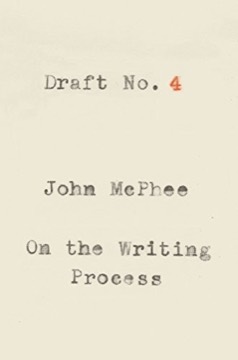
Draft No. 4
John McPhee on the process of writing long-form non-fiction, drawn from fifty years at The New Yorker and decades of teaching at Princeton. Structure, in particular, treated as the central problem.
- First published
- 2017
- Publisher
- Recorded Books
- Pages
- 208
- Shelf
- Design
- Level
- Core
- ISBN-13
- 9781664732407
Record checked against
Only one source carried a publication date for this work, so the year is uncorroborated.
Catalogue note
- Reads as
- PracticalWritten to be applied, not only understood.
- Level
- Core / BuildingAssumes general familiarity with the subject.
- Approach
- Practical
- Written for
- Designers and makers, Readers with some grounding
Saved in this browser only — no account, nothing sent anywhere. My library
Read this if
- You want to be understood the first time.
- You make things, and want to understand the work rather than wait for inspiration.
- You want something to apply, not only something to think about.
- You know roughly how the subject works and want the fuller account.
What it is
Eight essays on method: how McPhee finds a structure, how he handles interviews and notes, how fact-checking actually works, and what the successive drafts are for.
The title essay's argument is that the first draft exists only to produce something to revise, and that the writer's real work — the part that feels like writing — begins at the fourth.
The first draft's only job is to stop the page being blank. Everything good happens later.
Devmark’s reading — not a quotation from the book
Structure as the subject
The book's most distinctive material is on organising a piece before writing it: McPhee reproduces the actual diagrams he drew for particular articles, including a spiral and a set of interlocking chronologies.
His position is that structure is not a container you pour material into but a decision that determines what the piece can say, and that it should be settled before the prose starts.
He draws the shape of a piece before writing it, and shows you the actual drawings.
Devmark’s reading — not a quotation from the book
On the craft
The chapter on omission is the one most writers take away: what you leave out is the substance of the piece, and McPhee is explicit that his work is mostly the discarding.
He is also very good on the fear — the extended period of being unable to start — and unusually honest that fifty years of practice did not remove it.
Structure, worked out on paper
The essay on structure is the book's centre and describes a genuinely unusual method: reading his notes repeatedly, coding each fragment, sorting them into an order worked out as a diagram before any prose is attempted. He reproduces the diagrams, including one shaped as a spiral, and explains why a piece's shape must be discovered rather than imposed.
What the title means
The fourth draft is where McPhee says the work becomes possible: the first three exist to produce something, however bad, and only once a complete draft exists can the real activity begin — reading it as a reader, crossing out, and hunting for the word that is nearly right and the better one beside it.
The first three drafts exist so that there is something to cross out.
Devmark’s reading — not a quotation from the book
Omission
His essay on leaving things out is the one most writers take away. The argument is that writing is selection, that a piece is defined as much by the excellent material excluded as by what remains, and that the discipline is being willing to discard something genuinely good because it does not belong in this structure.
Fact-checking
A whole essay is given to the magazine's verification department and what it actually does to a manuscript. The account is both admiring and slightly appalled, and it is the clearest public description of an institutional apparatus that has largely disappeared elsewhere — which makes it a document as well as a craft essay.
Getting people to talk
His chapter on interviewing recommends a deliberately unimpressive manner: appearing slightly slow, asking the obvious question, allowing silence, and letting the subject correct you. His position is that a visibly clever interviewer gets performance, and that the useful material arrives when the subject stops managing the encounter.
Frames of reference
One short essay worries about allusion: a comparison that illuminates for one generation is opaque to the next, and the writer must decide how much of the piece to anchor in shared knowledge that will not stay shared. It is a narrow problem examined carefully, which is characteristic of the whole book.
What to take from it
This is a working writer's account of method rather than a course, and it is most useful to someone already doing the work and stuck on structure. Read the structure essay and the omission essay first; they are the two that transfer to any long piece of non-fiction, regardless of subject.
What to take away
- 01Draft fourThe first three drafts exist to make the fourth possible.
- 02Structure before proseThe shape is decided first and determines what the piece can say.
- 03Actual diagramsMcPhee reproduces the structural drawings for real articles.
- 04Omission is the workWhat is discarded defines the piece more than what stays.
- 05The fear does not goFifty years in, the inability to start was still there.