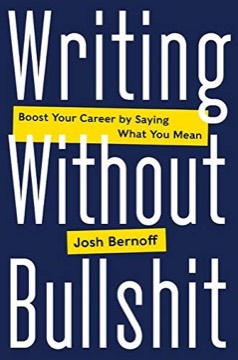
Writing Without Bullshit
Josh Bernoff's book on business writing — an argument that most professional prose fails because it is written to protect the writer rather than to inform the reader, and a set of methods for writing the other way.
- First published
- 2016
- Publisher
- HarperCollins Publishers and Blackstone Audio
- Pages
- 284
- Shelf
- Communication
- Level
- Entry
- ISBN-13
- 9780062477170
Record checked against
Only one source carried a publication date for this work, so the year is uncorroborated.
Catalogue note
- Reads as
- PracticalWritten to be applied, not only understood.
- Level
- Accessible / FoundationalNo prior reading assumed.
- Approach
- Practical
- Written for
- Writers and speakers, Newcomers to the subject
- Ideas
Saved in this browser only — no account, nothing sent anywhere. My library
Read this if
- You want to be understood the first time.
- You want something to apply, not only something to think about.
- You are starting from scratch here and want a way in that assumes no prior reading.
The diagnosis
Bernoff's definition is precise: bullshit in business writing is communication that is deliberately vague, evasive or inflated, and it exists because clear statements can be held against their author.
His framing is more useful than generic complaints about jargon because it identifies a motive. Passive constructions, abstraction and hedging are not carelessness — they are working as intended, protecting the writer from accountability, and that is why exhortations to write clearly have so little effect.
Vague business prose is not careless. It is working as intended, shielding the writer from being held to anything.
Devmark’s reading — not a quotation from the book
The reader's time
His opening calculation: a document sent to two hundred people multiplies every wasted minute by two hundred, so the writer's convenience is bought at a large collective cost.
His argument that the writer should spend time so the reader does not is the ethical core of the book, and it reframes revision from perfectionism into consideration for people who did not choose to read this.
The iron imperative and front-loading
His central rule: treat the reader's time as more valuable than your own. Its main consequence is front-loading — put the conclusion, the request or the news first, and the reasoning after it.
His argument against the build-up structure taught in school is that a business reader decides whether to continue within a few lines, so withholding the point until the end guarantees it will not be read by the people who most needed it.
Specific fixes
His catalogue of corrections: eliminate passive voice where it hides an actor, cut weasel words, delete jargon that has a plain equivalent, replace vague quantifiers with numbers, and remove qualifiers that signal uncertainty the writer does not actually have.
His treatment of numbers is the sharpest — that a claim of significant improvement is worthless and a claim of eleven per cent is not, and that writers reach for the first precisely because the second can be checked.
The ROAM framework
His planning method, applied before writing: identify the Readers, the Objective, the Action you want, and the iMpression you want to leave.
Its value is that it forces the writer to name a desired action, and a great deal of corporate writing fails the test immediately because no action was ever intended. Documents written with no purpose beyond being sent are the largest single category of waste he identifies.
Formats
Chapters on email, reports, blog posts, social posts, presentations and press releases, each with the specific failure modes of the form.
The email chapter is the most immediately valuable — subject lines that state the request, the action in the first two lines, and the recognition that a long email is a meeting nobody agreed to attend.
Working with others
His sections on the organisational reality: editing other people's work, surviving review cycles, dealing with legal and compliance input, and writing in groups.
His honesty that clear writing is frequently degraded by review — because each reviewer adds protection for their own position — is the part that most rings true to anyone who has watched a good draft pass through four approvals.
Each reviewer adds protection for their own position, which is how a clear draft becomes an unreadable one.
Devmark’s reading — not a quotation from the book
Where it is limited
It is a book of tactics with a repetitive structure, and its examples date quickly because they are drawn from contemporary corporate and marketing material.
It also assumes the writer has the standing to write directly, which many people in organisations do not. Its advice is easier to follow the more senior you are, and the book acknowledges this only briefly.
Its relation to the older manuals
Where Zinsser and Strunk address prose, this addresses documents — things with a purpose, an audience who did not choose them, and an organisational context that shapes what can be said.
That makes it the more directly applicable of the three for most working readers, and the least interesting to read.
What to take from it
Front-loading, which is the highest-return change available in business writing and requires no skill, only the decision to state the point before justifying it.
And the ROAM check, specifically the action question, because a document that cannot name the action it wants usually should not have been written at all.
What to take away
- 01Vagueness is protective, not carelessIt shields the writer from accountability, which is why telling people to write clearly rarely works.
- 02Front-load the pointReaders decide within a few lines, so a conclusion held until the end will not be reached.
- 03Name the action you wantA document that cannot name one usually should not have been written.
- 04Specific numbers can be checkedWhich is exactly why writers reach for 'significant improvement' instead.
- 05Review cycles degrade clarityEach approver adds protection for their own position, and the draft absorbs all of it.