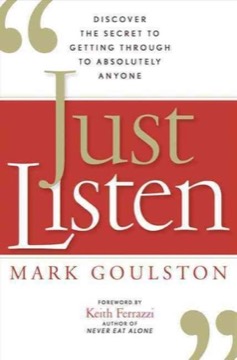
Just Listen
Mark Goulston's book on reaching people who are closed, angry or unreachable — techniques from a career in psychiatry and hostage negotiation training, aimed at the moment when normal persuasion has already failed.
- First published
- 2009
- Publisher
- AMACOM Books
- Pages
- 245
- Shelf
- Communication
- Level
- Entry
- ISBN-13
- 9780814414040
Record checked against
Only one source carried a publication date for this work, so the year is uncorroborated.
Catalogue note
- Reads as
- PracticalWritten to be applied, not only understood.
- Level
- Accessible / FoundationalNo prior reading assumed.
- Approach
- Practical
- Written for
- Writers and speakers, Newcomers to the subject
- Ideas
Saved in this browser only — no account, nothing sent anywhere. My library
Read this if
- You want to be understood the first time.
- You want something to apply, not only something to think about.
- You are starting from scratch here and want a way in that assumes no prior reading.
The situation it addresses
Goulston's subject is narrower and harder than general communication advice: the person who has stopped listening, who is entrenched, hostile, panicking or shut down.
His background is unusual for the genre — psychiatry, suicide intervention, and training FBI and police hostage negotiators — and his examples come from situations where failure had immediate consequences, which gives the techniques a different provenance from the usual business anecdote.
His examples come from situations where failure had consequences. That is a different provenance from most of the genre.
Devmark’s reading — not a quotation from the book
Moving up the brain
His organising model: a person in a reactive state is operating from the oldest parts of the brain, and no reasoning will land until they have moved to a state where reasoning is possible.
His three-layer framing is a considerable simplification of the neuroscience and he presents it more confidently than the evidence supports. The practical implication — do not argue with someone in a reactive state, first help them out of it — is sound regardless of the model.
From resistance to listening
His central sequence: the goal in a difficult exchange is to move the other person through a series of states, from resisting, to listening, to considering, to willing, to doing.
Naming the intermediate states is useful because it sets a realistic objective for a single conversation. Most attempts fail by trying to reach agreement from resistance in one move, which skips three states.
Make the other person feel felt
His central claim and the phrase the book is known for: people become reachable at the moment they believe you have accurately understood their internal state, and not before.
His technique is to name the feeling and the reason for it out loud, with enough specificity that it could not be a guess. His examples show that getting this slightly wrong is better than not attempting it, because the person corrects you and is then engaged.
The impossibility question and the fill-in-the-blank
Two of his specific techniques. The impossibility question asks what would be impossible to achieve but would transform things if it were possible, which moves a person from complaint into possibility.
The fill-in-the-blank asks the other person to complete a sentence rather than answer a question, which reduces the interrogation feeling and gets more information. Both are concrete and immediately testable.
Empathy jolts and stipulation
His techniques for defusing hostility: asking a question that requires the other person to consider your position from inside their own frustration, and stating their likely objection before they do.
Stipulating the objection — saying you are probably thinking this is another empty promise — is the most reliably effective of these, because it removes the other person's need to voice it and demonstrates that you already understand the situation.
Side by side and the power of hmmm
His attention to physical arrangement — that difficult conversations go better when people are not facing each other directly — and to the value of a minimal response that invites continuation.
His point that silence and a non-committal sound produce more information than any question is consistent with what interviewers and negotiators report, and is the easiest technique in the book to adopt.
A minimal sound and a pause produce more information than most questions do.
Devmark’s reading — not a quotation from the book
Where it is limited
The neuroscience framing is loose and should not be taken as description. The evidence throughout is clinical anecdote from the author's own practice and training work, with no systematic support.
The book is also structured as a long list of techniques with thin connective argument, which makes it repetitive to read and hard to retain as a coherent method.
How it sits against the others
*Difficult Conversations* gives the better structural analysis, *Nonviolent Communication* the better discipline, and this the better emergency toolkit.
It is the one to reach for when a relationship has already broken down and the other party is not willing to have a structured conversation at all.
What to take from it
Feeling felt as the precondition — that nothing persuasive lands until the other person believes their state has been accurately understood, which reorders what to do first in almost every hard conversation.
And stipulating the objection aloud, which is a small move that disproportionately reduces resistance and costs nothing to try.
What to take away
- 01Nothing lands until they feel understoodName their state specifically; being slightly wrong is better than not trying, because they correct you.
- 02Resistance to agreement is several stepsMost attempts fail by trying to cross all of them in one move.
- 03Say their objection before they doIt removes their need to voice it and demonstrates you already understand the situation.
- 04Silence gathers more than questionsA pause and a minimal sound is the cheapest technique in the book and among the most effective.
- 05The brain model is looseTreat it as a mnemonic rather than a description; the practical implication holds either way.