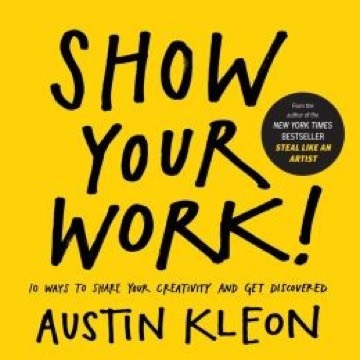
Show Your Work!
Austin Kleon's companion volume on the part his first book left thin — how to be discovered by sharing the process rather than only the finished object, and how to do it without becoming a self-promoter.
- First published
- 2014
- Publisher
- Mosaik
- Pages
- 224
- Shelf
- Design
- Level
- Entry
- ISBN-13
- 9780761178972
Record checked against
Catalogue note
- Reads as
- PracticalWritten to be applied, not only understood.
- Level
- Accessible / FoundationalNo prior reading assumed.
- Approach
- Practical
- Written for
- Designers and makers, Newcomers to the subject
Saved in this browser only — no account, nothing sent anywhere. My library
Read this if
- You make things, and want to understand the work rather than wait for inspiration.
- You are asking what you should be doing with your working life.
- You want something to apply, not only something to think about.
- You are starting from scratch here and want a way in that assumes no prior reading.
The problem it solves
His first book ended with the instruction to do good work and share it. The sharing half was a single chapter, and the obvious objection — that most people find self-promotion distasteful and are bad at it — went unanswered.
This book is the answer. Its premise is that the alternative to promotion is documentation: showing the work as it happens rather than announcing it once complete, which requires no claims about quality and produces a body of material as a by-product of working.
The alternative to self-promotion is documentation. Showing the process makes no claims that need defending.
Devmark’s reading — not a quotation from the book
Amateurs and the advantage of not knowing
His reclaiming of the amateur as someone who works from love and is therefore willing to be seen learning in public.
His argument is that the amateur's willingness to share incomplete understanding is a structural advantage over the professional's need to appear expert, because it produces more material, invites correction, and attracts people at the same stage. It is also the part of the book most obviously true of how communities of practice actually form online.
Think process, not product
His central instruction. The finished object is one artefact and appears rarely; the process generates material continuously — sketches, failures, notes, decisions, things read.
His point is that process material is more interesting than most people assume, because the audience for finished work is small and the audience for how something is made is large. It also removes the bottleneck where someone has nothing to share because nothing is finished.
Share something small every day
His practical rhythm: a daily dispatch of something noticed, made or learned, deliberately low-stakes.
The discipline is the value rather than any individual post. A daily habit lowers the significance of each item, which is what makes it sustainable, and over a year it accumulates into a record that no single deliberate effort would have produced.
Open your cabinet of curiosities
His argument that what you pay attention to is itself worth sharing: influences, collections, things found, the work of others you admire.
His claim that taste is a form of contribution, and that curating honestly is not a lesser activity than making, is defensible and is the mechanism behind a great many careers that began as sharing other people's work attentively.
Tell good stories
His chapter on framing: that work does not speak for itself, that context changes how it is received, and that the ability to describe what something is and where it came from is part of the practice.
His use of the pitch structure borrowed from screenwriting — the setup, the conflict, the resolution — is practical, and his insistence that the story be true rather than constructed is the constraint that keeps this from being advice about spin.
Teach what you know
His strongest chapter. Giving away method costs less than people fear and returns more than they expect: it establishes competence more convincingly than claiming it, and it attracts exactly the people who care about the same problem.
His answer to the fear of being copied is that the person who taught the method is rarely the one displaced by it, and that withholding produces obscurity more reliably than it produces advantage.
Giving the method away establishes competence more convincingly than claiming it ever does.
Devmark’s reading — not a quotation from the book
Handling the bad parts
His practical advice on criticism, on trolls, on the moment when attention arrives and is unpleasant: keep a thick skin, do not feed it, and remember the work is not the person.
His related advice on money — that selling out is mostly a fear rather than a real risk, and that asking to be paid is normal — is brief but useful for readers who have absorbed the idea that commerce contaminates the work.
Where it is limited
It was written for an earlier social internet, and its assumptions about how sharing produces audience have not survived the shift to algorithmic feeds and paid distribution. The advice to post consistently on your own site and let people find it is better practice than it is a working strategy.
Its examples also come mostly from visual and literary practice, and it has nothing to say about fields where the process cannot be shown for reasons of confidentiality or client agreement.
What to take from it
The reframe from promotion to documentation, which removes the distaste that stops most people from sharing at all, and which produces something useful whether or not anyone is watching.
And teaching what you know, which is the highest-return practice in the book and the one least dependent on the platform conditions that have since changed.
What to take away
- 01Document instead of promotingShowing the process makes no claim about quality, so it requires none of the confidence promotion does.
- 02Share something small dailyLowering the stakes of each item is what makes the habit survivable, and it compounds over a year.
- 03Teach the methodIt demonstrates competence better than claiming it, and the teacher is rarely displaced by the students.
- 04Taste is a contributionCurating what you admire honestly is a real form of making, not a substitute for it.
- 05The platform advice has datedWritten for an earlier internet, its account of how sharing finds an audience no longer describes the mechanics.