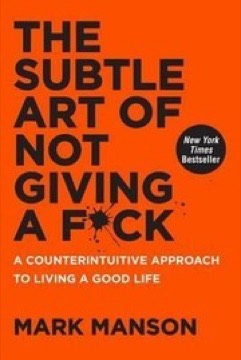
The Subtle Art of Not Giving a F*ck
Mark Manson's argument that the problem is not a shortage of positivity but a surplus of caring about the wrong things, and that choosing your problems is the only real freedom available.
- First published
- 2016
- Publisher
- HarperCollins Publishers
- Pages
- 224
- Shelf
- Habits
- Level
- Entry
- ISBN-13
- 9780063228252
Record checked against
Catalogue note
- Reads as
- PracticalWritten to be applied, not only understood.
- Level
- Accessible / FoundationalNo prior reading assumed.
- Approach
- Practical
- Written for
- Anyone changing how they work, Newcomers to the subject
- Ideas
Saved in this browser only — no account, nothing sent anywhere. My library
Read this if
- You want to understand what makes people willing to follow a decision.
- You have to choose what not to do, and want a way to think about it.
- You want something to apply, not only something to think about.
- You are starting from scratch here and want a way in that assumes no prior reading.
The core idea
Manson's premise is that everyone has a limited supply of attention and concern, and that most unhappiness comes from spending it indiscriminately. The book is about selection rather than detachment: caring less about most things in order to care properly about a few.
His second move is to reject the standard promise of the genre. He argues that life contains a fixed quantity of struggle and the only meaningful question is which struggle you are willing to have.
The question is not what you want but what pain you are prepared to sustain for it.
Devmark’s reading — not a quotation from the book
The arguments that carry
The strongest chapters are on responsibility versus fault — that you can be responsible for handling a situation you did not cause — and on the distinction between values that are actionable and values that depend on things outside your control.
He is also usefully blunt about the entitlement built into constant positive thinking: the expectation of feeling good is itself a source of feeling bad.
What to expect
The register is profane and deliberately anti-inspirational, which is the book's marketing and also its argument. Readers who find that tiresome will find little else here.
It is not original philosophy — the ideas are broadly Stoic and Buddhist, and Manson says so — but the translation into direct contemporary language is what the book is for.
The ideas are borrowed and acknowledged; the delivery is the contribution.
Devmark’s reading — not a quotation from the book
The backwards law
The book's opening argument, borrowed and credited, is that pursuing a positive experience is itself a negative experience, while accepting a negative one is a positive one. Wanting more happiness confirms a deficiency; the pursuit reinforces the lack it is meant to remove. It is the philosophical hinge everything else swings on.
Choose your suffering
Manson reframes the standard question. Asking what you want produces a useless answer because everyone wants the same things; asking what pain you are willing to sustain is discriminating, because the answer determines what you will actually end up with. Wanting the outcome without wanting its cost is, in his account, the definition of not really wanting it.
Everyone wants the result. The useful question is what pain you will keep showing up for.
Devmark’s reading — not a quotation from the book
Responsibility without fault
The distinction he handles best: fault is about the past and responsibility is about the present, and they are routinely conflated. Something can be genuinely not your fault and still entirely your problem to respond to. Manson is careful that this is not victim-blaming — it is the observation that waiting for the responsible party to fix it is a strategy with a poor record.
Good and bad values
He supplies a test rather than a list. A workable value is reality-based, socially constructive, and immediate and controllable; a bad one depends on external validation, on other people losing, or on something outside your influence. Applied honestly it disqualifies most of what people report caring about, including success defined comparatively.
The law of avoidance
His account of why people resist change is that the threat is to identity rather than to comfort: anything that would require revising your description of yourself is avoided even when it is obviously beneficial. The prescription is to hold identity loosely and define yourself in narrower, more mundane terms, because a smaller self-concept has less to defend.
The ending
The final chapter turns to mortality and leans explicitly on a mid-century argument that most human striving is a defence against death. It is the most serious writing in the book and it recasts everything before it: the recommendation to care about fewer things is grounded in the observation that the time available for caring is finite and short.
Where it is borrowed
Manson is upfront that little of this is original — the backwards law, existentialist ethics, Buddhist non-attachment, the death argument are all credited. What he contributes is compression and register: the profanity and bluntness are a delivery mechanism for ideas that would be ignored in their original packaging by the readers he is aiming at.
What to take away
- 01Choose your problemsStruggle is fixed in quantity; the choice is which one you take on.
- 02Responsibility without faultYou can be responsible for a situation you did not cause.
- 03Actionable valuesA value that depends on other people's behaviour is not usable.
- 04Positivity as a trapExpecting to feel good is itself a reliable source of feeling bad.
- 05Borrowed, and says soStoic and Buddhist material in blunt contemporary language.