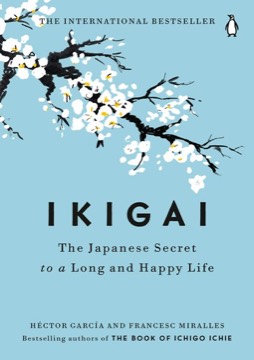
Ikigai
The Japanese Secret to a Long and Happy Life
Héctor García and Francesc Miralles's short introduction to the Japanese concept of a reason to get up in the morning, built around interviews in Ogimi, Okinawa, a village with unusual longevity.
- First published
- 2016
- Publisher
- Total Kannada
- Pages
- 208
- Shelf
- Habits
- Level
- Entry
- ISBN-13
- 9781469007434
Record checked against
Only one source carried a publication date for this work, so the year is uncorroborated.
Catalogue note
- Reads as
- PracticalWritten to be applied, not only understood.
- Level
- Accessible / FoundationalNo prior reading assumed.
- Approach
- Practical
- Written for
- Anyone changing how they work, Newcomers to the subject
Saved in this browser only — no account, nothing sent anywhere. My library
Read this if
- You are asking what you should be doing with your working life.
- You want to examine an assumption you have never examined.
- You want something to apply, not only something to think about.
- You are starting from scratch here and want a way in that assumes no prior reading.
The idea
Ikigai translates roughly as a reason for being: the thing that gets a person out of bed. In Japanese usage it is ordinary and often small — a garden, a craft, a grandchild — rather than a grand purpose.
The authors interviewed residents of Ogimi in northern Okinawa, one of the so-called Blue Zones, and report what the people there described about work, community and daily routine.
In Japanese usage ikigai is usually small and specific. It is not a life mission.
Devmark’s reading — not a quotation from the book
What the book collects
Alongside the interviews: Okinawan dietary patterns including hara hachi bu, the practice of eating to around eighty percent full; gentle continuous movement rather than exercise; strong local social groups called moai; and a notable absence of retirement as a concept.
There are also chapters on flow, on Morita and Naikan therapy, and on antifragility, which are connected loosely rather than argued.
What to know
The four-circle Venn diagram widely captioned "ikigai" — what you love, what you are good at, what the world needs, what you can be paid for — is a Western construction that was not originally about ikigai at all. This book popularised the association.
Treat it as an accessible introduction to a set of Okinawan practices rather than as scholarship on Japanese philosophy. It is short and pleasant; the Blue Zone research itself has also been contested on data quality.
The famous four-circle diagram is a Western invention that was attached to the word later.
Devmark’s reading — not a quotation from the book
What the word actually means
In ordinary Japanese usage ikigai is modest and often small: a reason to get up, which might be a grandchild, a garden, or a craft. It carries no implication of career, calling or monetisation. The inflation of the term into a life-purpose framework is a Western addition, and the book both reports the modest meaning and participates in the inflation.
Ogimi
The reporting core is a set of interviews with very old residents of a northern Okinawan village, and the recurring answers are unglamorous: daily routine, a reason to leave the house, gardening, and continued usefulness to other people. Nobody interviewed describes having found a purpose; they describe having things to do.
Not one of them reported finding their purpose. They reported having somewhere to be.
Devmark’s reading — not a quotation from the book
Hara hachi bu and the diet
The practice of stopping at around eighty percent fullness is presented alongside the traditional Okinawan diet — sweet potato as a staple, soy, bitter melon, very little meat, small portions. The dietary pattern has reasonable epidemiological support; the causal attribution of exceptional longevity to any single element of it does not.
Moai
The social structure the authors emphasise most is the mutual-support group formed in childhood and maintained for life, with a financial as well as an emotional function. Of everything in the book this has the strongest support in the wider literature, where social connection is among the more robust predictors of late-life health.
Flow and Morita therapy
The middle chapters graft on two other frameworks: the psychology of absorbed attention, and a Japanese therapeutic tradition that treats action as prior to feeling and does not require a difficult emotion to be resolved before proceeding. The second is genuinely interesting and gets less space than it deserves.
Where the evidence is shakier
Okinawa's longevity statistics have been questioned on record-keeping grounds, the cohort that produced them had a specific wartime and post-war history unlikely to repeat, and the book moves freely between correlation and recommendation. It is a popular introduction, not an epidemiological argument, and it is thin and repetitive in places.
What to take from it
The four-circle diagram everyone associates with the word is a recent Western invention and is not what the book or the concept is about. What survives is smaller and better evidenced: keep moving, eat less than full, stay connected to a small group, and retain a daily reason to get up. None of it requires finding a purpose.
What to take away
- 01A reason to riseOrdinarily small and concrete, not a grand life purpose.
- 02Hara hachi buEating to roughly eighty percent full, reported as habitual in Ogimi.
- 03MoaiLifelong local support groups, described as central to the community.
- 04No retirementThe concept is largely absent, and work continues in altered form.
- 05The diagram is not JapaneseThe four-circle version is a Western construction attached afterwards.