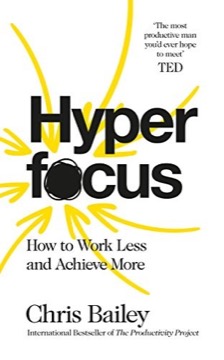
Hyperfocus
Chris Bailey's treatment of attention management, built on a distinction between two modes — deliberate concentration on one thing, and deliberate mind-wandering — and the argument that both are productive and only one gets any respect.
- First published
- 2018
- Publisher
- PAN MACMILLAN U.K
- Pages
- 256
- Shelf
- Habits
- Level
- Entry
- ISBN-13
- 9781509866137
Record checked against
Only one source carried a publication date for this work, so the year is uncorroborated.
Catalogue note
- Reads as
- PracticalWritten to be applied, not only understood.
- Level
- Accessible / FoundationalNo prior reading assumed.
- Approach
- Practical
- Written for
- Anyone changing how they work, Newcomers to the subject
- Ideas
Saved in this browser only — no account, nothing sent anywhere. My library
Read this if
- You are losing your attention to things you did not choose.
- You want something to apply, not only something to think about.
- You are starting from scratch here and want a way in that assumes no prior reading.
Two modes, both necessary
Bailey's structure rests on hyperfocus, in which attention is directed entirely at one complex task, and scatterfocus, in which attention is deliberately allowed to wander.
His claim is that the second is not a failure state. Mind-wandering is where connection, planning and creative recombination occur, and a schedule that permits no unoccupied attention removes the capacity for all three.
Mind-wandering is not attention failing. It is the mode where connection and planning actually happen.
Devmark’s reading — not a quotation from the book
Attentional space
His working metaphor: a limited quantity of simultaneous attention, which can be filled with one demanding task, several habitual ones, or a mixture.
His practical rules follow from capacity — two habitual tasks can share the space, one complex task cannot share with anything, and the common failure is pairing a complex task with a habitual one that keeps claiming space back.
The four steps into hyperfocus
Choose a productive object of attention, eliminate internal and external distraction, focus on that object, and return to it repeatedly when the mind wanders.
The fourth is the one he treats most seriously: wandering is inevitable, and the skill is the speed of noticing and returning rather than the prevention of departure.
Distraction before it arrives
His preference for removing distraction in advance rather than resisting it in the moment — a distraction-free working mode set up before starting, because the moment of temptation is a contest you will lose often enough to matter.
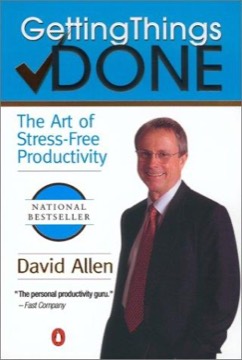
He pairs this with a recommendation to deal with internal distractions by capturing them rather than suppressing them, which is Allen's insight applied at a smaller timescale.
Scatterfocus, deliberately
His three variants: capture mode, letting the mind wander and recording what surfaces; problem-crunching mode, holding a problem loosely while doing something undemanding; and habitual mode, engaging in a simple physical activity that permits wandering.
His argument that habitual mode is most productive — walking, showering, routine chores — matches the common experience of ideas arriving away from the desk, and gives it a mechanism.
Ideas arrive in the shower because an undemanding physical task is the condition wandering requires.
Devmark’s reading — not a quotation from the book
Rest as an input
His treatment of recovery is more substantive than most: attention is a finite resource that depletes and is restored by genuine rest, and passive consumption is a poor restorative because it still occupies attentional space.
His distinction between rest that restores attention and leisure that merely occupies it is the most useful practical idea in this section.
Where the evidence is stronger and weaker
The mind-wandering research he draws on is a real and active area, and the association between undirected thought and creative problem-solving is reasonably supported.
The attentional-space metaphor is a teaching device rather than a neuroscientific model, and the book occasionally treats it as though it were the latter. Several productivity claims are also from self-experiment rather than controlled work.
How it compares
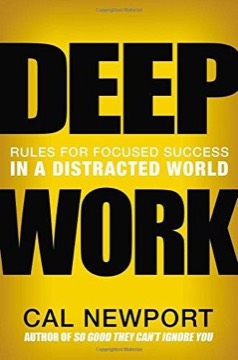
Against Newport it is more balanced and less austere: Newport argues for concentration, Bailey argues that concentration alone is half a system.
Against *Make Time* it is more conceptual and less tactical. Bailey explains mechanisms; Knapp and Zeratsky hand you a list. Readers who want to understand rather than to implement usually prefer this.
Where it is padded
The book is considerably longer than its two central ideas require, with self-experiment anecdotes and end-of-chapter recaps that add length rather than content or nuance.
The essential argument is contained in the first third, and the remainder elaborates it without much complicating it. A reader who stops at the halfway point will have everything the book has to offer, which is worth knowing before committing to the whole thing.
What to take from it
The permission is the contribution: scheduling unoccupied attention deliberately, rather than treating every unfilled moment as waste to be filled with a podcast.
And the capacity rule — that a complex task cannot share attentional space with anything, including the habitual task you assumed was free.
What to take away
- 01Both modes are productiveDirected concentration and deliberate wandering do different jobs, and only one of them gets respect.
- 02A complex task cannot share spaceThe common failure is pairing demanding work with a habitual task that keeps reclaiming attention.
- 03Speed of return is the skillWandering is inevitable; noticing quickly and coming back is what can actually be trained.
- 04Undemanding physical activity enables wanderingWhich is the mechanism behind ideas arriving in the shower rather than at the desk.
- 05Passive consumption does not restoreIt still occupies attentional space, which is why it leaves you as depleted as before.