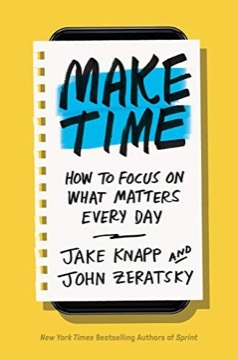
Make Time
Jake Knapp and John Zeratsky's practical system for reclaiming attention, built from their experience designing the products that consume it — a daily framework of four steps and a menu of tactics to choose from rather than adopt wholesale.
- First published
- 2018
- Publisher
- Currency
- Pages
- 306
- Shelf
- Habits
- Level
- Entry
- ISBN-13
- 9780525572428
Record checked against
Catalogue note
- Reads as
- PracticalWritten to be applied, not only understood.
- Level
- Accessible / FoundationalNo prior reading assumed.
- Approach
- Practical
- Written for
- Anyone changing how they work, Newcomers to the subject
- Ideas
Saved in this browser only — no account, nothing sent anywhere. My library
Read this if
- You are losing your attention to things you did not choose.
- You want something to apply, not only something to think about.
- You are starting from scratch here and want a way in that assumes no prior reading.
The premise
Their diagnosis is that two forces consume a day: Busy Bandwagon, the culture of default busyness and reactive work, and Infinity Pools, the apps and feeds that refill endlessly and never signal a stopping point.
Neither is anyone's decision. Both are defaults, and their argument is that a default can be changed without any change in discipline.
Busy work and bottomless feeds are defaults, not choices. Defaults can be changed without any discipline at all.
Devmark’s reading — not a quotation from the book
Highlight
The first step: choose one thing each day that will be the day's focus, and choose it by asking what would make today feel satisfying rather than what is most urgent.
Their sizing guidance is specific — sixty to ninety minutes, large enough to matter and small enough to finish. The purpose is intention rather than throughput: a day with a completed highlight feels different even if the rest was ordinary.
Laser
The second step: defend attention for the highlight, mostly by removing distraction rather than by summoning focus.
Their most radical tactic is the distraction-free phone — deleting social apps, email and browsers from the device entirely — which they present as reversible, immediately effective, and much easier than it sounds.
Energise
Their third step, and the one that distinguishes the book from other attention advice: treating the brain as part of a body, and attention as dependent on movement, food, sleep and quiet.
Their tactics are modest and evidence-aligned — short daily exercise rather than a programme, real food, caffeine timed deliberately rather than habitually, and protecting sleep as an input rather than a residual.
Reflect
The fourth step: a brief daily note on what was chosen, what worked, and what to adjust — treating the whole system as an experiment rather than a regime.
This is the part most readers skip and the part that makes the menu approach function, since the point is to discover which tactics work for you rather than to comply with all of them.
It is a menu, not a programme. Without the daily note you never learn which items on it are yours.
Devmark’s reading — not a quotation from the book
The tactics menu
Roughly eighty small tactics across the four steps, presented explicitly as options to try rather than rules to follow.
The design is deliberate: they argue that productivity systems fail because they demand total adoption, and that picking two or three that fit your circumstances produces more change than attempting all of them for a week.
Their credibility, and its limits
Both authors designed products at large technology companies, including ones explicitly built to capture attention, and the book's authority rests partly on that.
It is also a limitation. Their prescriptions assume a job with some discretion over daily structure, and the highlight concept is difficult to apply in genuinely reactive work — support, clinical, or shift-based roles.
Where it is light
There is no evidence base and no argument, by design. This is a book of practices assembled from personal experimentation and presented as such, which is honest but means nothing here is established.
Several tactics are also trivially obvious, and the eighty-item menu pads the count with variations on a handful of ideas.
How it compares
Against Newport it is far more practical and far less philosophical — Newport argues a position, Knapp and Zeratsky hand you a list.
Against *Atomic Habits* it is narrower, addressing the daily allocation of attention rather than behaviour change generally. It is also considerably shorter, and it is designed to be used rather than read.
What to take from it
The highlight practice alone is worth trying for a week: name one thing in the morning, protect time for it, and notice whether the day feels different regardless of what else happened.
And the distraction-free phone, which is the single highest-leverage tactic in the book and the one most readers dismiss before trying.
What to take away
- 01Change the default, not the disciplineBusy work and endless feeds are defaults nobody chose, and defaults are editable.
- 02Name one highlight a dayChosen for satisfaction rather than urgency, sized at sixty to ninety minutes so it can actually finish.
- 03Remove distraction rather than summon focusThe distraction-free phone is the highest-leverage tactic here and the one most people skip.
- 04Attention is physiologicalMovement, food, caffeine timing and sleep are inputs to focus, not separate concerns.
- 05Treat it as a menuPick two or three that fit. Systems demanding total adoption are why systems fail.