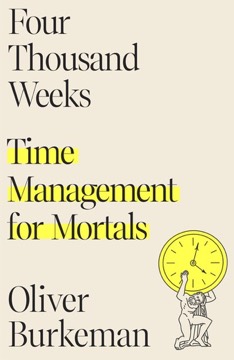
Four Thousand Weeks
Time Management for Mortals
Oliver Burkeman's argument against time management: that the attempt to get on top of everything is not merely difficult but incoherent, and that a finite life becomes usable only once you accept you will never do most of what you could.
- First published
- 2021
- Publisher
- Farrar, Straus and Giroux
- Pages
- 280
- Shelf
- Habits
- Level
- Core
- ISBN-13
- 9780374715243
Record checked against
Catalogue note
- Reads as
- ReflectiveChanges how you see rather than what you do.
- Level
- Core / BuildingAssumes general familiarity with the subject.
- Approach
- Theoretical
- Written for
- Anyone changing how they work, Readers with some grounding
Saved in this browser only — no account, nothing sent anywhere. My library
Read this if
- You want to know how the universe is put together.
- You want to examine an assumption you have never examined.
- You want a book that changes how you see things rather than what you do tomorrow.
- You know roughly how the subject works and want the fuller account.
The core idea
The title is arithmetic: roughly four thousand weeks in an eighty-year life. Burkeman's move is to treat finitude not as a problem productivity might solve but as the defining condition that makes choice meaningful at all.
His central claim is that most time-management advice contains a hidden promise — that with the right system you will eventually get on top of things — and that the promise is false, which is why each new system eventually disappoints.
The problem is not that you are bad at managing time. It is that the amount of time is not the problem.
Devmark’s reading — not a quotation from the book
Why efficiency backfires
Burkeman's most useful practical observation is that getting faster at a category of work usually increases the volume of it. Clear your inbox promptly and you train people to send more; automate a process and the freed capacity fills.
This is a version of induced demand applied to attention, and it explains why the feeling of being behind is not correlated with how much anyone actually gets done.
The efficiency trap and 'existential overwhelm'
The deeper version of the argument is that the supply of things worth doing is effectively infinite, and any finite throughput divided into an infinite queue gives the same answer.
Burkeman's conclusion is that the feeling of overwhelm is not a signal of poor organisation. It is an accurate perception of the ratio between what could be done and what a mortal can do, and no system changes that ratio.
Choosing is losing
The book reframes every decision as a small bereavement: choosing one thing means giving up the alternatives permanently, and this is what makes choosing feel so uncomfortable.
His argument is that the attempt to keep options open is itself a way of avoiding the finitude, and that commitment — to a person, a place, a body of work — is what converts time from an anxious resource into a lived one.
Settling, on purpose
Burkeman defends settling, which he treats as unavoidable rather than regrettable. Every commitment forecloses others, so the question is not whether to settle but what to settle on and whether you will admit it.
The related argument concerns hobbies. He makes an unfashionable case for doing things badly and without ambition, on the grounds that an activity which must justify itself by improvement has been quietly converted into work.
An activity that must justify itself by getting better has already been turned into work.
Devmark’s reading — not a quotation from the book
Patience as a skill
Three rules structure the practical middle of the book: develop a taste for having problems, since a life without them is not a life; embrace radical incrementalism, tolerating stopping when the day's small portion is done; and resist the urge to pass the most significant thing on your list.
The underlying claim is that patience is not passive but an active capacity that has been eroded by systems designed to remove waiting — and that much worthwhile work is only available to people who can tolerate slowness.
Cosmic insignificance therapy
The chapter that gives the book its emotional turn argues that your importance is vanishingly small on any cosmic scale, and that this is a relief rather than a wound.
If your life does not have to justify itself against a standard of significance, the actual contents of a Tuesday become permissible to enjoy. Burkeman is careful that this is not nihilism: the smallness applies to the demand for justification, not to the experience.
Where it is vulnerable
The most serious criticism is one Burkeman partly acknowledges: the advice assumes a degree of control over one's obligations. Telling someone working two jobs to embrace finitude and settle is advice for a different life than theirs.
The book is also structurally uneven. It is strongest in the first half as diagnosis and thinner in the second, where the philosophical consolation does more work than the practical guidance.
Where it gets misread
It is not an anti-productivity book. Burkeman is not arguing against doing things or planning; he is arguing against a specific fantasy of eventual control, and several of his suggestions are quite concrete.
It is also not permission to abandon commitments. His argument runs the other way — that commitment is the thing that makes finite time meaningful and that the avoidance of it is the real failure mode.
What to take from it
The transferable core is a single reframing: stop treating the list as something that could in principle be completed, and start treating the day as something that will contain a small number of things.
Its most practical rule is also its simplest — limit work in progress, and finish before starting. That is ordinary advice, but it lands differently once the impossibility of the alternative has been argued properly.
What to take away
- 01Finitude is the condition, not the bugNo system changes the ratio between what could be done and what a mortal can do.
- 02Efficiency induces demandGetting faster at a category of work reliably produces more of that work, not more free time.
- 03Every choice is a small lossDiscomfort in deciding comes from foreclosure, and keeping options open is avoidance rather than freedom.
- 04Do something badly on purposeAn activity that has to justify itself by improvement has stopped being a hobby.
- 05Finish before startingLimiting work in progress is ordinary advice that lands differently once completion is admitted impossible.