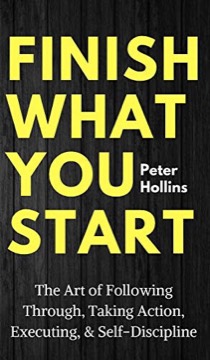
Finish What You Start
Peter Hollins's practical treatment of follow-through — why projects are abandoned partway and what can be arranged in advance to make completion more likely than starting again.
- First published
- 2019
- Publisher
- Pkcs Media, Inc.
- Pages
- 206
- Shelf
- Habits
- Level
- Entry
- ISBN-13
- 9781647430511
Record checked against
Only one source carried a publication date for this work, so the year is uncorroborated.
Catalogue note
- Reads as
- PracticalWritten to be applied, not only understood.
- Level
- Accessible / FoundationalNo prior reading assumed.
- Approach
- Practical
- Written for
- Anyone changing how they work, Newcomers to the subject
Saved in this browser only — no account, nothing sent anywhere. My library
Read this if
- You want to change what you do repeatedly, not just what you intend.
- You want something to apply, not only something to think about.
- You are starting from scratch here and want a way in that assumes no prior reading.
The problem it addresses
Hollins's subject is the specific gap between beginning and completing: people initiate readily and abandon at a predictable point, and the failure is rarely about the original decision being wrong.
His framing is that starting is emotionally rewarded — novelty, possibility, the pleasure of planning — while finishing is not, which makes the motivational structure of a project front-loaded by default.
Starting is rewarded by novelty and possibility. Finishing is rewarded by nothing until it is done.
Devmark’s reading — not a quotation from the book
The four enemies
His diagnostic list of what actually stops completion: lack of focus, procrastination, poor self-discipline, and an inability to defer gratification.
The list itself is unremarkable and appears in a hundred other books. The diagnostic framing is what earns its place — it asks which of four distinct failures is operating in this particular case, rather than treating abandonment as a single undifferentiated character defect that has to be fixed all at once.
Inhibition and the stopping impulse
His more interesting material draws on the executive function literature: completion requires suppressing competing impulses repeatedly over a long period, which is a different capacity from the one that generates enthusiasm.
This reframes follow-through as an inhibition problem rather than a motivation problem, which points at different remedies.
Rules over decisions
His central practical recommendation: replace in-the-moment decisions with predetermined rules, because the moment of decision is exactly when the competing impulse is strongest.
His versions — fixed working times, a rule about what constitutes done, a predefined response to the urge to switch projects — are conventional and sound, and the underlying principle is well supported.
The 40 percent rule and its problem
He repeats the claim, attributed to military training culture, that people feel finished at roughly forty per cent of their actual capacity.
This is a popular anecdote rather than a research finding, and the book presents it with more confidence than it deserves. The underlying point — that perceived limits are typically reached before actual ones — is plausible and the specific figure should not be quoted.
The forty-per-cent figure is an anecdote, not a finding. The underlying point survives; the number should not be repeated.
Devmark’s reading — not a quotation from the book
Scheduling and singular focus
His operational advice: work on one project to completion rather than several in parallel, define completion criteria before starting, and schedule the work rather than leaving it to available time.
The completion-criteria point is the most valuable — a project without a definition of done cannot be finished, only abandoned, which reframes many apparent follow-through failures as specification failures.
Where it is derivative
Hollins is a prolific synthesiser rather than a researcher, and the content here overlaps heavily with the wider self-improvement literature — implementation intentions, precommitment, temptation bundling, deliberate practice.
Very little here is original, and the book does not claim otherwise, but neither does it point readers toward the primary sources with much care.
Where it is weak
The citation practice is loose, several claims are repeated from popular circulation rather than from the studies behind them, and the tone is confident throughout regardless of evidential strength.
It is also short and somewhat padded, with chapter summaries that restate material covered a few pages earlier.
Who it suits
Someone who specifically abandons projects partway and wants a compact practical treatment aimed at that failure rather than at habits generally.
Someone who wants the research should go to the sources — implementation intentions from Gollwitzer, precommitment from the behavioural economics literature — which are better and not much harder.
What to take from it
Define done before starting. A surprising proportion of unfinished work was never given a condition under which it would be complete, which makes finishing structurally impossible.
And the rules-over-decisions principle, which removes the negotiation at exactly the moment you are least equipped to win it.
What to take away
- 01Define done before you beginA project with no completion condition cannot be finished, only abandoned.
- 02Follow-through is inhibition, not enthusiasmCompletion requires suppressing competing impulses repeatedly, which is a different capacity from starting.
- 03Set the rule in advanceThe moment of decision is when the competing impulse is strongest, which is the worst time to decide.
- 04The motivation is front-loaded by defaultNovelty and planning reward the start; nothing rewards the middle until it is over.
- 05Do not repeat the forty-per-cent figureIt is an anecdote in wide circulation, not a research finding.