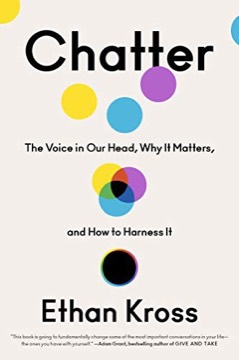
Chatter
Ethan Kross on the inner voice: why talking to yourself is normal and useful, why it sometimes locks into a loop, and what the research says actually breaks the loop.
- First published
- 2021
- Publisher
- Ebury Publishing
- Pages
- 272
- Shelf
- Mind
- Level
- Entry
- ISBN-13
- 9780593238752
Record checked against
Sources disagree on the publication year (openlibrary 1900, wikipedia 2021). The value shown is the one preferred by the most reliable source for original publication date; the disagreement is recorded rather than resolved.
Catalogue note
- Reads as
- ConceptualExplains how something works before what to do about it.
- Level
- Accessible / FoundationalNo prior reading assumed.
- Approach
- Theoretical
- Written for
- Curious general readers, Newcomers to the subject
Saved in this browser only — no account, nothing sent anywhere. My library
Read this if
- You want to change what you do repeatedly, not just what you intend.
- You want evidence about why people behave as they do, not folklore.
- You want to understand how it works before deciding what to do about it.
- You are starting from scratch here and want a way in that assumes no prior reading.
The core idea
Kross runs an experimental psychology lab at Michigan studying inner speech. His starting point is that the inner voice is a feature — it rehearses, plans and simulates — and that chatter is what happens when it gets stuck circling a problem without progressing.
The cost is measurable: chatter degrades performance, strains relationships when it spills into repeated venting, and has physical correlates.
The inner voice is not the problem. The loop is.
Devmark’s reading — not a quotation from the book
What the research suggests
The best-supported technique is distanced self-talk: addressing yourself by name or as "you" rather than "I", which reliably improves emotion regulation in experiments. Kross's lab produced much of this evidence.
Others include temporal distancing (how will this look in a year), ritual, contact with awe-inducing environments, and an argument that venting to friends often deepens the loop rather than relieving it.
Say your own name to yourself. It sounds absurd and it measurably works.
Devmark’s reading — not a quotation from the book
The social side
Kross devotes real space to other people, in both directions. Support that only validates feeling tends to keep the loop running, while support that also helps reframe the problem tends to break it — which means the useful friend is the one who eventually asks a different question.
He is equally interested in the environments that quiet chatter without any conversation at all: order, green space, and experiences large enough to make the self feel briefly small. The lab evidence for awe is among the more surprising findings in the book.
How to read it
This is a popular book by a working researcher, and it is better sourced than most in the genre. The effect sizes are modest and Kross is reasonably careful about that.
Useful as a set of tools with evidence behind them, rather than as a general theory of the mind.
What the inner voice is for
Kross begins by defending internal speech rather than pathologising it: it rehearses, simulates, plans, holds instructions, and maintains a continuous account of who you are. Chatter is the same faculty stuck in a loop — the problem-solving machinery running on a problem it cannot solve, at a cost to attention, sleep and the people nearby.
Talking to yourself in the third person
The most replicated technique in the book is a small grammatical shift: addressing yourself by name or as "you" rather than "I". The reported effect is a measurable drop in emotional intensity and better performance under pressure, apparently because the second-person framing recruits the way people naturally advise others, which is calmer and more practical than how they address themselves.
People give better advice to other people. Addressing yourself as one borrows that.
Devmark’s reading — not a quotation from the book
The children's version
A charming line of research has young children take on the identity of a capable fictional character while doing a boring or difficult task, and they persist markedly longer than children asked to think about their own feelings. It is the same distancing mechanism arriving through a different door, and Kross uses it to show the effect is not a verbal trick confined to adults.
Zooming out in time
Alongside distance in person, Kross covers distance in time: asking how much this will matter in ten years, or writing about a current distress as though recalling it later. The technique does not require believing the answer — the act of adopting the longer frame appears to do the work on its own.
Why venting makes it worse
One of the book's most useful corrections concerns social support. Talking it through helps when the listener moves the conversation toward perspective and problem-solving; it reliably makes things worse when the listener only validates, because repeated retelling rehearses the distress. Kross is direct that the common understanding of a good friend in this situation is approximately backwards.
Order, green space and awe
The later chapters move outside the head: tidying a physical space when the internal one is chaotic, exposure to natural environments, and deliberately seeking experiences of scale. Kross presents these as modest, well-evidenced adjuncts rather than cures, and is explicit that the effect sizes are small and the mechanisms not fully settled.
What to take from it
It is unusually honest for the genre about how large the effects are, which is a point in its favour. The techniques are free, take seconds, and stack: use your own name, widen the time frame, choose a listener who will move you on, and go outside. None of it requires the book's full apparatus.
What to take away
- 01Chatter versus inner speechThe voice is useful; the loop is the failure mode.
- 02Distanced self-talkUsing your own name shifts perspective measurably.
- 03Venting can backfireRepeated co-rumination with friends often deepens the loop.
- 04Temporal distanceAsking how this will look in a year reliably reduces intensity.
- 05Modest effects, honestly statedKross is a researcher and does not oversell the findings.