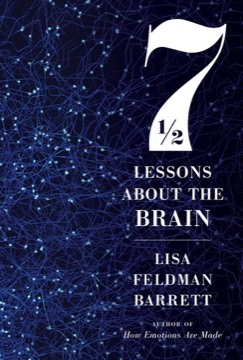
Seven and a Half Lessons About the Brain
Lisa Feldman Barrett's very short book of essays correcting the most common misconceptions about what the brain is and what it is for.
- First published
- 2020
- Publisher
- Mariner Books
- Pages
- 192
- Shelf
- Science
- Level
- Entry
- ISBN-13
- 9780358645597
Record checked against
Only one source carried a publication date for this work, so the year is uncorroborated.
Catalogue note
- Reads as
- ConceptualExplains how something works before what to do about it.
- Level
- Accessible / FoundationalNo prior reading assumed.
- Approach
- Theoretical
- Written for
- Curious general readers, Newcomers to the subject
- Ideas
Saved in this browser only — no account, nothing sent anywhere. My library
Read this if
- You are curious what is actually happening in the brain.
- You want to understand how it works before deciding what to do about it.
- You are starting from scratch here and want a way in that assumes no prior reading.
The premise
Seven short lessons plus a half-lesson opening, each dismantling a popular idea: that the brain is for thinking, that it has a reptilian core beneath a rational cortex, that there are separate emotional and rational systems.
Her replacement claim is that the brain's job is allostasis — predictively managing the body's energy budget — and that everything else, including thought and feeling, is in service of that.
The brain's job, in her account, is running a body's energy budget. Thinking is a side effect.
Devmark’s reading — not a quotation from the book
The triune brain
The strongest chapter demolishes the lizard-brain model: the idea that a primitive reptilian core is overlaid by mammalian emotion and human reason.
Barrett is clear that this was never supported by evolutionary neuroscience, that it survives because it is a satisfying story, and that it underpins a great deal of bad reasoning in business and self-help writing.
There is no lizard brain. The model was never supported and it is still everywhere.
Devmark’s reading — not a quotation from the book
The other lessons
That brains are networks rather than modules; that they predict rather than react; that they wire to their environment, so early caregiving is construction rather than influence; that many minds are possible, and that we are responsible for the brains we shape in others.
The last is the least empirical and the most interesting.
What it is
Around a hundred and fifty small pages, written for a general reader, with substantial endnotes for those who want the evidence.
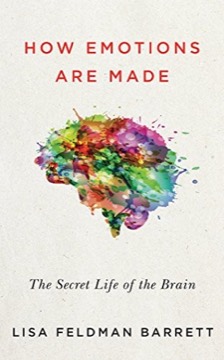
It is the compressed version of How Emotions Are Made and of her wider research programme. Read this first if the longer book looks daunting.
The half lesson
The book opens with a short piece arguing that brains did not evolve for thinking. They appeared to manage the resources of increasingly complex bodies, and cognition is a consequence of that regulatory job rather than its purpose. Every subsequent lesson is a correction that follows from taking this seriously.
Against the lizard brain
The strongest chapter dismantles the popular model of a primitive emotional core overlaid by a rational cortex. The layered account does not survive modern comparative neuroanatomy: the relevant structures are present across species and the tidy evolutionary storey-by-storey picture is a mid-century idea that persisted in popular writing long after specialists abandoned it.
There is no ancient lizard beneath your reason. That building was never constructed in floors.
Devmark’s reading — not a quotation from the book
Networks, not modules
She replaces the idea of dedicated regions with a network account: the same tissue participates in many functions depending on context, and looking for the brain's seat of anything is usually the wrong question. It explains why so many localisation findings from imaging studies have failed to hold up.
Brains predict
The recurring theme across the lessons is anticipation. The brain runs ahead of the senses, preparing the body for what it expects to encounter and treating incoming sensory information as feedback on predictions it has already issued. Barrett's point is that this reverses the intuitive stimulus-then-response picture almost completely: by the time you notice something, your brain has already been acting on its guess about it for some time.
Brains regulate other brains
One lesson covers the social claim: that human nervous systems influence each other's bodily regulation directly, so that other people are a physiological variable rather than a social one. She draws the consequence explicitly — words and relationships affect health through a real mechanism, not a metaphorical one.
Responsibility without free will
The final lesson handles the uncomfortable implication. If experience is constructed from concepts built by past exposure, then a person is substantially shaped by what they have encountered — and Barrett argues this increases rather than removes responsibility, because what you expose yourself to becomes what you later are.
What it is for
It is very short, written for a general reader, and functions as a corrective rather than an introduction — it assumes you have absorbed popular neuroscience and is dismantling it. Anyone who has repeated the lizard-brain line, or looked for the part of the brain responsible for something, is the intended audience.
What to take away
- 01Budgeting, not thinkingAllostasis as the brain's actual job.
- 02No triune brainThe lizard-brain model was never supported.
- 03Networks, not modulesFunction distributed rather than localised.
- 04Wired by environmentEarly caregiving as construction rather than influence.
- 05The short versionA compression of her longer work, with full endnotes.