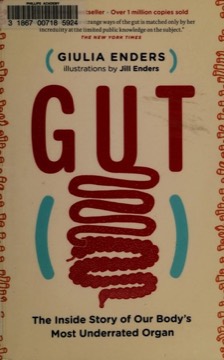
Gut
Giulia Enders's popular account of the digestive system, written while she was a medical student. Cheerful, illustrated by her sister, and unembarrassed about a subject most books avoid.
- First published
- 2015
- Publisher
- New River Books Ltd
- Pages
- 276
- Shelf
- Science
- Level
- Entry
- ISBN-13
- 9781925228601
Record checked against
Only one source carried a publication date for this work, so the year is uncorroborated.
Catalogue note
- Reads as
- ConceptualExplains how something works before what to do about it.
- Level
- Accessible / FoundationalNo prior reading assumed.
- Approach
- Theoretical
- Written for
- Curious general readers, Newcomers to the subject
- Ideas
Saved in this browser only — no account, nothing sent anywhere. My library
Read this if
- You want to understand living things by how they came to be.
- You want to understand how it works before deciding what to do about it.
- You are starting from scratch here and want a way in that assumes no prior reading.
What it covers
The anatomy and mechanics of digestion from mouth to exit, explained without euphemism: how swallowing actually works, what the small intestine's surface area is for, why the sphincter system has two parts and what that means for ignoring the urge to go.
Then the microbiome — what lives there, what it appears to do, and how antibiotics, diet and early-life exposure shape it.
It is a book about digestion that declines to be embarrassed, which is most of why it worked.
Devmark’s reading — not a quotation from the book
The gut-brain material
The chapters on the enteric nervous system and the vagus nerve are the most interesting and the most cautious. Enders reports the animal work on gut flora and behaviour and is reasonably clear that human evidence was thinner at the time of writing.
This field has moved considerably since 2015, and some of the more excited claims about microbiome and mood have not held up as strongly as the book implies.
How to read it
Written for a general reader with no biology, by someone in medical training rather than a researcher. The physiology is sound; the speculative sections should be treated as of their date.
It is genuinely funny, which is rare in the genre and is the reason it sold in the millions.
The anatomy holds up well; the microbiome speculation should be read as of 2015.
Devmark’s reading — not a quotation from the book
The two sphincters
Enders's best-known passage explains continence as a negotiation between two muscles — one under conscious control, one not — and the sampling process by which the body decides what is arriving and whether it can be released. It is characteristic of the book: a genuinely unglamorous mechanism explained precisely, without either euphemism or snickering.
Posture
The argument about toilet posture rests on a specific anatomical detail: a muscle that loops around the rectum and kinks it while sitting, a design that makes sense for continence while upright and works against the process when seated. Her recommendation to raise the knees follows directly from the anatomy rather than from a wellness claim.
The appendix, rehabilitated
Long taught as a vestigial leftover, the appendix is presented here as a plausible reservoir — a side pocket where a sample of the gut's bacterial population can survive an episode that flushes the main community, and from which recolonisation can start. Enders flags it as a well-supported hypothesis rather than an established fact.
Not a leftover. A cupboard where a copy of the population is kept.
Devmark’s reading — not a quotation from the book
Why intolerances happen
The chapters on lactose, fructose and gluten separate three things readers routinely merge: an enzyme that most adults worldwide stop producing, a transport limitation that varies between people, and an autoimmune condition with a definite diagnosis. She is firm that the first two are common and unremarkable and that the third is not a lifestyle choice.
The gut and the brain
The chapters on the enteric nervous system are where Enders is most careful, and the restraint is deliberate. She describes the extent of the wiring and the direction of traffic along the vagus nerve, then declines to conclude that gut bacteria determine mood — noting that most of the striking findings are in rodents and that human evidence is correlational.
What kind of book it is
Written by a medical student rather than a researcher, for readers with no biology, and originally a German bestseller illustrated by the author's sister. The tone is cheerful to a degree that some readers find grating, and the microbiome chapters have dated faster than the anatomy, which has not dated at all.
What to take from it
Read it for the mechanics. The lasting value is a working picture of what actually happens between swallowing and the other end, which most people never acquire, plus enough physiology to recognise when a digestive health claim is describing a real mechanism and when it is not.
What to take away
- 01Anatomy without euphemismMechanics of digestion explained plainly and cheerfully.
- 02A two-part sphincterThe physiology of continence, and why ignoring signals has consequences.
- 03The enteric nervous systemThe gut's own neural network, and the vagus connection to the brain.
- 04Microbiome, cautiouslyAnimal evidence was stronger than human evidence when she wrote.
- 05Dated in partsThe field moved after 2015 and not always in the direction implied.