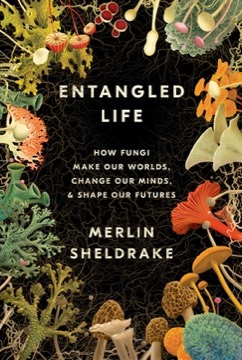
Entangled Life
Merlin Sheldrake's book on fungi — their biology, their role in ecosystems, their relationships with plants and animals, and the ways they complicate ordinary assumptions about individuality.
- First published
- 2020
- Publisher
- Random House
- Pages
- 368
- Shelf
- Science
- Level
- Core
- ISBN-13
- 9781847925190
Record checked against
Catalogue note
- Reads as
- ConceptualExplains how something works before what to do about it.
- Level
- Core / BuildingAssumes general familiarity with the subject.
- Approach
- Theoretical
- Written for
- Curious general readers, Readers with some grounding
Saved in this browser only — no account, nothing sent anywhere. My library
Read this if
- You want to understand living things by how they came to be.
- You want to understand a place, or what we are doing to one.
- You want to understand how it works before deciding what to do about it.
- You know roughly how the subject works and want the fuller account.
Why fungi
Sheldrake's argument for attention: fungi are a kingdom as distinct from plants as animals are, they are involved in an enormous proportion of terrestrial processes, and they have been comparatively neglected by both research and public interest.
His framing is that they are not a minor category but one of the major ways of being alive, with a mode of existence — growing as a network, digesting externally — that is genuinely unlike ours.
Not a minor category but one of the major ways of being alive, and organised on principles unlike ours.
Devmark’s reading — not a quotation from the book
Mycelium as a way of being
His central biological material: fungal bodies as networks of hyphae that grow toward resources, fuse with themselves and others, and have no centre or fixed boundary.
His point is that mycelium is not an organism with a shape but a process of exploration. It solves problems — finding routes, allocating resources — without anything resembling a nervous system, which is what makes it philosophically interesting as well as biologically.
Lichens
His chapter on the organisms that forced biology to revise what an individual is: a fungus and a photosynthetic partner, or often several partners, living as a composite that neither could be alone.
His account of the nineteenth-century resistance to Schwendener's dual hypothesis, and of the recent discovery that many lichens involve a third partner, makes the case that the category of individual is a convenience rather than a fact about nature.
Mycorrhizal relationships
His treatment of the partnerships between fungi and plant roots, which are involved in the nutrition of the great majority of plant species and which made the colonisation of land possible.
He is careful where popular accounts are not: the relationships are not uniformly cooperative, they involve trade under something like market conditions, and both partners can withhold or cheat. This is a more accurate picture than the harmonious network of popular writing.
The wood wide web, handled carefully
His chapter on shared mycorrhizal networks between trees, which is the subject he is best placed to discuss and most careful about.
He presents the evidence for resource transfer, the alternative explanations, the methodological difficulties of field experiments, and the disputes among researchers. His treatment is a useful corrective to accounts that present the network as settled and benevolent.
He gives the evidence, the alternative explanations and the disputes, which most accounts of this subject do not.
Devmark’s reading — not a quotation from the book
Psilocybin and altered states
His chapters on psychoactive fungi, on the clinical research into psilocybin for depression and end-of-life distress, and on the question of why a fungus produces a compound that affects human cognition.
He includes his own experiences, which some readers find illuminating and others find self-indulgent. The clinical material is presented with appropriate caution about trial sizes and expectancy effects.
Fungi that manipulate behaviour
His material on the cordyceps and related fungi that alter insect behaviour, directing an ant to a particular height and orientation before killing it and fruiting.
His interest is in what this implies about the boundary between an organism and its behaviour, and about how much of any animal's conduct is directed by something other than itself.
Radical mycology and applications
His chapters on using fungi practically: breaking down pollutants, producing materials, replacing plastics and leather, and remediating contaminated ground.
He is appropriately sceptical about how much has been demonstrated at scale versus how much is enthusiasm, which distinguishes this from most writing on the subject.
The individuality argument
The theme running underneath everything: that the more closely one looks at fungi, the harder it becomes to say where one organism ends and another begins.
His extension to ourselves — that a human body contains vastly more microbial cells than the standard picture assumes and depends on them — makes the point general rather than a curiosity about fungi.
Style and limits
He writes well, with a personal register and frequent first-person excursions, and readers divide on whether the personal material adds or distracts.
The book is also broad rather than deep: each chapter opens a field without exhausting it, and a reader wanting the mycology in detail will need a textbook. What it does supply is a sense of why the kingdom is worth attention.
What to take away
- 01Mycelium is a process, not a shapeIt solves routing and allocation problems with no centre and nothing resembling a nervous system.
- 02Lichens broke the category of individualA composite of two or more organisms that neither partner could be alone.
- 03Mycorrhizal trade is not harmonyBoth partners can withhold and cheat, which is a more accurate picture than the cooperative network.
- 04He gives the disputes, not the conclusionHis treatment of shared tree networks includes the alternative explanations that popular accounts omit.
- 05The boundary question generalisesA human body depends on vastly more microbial cells than the standard picture allows.