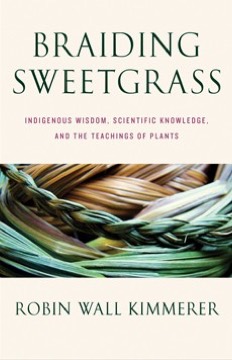
Braiding Sweetgrass
Robin Wall Kimmerer — a botanist and enrolled member of the Citizen Potawatomi Nation — braids scientific training, Indigenous knowledge and personal essay into an argument that the natural world should be approached as a relationship of reciprocity rather than a resource.
- First published
- 2013
- Publisher
- Milkweed Editions
- Pages
- 409
- Shelf
- Science
- Level
- Core
- ISBN-13
- 9781571313560
Record checked against
Catalogue note
- Reads as
- ReflectiveChanges how you see rather than what you do.
- Level
- Core / BuildingAssumes general familiarity with the subject.
- Approach
- Theoretical
- Written for
- Curious general readers, Readers with some grounding
Saved in this browser only — no account, nothing sent anywhere. My library
Read this if
- You want to understand a place, or what we are doing to one.
- You make things, and want to understand the work rather than wait for inspiration.
- You want a book that changes how you see things rather than what you do tomorrow.
- You know roughly how the subject works and want the fuller account.
The braid
The book's structure is its argument. Kimmerer weaves three strands — Potawatomi teaching and story, the methods and findings of plant ecology, and her own life as a mother, a teacher and a scientist — and insists that none of the three is subordinate to the others.
The claim underneath is epistemological: that Indigenous knowledge is a system of knowing with its own rigour, developed over long observation, and not folklore awaiting scientific validation.
Three strands, and the argument is that none of them is there to be validated by the others.
Devmark’s reading — not a quotation from the book
The grammar of animacy
The book's most quoted chapter concerns language. Kimmerer describes Potawatomi as a language in which a large proportion of words are verbs and in which the animate/inanimate distinction includes rocks, water and mountains among the animate.
Her argument is that English, by rendering almost everything non-human as *it*, makes objectification the default grammatical position — and that a language which requires you to name a bay as a state of being rather than a thing makes a different relationship available.
The Honourable Harvest
The set of principles she returns to most: ask permission; take only what you need; never take more than half; harvest in a way that minimises harm; use what you take; share it; give thanks; and give a gift in return.
Kimmerer presents this as a functioning protocol rather than a sentiment, and notes that several of its rules have straightforward ecological justification — the half rule in particular is a sustainable-yield constraint arrived at without the mathematics.
Sweetgrass, and reciprocity as an empirical claim
The book's central empirical case concerns sweetgrass itself, which Potawatomi teaching holds flourishes when harvested respectfully and declines when left alone.
Kimmerer describes a graduate student's experiment testing exactly this, and its finding that harvested plots did better than unharvested ones — a result the ecology of disturbance can account for. She uses it to argue that reciprocity is not only an ethic but sometimes a description of how a system works.
The gift economy
A recurring contrast between treating something as a commodity and treating it as a gift. A commodity creates no relationship and ends the transaction; a gift creates obligation and continues it.
Her argument is that framing a forest, a river or a fishery as property makes depletion rational, while framing it as a gift makes depletion a breach. This is the book's core political claim, and she is direct that it has consequences for how land is held.
Property makes depletion rational. A gift makes it a breach. The framing is doing the work.
Devmark’s reading — not a quotation from the book
The Windigo
The Anishinaabe figure of an insatiable being — the appetite that consumes and is never filled — used as an analytical frame for extraction economics and consumption.
Kimmerer's use of it is careful and non-decorative: she is arguing that the tradition already contains a diagnosis of exactly this failure mode, and that the story functions as a cultural constraint on behaviour rather than merely as a tale.
Science, and her position toward it
Kimmerer is a trained botanist and does not reject scientific method. Her critique is narrower: that the scientific worldview as usually taught requires treating the subject as object, and that this rules out relationship as a source of knowledge.
Her account of being told, as a student, that her question about why asters and goldenrod look beautiful together was not a scientific question is the book's clearest statement of what she thinks is being lost.
Where readers diverge
The book is long and unhurried, and readers wanting argument rather than essay sometimes find the pace difficult. The chapters are loosely connected and several could stand alone.
Some scientific readers object that the reciprocity claims are generalised beyond the cases that support them. Some Indigenous readers have noted that one nation's teaching is often received by a general audience as pan- Indigenous, which is a problem of reception more than of the book.
Why it found its audience
It was published in 2013 by a small press and became widely read years later, largely by word of mouth — an unusual trajectory that says something about what readers were looking for.
Its appeal is that it offers a stance rather than an alarm. Most environmental writing describes loss; this describes a relationship and what maintaining one would require, which is a more usable thing to be given.
What to take from it
The transferable core is a question rather than a programme: what would you do differently if you regarded what you take from as a giver rather than a supply?
The Honourable Harvest is also usable directly, and not only in relation to land. Ask permission, take less than you could, use what you take, and give something back is a workable ethic in a good many contexts that have nothing to do with plants.
What to take away
- 01Grammar shapes the relationshipA language where rocks and water are animate makes objectification a choice rather than the default.
- 02Reciprocity can be descriptiveThe sweetgrass case argues that respectful harvest sometimes produces better outcomes for the harvested.
- 03Gift and commodity are different framesOne creates continuing obligation; the other ends at the transaction — and depletion follows the second.
- 04Take no more than halfA sustainable-yield constraint arrived at through long observation rather than through mathematics.
- 05The tradition contains its own diagnosisThe Windigo names insatiable extraction as a failure mode and functions as a constraint on it.