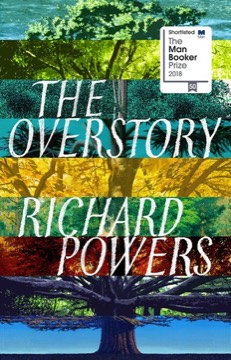
The Overstory
Richard Powers's Pulitzer-winning novel about nine people whose lives are shaped by trees, structured in four sections named for the parts of a tree.
- First published
- 2018
- Publisher
- Penguin Random House
- Pages
- 531
- Shelf
- Fiction
- Level
- Deep
- ISBN-13
- 9781473554481
Record checked against
Catalogue note
- Reads as
- ReflectiveChanges how you see rather than what you do.
- Level
- Advanced / AdvancedAssumes you have read around the subject already.
- Approach
- Theoretical
- Written for
- Readers of literature, Specialists and serious readers
Saved in this browser only — no account, nothing sent anywhere. My library
Read this if
- You read for the writing as much as for the argument.
- You want to understand a place, or what we are doing to one.
- You want a book that changes how you see things rather than what you do tomorrow.
- You have read around this already and want a book that assumes it.
The structure
Roots gives eight separate novellas, each introducing a character and the tree in their family history. Trunk brings several of them together around forest activism. Crown disperses them again. Seeds is the aftermath.
The form is the argument: the reader experiences the shift from human timescale to arboreal timescale structurally rather than being told about it.
The book's four sections are shaped like a tree, and the shape is the argument.
Devmark’s reading — not a quotation from the book
The science
Powers draws on real forestry research, particularly the work on mycorrhizal networks and inter-tree signalling associated with Suzanne Simard, who is a partial model for the character Patricia Westerford.
That science was contested when the book appeared and has been further debated since. The novel treats it as more settled than the literature does, which is worth knowing.
What it argues
That trees are agents rather than scenery, that human attention operates on a timescale too short to perceive them, and that the legal category of personhood is the pivot on which environmental protection turns.
The activism sections are the most contested: some readers find them the novel's moral centre, others find the characters subordinated to the argument.
Its weakest passages are the ones where characters exist to carry the thesis, and it has several.
Devmark’s reading — not a quotation from the book
Reading it
Long, ambitious and uneven. The eight opening novellas are the strongest writing, and several readers stop after them without regret.
It changed how many readers look at trees, which is a modest claim and probably the honest one.
Powers has said he wrote it after moving to the Great Smoky Mountains and encountering old-growth forest for the first time, and the sections written closest to that experience are the ones that work best.
Roots, trunk, crown, seeds
The novel's four sections are named for the parts of a tree, and the form follows. Roots is nine separate short stories; Trunk brings some of those lives together; Crown disperses them again; Seeds is aftermath. Readers who give up during the opening stories are stopping before the structure has declared itself.
The nine
Each opening story is effectively a novella — an immigrant family photographing one chestnut across generations, a scientist, a student after a near-death experience, a Vietnam veteran, a games designer, an artist, a couple. Powers gives each a complete arc before the book asks what they have in common.
Where the research has since been argued over
The forestry findings the novel dramatises — chemical signalling between trees, resource sharing through fungal networks, coordinated response to attack — come from real published work, some of it associated with a researcher whose career the book partly fictionalises. Several of those claims have since been contested by other scientists who argue the evidence has been overstated in popular retellings. The dispute is live, and it is worth carrying into the novel rather than discovering afterwards.
The research is real and named. Whether it supports everything built on it is now argued over.
Devmark’s reading — not a quotation from the book
Activism and its cost
The central section follows tree-sitting, sabotage and the point at which direct action becomes something people go to prison for. Powers does not romanticise it: the campaign fails, the trees come down, and the participants' lives are damaged in ways the novel follows for decades afterwards.
The problem it sets itself
Powers has said the difficulty was writing a novel in which trees are characters when the form is built around human timescales and human interest. The book's solution — long time, many lives, humans as the short-lived subplot — is why it feels unlike other novels and why some readers find it cold.
Where it is didactic
It argues openly and at length, and several characters exist substantially to deliver positions. The dialogue occasionally becomes lecture, and the moral distribution is not subtle. Readers who share the argument mind this much less than those who do not, which is a reasonable warning either way.
What to take away
- 01Four sections, tree-shapedRoots, trunk, crown, seeds — the structure carries the thesis.
- 02Eight opening novellasThe strongest writing in the book.
- 03Mycorrhizal networksReal research, treated as more settled than it is.
- 04Personhood as pivotLegal standing for non-humans as the practical argument.
- 05UnevenCharacters occasionally reduced to carrying the case.