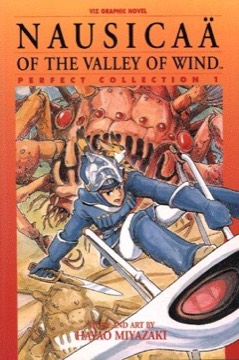
Nausicaä of the Valley of the Wind
Perfect Collection, Vol. 2
Hayao Miyazaki's manga, serialised from 1982 to 1994, set a thousand years after an industrial collapse, following a princess navigating between warring states and a toxic forest.
- First published
- 1982
- Publisher
- VIZ Media LLC
- Pages
- 287
- Shelf
- Anime
- Level
- Core
- ISBN-13
- 9781569310878
Record checked against
Catalogue note
- Reads as
- ReflectiveChanges how you see rather than what you do.
- Level
- Core / BuildingAssumes general familiarity with the subject.
- Approach
- Theoretical
- Written for
- Readers of comics, and anyone curious how the form works, Readers with some grounding
Saved in this browser only — no account, nothing sent anywhere. My library
Read this if
- You read for the writing as much as for the argument.
- You want to understand a place, or what we are doing to one.
- You want a book that changes how you see things rather than what you do tomorrow.
- You know roughly how the subject works and want the fuller account.
What it is
A thousand years after the civilisation that used industrial weapons destroyed itself, humanity survives in pockets at the edge of a spreading toxic jungle populated by enormous insects.
Nausicaä, princess of a small valley kingdom, has an unusual capacity to understand the forest and its creatures, and finds herself moving between two empires at war and a set of people who want to burn the jungle away.
Two empires at war, and the thing that will outlast both is a forest they both want destroyed.
Devmark’s reading — not a quotation from the book
The manga against the film
Miyazaki began the manga in 1982, made the film in 1984 from roughly its first two volumes, and then continued the manga for another decade.
The differences are substantial. The film ends in reconciliation; the manga goes considerably further, becomes far more politically complicated, and arrives at conclusions the film's structure could not support.
Ecology, reconsidered
The toxic jungle is not simply a wound. The series reveals a process by which the forest is purifying the earth, and the poison is a by-product of that work rather than its purpose.
Miyazaki refuses the simple version of his own premise. The forest is not benevolent, the insects are genuinely dangerous, and the humans burning it have defensible reasons.
War as the constant
Most of the series is occupied with a conflict between two empires, complete with logistics, betrayals, succession disputes and the treatment of small states as terrain.
Miyazaki is unusually good on this. The war is not a backdrop; it is conducted by people with coherent strategic reasoning, and the small kingdom is crushed between them in entirely predictable ways.
Nausicaä herself
She is compassionate, physically capable, and repeatedly complicit in violence she cannot prevent, and the series does not let her remain uncontaminated.
By the later volumes she has made decisions that are defensible and terrible, and the work's refusal to keep its protagonist clean is what separates it from the film.
The ending's argument
The final volumes uncover the origin of the forest and of the current human population, and present a choice about whether a designed future is preferable to an uncertain one.
Nausicaä's answer is contested among readers and was reportedly contested by Miyazaki himself. It is not a comfortable conclusion and it is not framed as obviously correct.
Density
The pages are extremely dense: small panels, heavy hatching, extensive dialogue and large casts, with battles rendered at a level of detail that requires slow reading.
It is not a quick book. Readers accustomed to the film's clarity frequently find the manga hard going for the first volume or two.
The art
Miyazaki drew it in pencil rather than ink, which gives the reproduction a soft grey quality unlike almost anything else in the medium.
The creature design — particularly the Ohmu — is among the most distinctive in manga, and the landscapes carry a sense of scale that his animation achieves with movement.
Religion and prophecy
A prophecy about a figure in blue robes runs through the series, and Nausicaä's relationship to it is deliberately ambiguous — she is used by people who believe it and does not obviously believe it herself.
Miyazaki treats faith seriously without endorsing it, and several manipulative uses of the prophecy are shown clearly for what they are.
Its place in his work
It is the most substantial thing Miyazaki made outside animation and is generally considered more complex than any of his films.
Readers who know him only through Studio Ghibli usually find it darker, angrier and much less resolved than they expect, particularly in its final third.
Editions
The English edition is available as a seven-volume set or a two-volume boxed hardcover, both printed right-to-left with the pencil art reproduced at reasonable size.
The larger format is worth seeking out. Much of the detail in the battle sequences is simply illegible at smaller reproduction.
Who it is for
Readers willing to work. It is long, dense, politically complicated and unwilling to resolve its own arguments.
Readers who want Miyazaki's warmth will find it here in places, and will also find mass death, ecological despair and a heroine who becomes implicated in both. It is the least consoling thing he made, and the distance from the films is the point rather than an accident.
What to take away
- 01The film is the first two volumesMiyazaki continued the manga for a decade after the 1984 film, and it arrives at conclusions the film could not support.
- 02The premise refused its easy versionThe forest is purifying the earth, the insects are genuinely lethal, and the people burning it have defensible reasons.
- 03A protagonist who becomes implicatedNausicaä is repeatedly complicit in violence she cannot prevent, and the work declines to keep her clean.
- 04War conducted competentlyThe empires have coherent strategy and logistics, and the small kingdom is crushed between them in predictable ways.
- 05Faith taken seriously, not endorsedA prophecy runs through the series and is shown being used manipulatively without the book dismissing belief itself.
- 06Drawn in pencilThe soft grey reproduction is unlike almost anything else in the medium and demands a larger format to read properly.