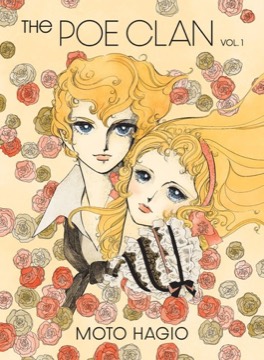
The Poe Clan
Moto Hagio's series, begun in 1972, following a family of vampires across several centuries in non-chronological fragments. Shōjo as experimental literature.
- First published
- 1972
- Publisher
- Fantagraphics
- Pages
- 512
- Shelf
- Anime
- Level
- Core
- ISBN-13
- 9781683962083
Record checked against
Catalogue note
- Reads as
- ReflectiveChanges how you see rather than what you do.
- Level
- Core / BuildingAssumes general familiarity with the subject.
- Approach
- Theoretical
- Written for
- Readers of comics, and anyone curious how the form works, Readers with some grounding
Saved in this browser only — no account, nothing sent anywhere. My library
Read this if
- You read for the writing as much as for the argument.
- You want to be kept up late, and made uneasy about who to believe.
- You want a book that changes how you see things rather than what you do tomorrow.
- You know roughly how the subject works and want the fuller account.
What it is
The Poe clan are vampires who live in a village that exists slightly outside ordinary time, and who must move on whenever their agelessness becomes noticeable. Edgar and Marybelle are two children brought into the clan and unable to grow up.
The series proceeds as disconnected episodes across roughly two centuries, told out of order.
Two children who cannot grow older, moving through two hundred years in the wrong sequence.
Devmark’s reading — not a quotation from the book
Non-chronological structure
Episodes jump between the eighteenth century and the twentieth without transition, and the reader assembles the chronology retrospectively.
This was formally radical for a girls' comic in 1972, and the fragmentation carries the theme directly: characters who cannot progress are described by a narrative that does not either.
Agelessness as tragedy
Edgar is permanently fourteen, and the series is precise about what that costs: no education completed, no relationship sustained, and a permanent inability to be taken seriously.
Vampirism here is not power. It is a condition that prevents anything from ever concluding. Hagio is also precise about the practical consequences: documents that cannot be renewed, friendships that must be abandoned, and a village that must periodically disappear.
The villages
The clan's settlements exist in a kind of temporal pocket, appearing and vanishing, and the imagery — roses, a walled garden, perpetual autumn — is among the most distinctive in the medium.
Hagio's landscapes are drawn with real attention, and the sense of a place that cannot be returned to is the series' governing atmosphere.
Marybelle
Edgar's sister is fragile, sheltered and brought into the clan against his better judgement, and her situation is the series' most direct source of grief.
The relationship between them is the emotional centre, and Hagio is careful that Edgar's protectiveness is also a form of confinement.
Literary ambition
The series draws on Gothic fiction, English poetry and European Romanticism directly, and expects its readers to follow the references.
Hagio was writing for teenage girls and assumed they could handle it, which was itself a significant editorial position at the time. The title itself is a reference, and several episodes take their structure from poems rather than from conventional narrative shapes.
The art
Fine, decorative linework with elaborate period costume, and page layouts that dissolve into overlapping images during emotional passages.
The style established much of what shōjo manga still looks like, and the period detail is handled with unusual care for a serialised comic of the 1970s.
Its place in history
Alongside The Heart of Thomas, this is the work that established Hagio's reputation and demonstrated the category's range.
It was enormously influential on subsequent vampire fiction in Japan, and the melancholy, beautiful, permanently adolescent vampire descends substantially from Edgar. It was serialised in a magazine for young girls, which makes the formal ambition more remarkable rather than less, and its commercial success helped establish that such work could sell.
Difficulty
The non-linear structure, the large cast and the fragmentary episodes make it considerably harder to follow than most manga of any period.
Readers frequently need a second pass to assemble the chronology, and the work is more rewarding for it than a linear version would have been.
The continuation
Hagio returned to the series decades later with new material, which is unusual and which readers have received with some ambivalence.
The original run is the work that matters historically, and the later volumes are best approached as a separate undertaking. The gap between the original run and the continuation is longer than most careers, and the later work is inevitably a different artist writing about the same characters.
The English edition
Fantagraphics has published it in hardcover volumes with contextual material, following their edition of The Heart of Thomas.
It took more than forty years to reach English, which is itself a comment on how slowly the medium's literary history has been translated. The volumes include Hagio's own commentary, which is useful given how much of the original context is unavailable to an English reader approaching it fifty years later.
Who it is for
Readers interested in formal experiment, in the history of shōjo, or in Gothic fiction generally.
It is beautiful, difficult and sad, and it asks considerably more of a reader than most of what surrounds it in this section. Readers new to Hagio may find The Heart of Thomas the easier entry.
What to take away
- 01Form matching conditionA narrative that refuses chronological progression describes characters who cannot progress either.
- 02Vampirism as preventionAgelessness costs Edgar every completed education and every sustained relationship; it is a condition, not a power.
- 03Protection as confinementEdgar's care for his sister is also what traps her, and the series does not let him off that.
- 04References the reader must followGothic fiction and English Romanticism are used directly, on the assumption that teenage girls could handle them.
- 05The melancholy vampire's originThe beautiful, permanently adolescent, sorrowful vampire in Japanese fiction descends substantially from Edgar.
- 06Forty years to translationIts late arrival in English is itself a comment on how slowly the medium's literary history has been made available.