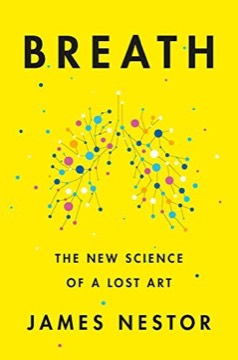
Breath
James Nestor's investigation into how humans breathe, why so many do it badly, and what the research on nasal breathing, pace and carbon dioxide tolerance actually supports.
- First published
- 2020
- Publisher
- PENGUIN LIFE
- Pages
- 334
- Shelf
- Science
- Level
- Entry
- ISBN-13
- 9780241289099
Record checked against
Catalogue note
- Reads as
- PracticalWritten to be applied, not only understood.
- Level
- Accessible / FoundationalNo prior reading assumed.
- Approach
- Practical
- Written for
- Curious general readers, Newcomers to the subject
Saved in this browser only — no account, nothing sent anywhere. My library
Read this if
- You want to understand living things by how they came to be.
- You want to know how we know things, and how that goes wrong.
- You want something to apply, not only something to think about.
- You are starting from scratch here and want a way in that assumes no prior reading.
The premise
Nestor, a journalist, begins with a Stanford experiment in which he and a colleague had their noses plugged for ten days and their physiology monitored, then breathed only nasally for ten more.
Around that he builds a history of breathing research — the anatomical shrinkage of the human face, the pulmonology of slow breathing, and the fringe traditions that arrived at similar conclusions centuries earlier.
The book's spine is a self-experiment: ten days of mouth breathing, ten of nasal, measured.
Devmark’s reading — not a quotation from the book
The claims
The best-supported threads are that nasal breathing filters, humidifies and produces nitric oxide; that slower breathing around five to six breaths a minute affects heart rate variability and the autonomic system; and that carbon dioxide tolerance, not oxygen, governs the urge to breathe.
The mouth-breathing experiment produced real measured deterioration, which is the most concrete evidence in the book.
Where to be careful
Nestor moves between peer-reviewed physiology and much weaker material — historical anatomy arguments and some practitioner claims — in the same confident register, and the book does not always signal which is which.
Read the physiology as well established and the wider historical thesis about facial development and modern diet as interesting and contested.
The register is uniform; the evidence underneath it is not, and the book does not flag the seam.
Devmark’s reading — not a quotation from the book
The practical residue
Stripped of the historical argument, the actionable content is short: breathe through the nose including while asleep, slow the rate deliberately during stress, and exhale for longer than you inhale.
None of that is novel and none of it requires the book's wider thesis to be correct. It is, however, free, reversible and supported by the physiology chapters, which is a better position than most health advice occupies.
The experiment he ran on himself
The book's spine is a self-experiment: ten days with the nose blocked, forcing pure mouth breathing, under measurement at a university lab, followed by ten days of nasal breathing with the same instruments running. The reported deterioration — blood pressure, sleep quality, snoring and apnoea events — is the strongest single thing Nestor has, and he is appropriately clear that it is two subjects.
The pulmonauts
A parallel history runs through the book: the breathing coaches, clinicians and enthusiasts who worked outside institutional research for most of the twentieth century. Nestor is interested in them partly as characters and partly because their claims are now being partially recovered by physiologists, which is the pattern he wants — marginal practice, later vindicated in part.
The rate that keeps reappearing
The most reproducible finding he reports is about pace rather than route: slowing to roughly five and a half breaths a minute, with equal in and out, puts heart rate variability and blood pressure into a favourable pattern, and the same approximate rhythm turns up independently in prayer and chant traditions across cultures. This is the part of the book with the firmest physiological support.
Carbon dioxide
Nestor's most counter-intuitive chapter argues that the urge to breathe is driven by carbon dioxide accumulation rather than oxygen shortage, and that chronic over-breathing lowers tolerance for it, producing breathlessness at rest. The underlying respiratory physiology is standard; the therapeutic claims built on top of it, drawn from a mid-century Soviet method, are much weaker and he does not always separate the two.
The jaw argument
The most contested material is the claim that modern faces are narrower than historical ones because of soft diets and mouth breathing, and that adult palatal expansion can partially reverse it. Some of this draws on a school of orthodontics that mainstream dentistry rejects, and one of its principal figures has faced professional sanction. Treat this section as an interesting hypothesis being asserted as settled.
The physiology chapters and the orthodontics chapters are not equally supported, and the book reads as though they were.
Devmark’s reading — not a quotation from the book
Where the evidence thins
The pattern to watch is a well-evidenced mechanism used as a springboard to a much larger claim, with the transition unmarked. Nasal nitric oxide is real; "breathing cures disease" is not what the literature says. The historical and anthropological material is the weakest and the personal experiment, though genuinely interesting, is not a trial.
What to take from it
The actionable residue is small, safe and reasonably supported: breathe through the nose, including while asleep if you can manage it, and slow down deliberately when you want to settle. That is worth having, and it does not require accepting the book's larger historical thesis.
What to take away
- 01Nose over mouthFiltration, humidification and nitric oxide give nasal breathing measurable advantages.
- 02Slow is the variableAround five to six breaths a minute shows consistent autonomic effects.
- 03Carbon dioxide drives the urgeThe need to breathe tracks CO2, not oxygen depletion.
- 04A measured self-experimentTen days of forced mouth breathing produced real documented decline.
- 05Uneven evidenceStrong physiology and weak history share the same confident tone.