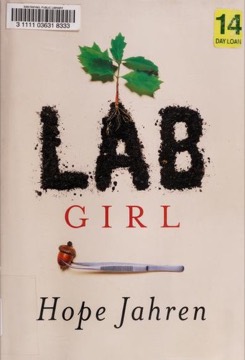
Lab Girl
Hope Jahren's memoir of becoming a geobiologist: the science of trees and seeds interleaved with an account of building three laboratories, chronic funding insecurity, and a twenty-year working partnership.
- First published
- 2016
- Publisher
- Little, Brown Book Group Limited
- Pages
- 316
- Shelf
- Science
- Level
- Entry
- ISBN-13
- 9781432840846
Record checked against
Catalogue note
- Reads as
- ReflectiveChanges how you see rather than what you do.
- Level
- Accessible / FoundationalNo prior reading assumed.
- Approach
- Theoretical
- Written for
- Curious general readers, Newcomers to the subject
Saved in this browser only — no account, nothing sent anywhere. My library
Read this if
- You want a life told honestly, at full length.
- You want to understand living things by how they came to be.
- You want to know how we know things, and how that goes wrong.
- You want a book that changes how you see things rather than what you do tomorrow.
- You are starting from scratch here and want a way in that assumes no prior reading.
What it is
Alternating chapters: one on plant biology — what a seed is doing while it waits, how a tree decides to leaf out, what roots are actually solving — and one on Jahren's life, from her father's community college laboratory in Minnesota to her own labs in Georgia, Baltimore and Hawaii.
The two strands are not decorative parallels. The plant chapters set up the human ones by supplying the metaphor before the event.
The plant chapters arrive first and quietly explain the human chapters that follow them.
Devmark’s reading — not a quotation from the book
What it shows about science
It is one of the most honest accounts available of scientific work as labour: writing grants, losing grants, the physical building of equipment, the years between an idea and a publishable result.
Her partnership with Bill, her lab manager across two decades, is the book's central relationship and is unlike anything else in the genre.
Themes
Jahren writes directly about being a woman in field science, about her bipolar disorder and about a pregnancy during which she was barred from her own laboratory. None of it is framed as inspirational.
The prose is the reason the book is read outside science. She writes about plants with real precision and no condescension, and the science is not diluted to make room for the memoir.
The science is not thinned to make space for the life, which is the hard part of this form.
Devmark’s reading — not a quotation from the book
The two kinds of chapter
The book alternates between plant biology and autobiography, and the pairing is argumentative rather than decorative: a chapter on what a seed does while waiting sits beside a chapter about waiting for a grant. The parallels are never spelled out, which is what keeps them from becoming twee.
Money
Among the most valuable material for anyone outside science is the account of funding: the proportion of a researcher's life spent writing applications, the rejection rates, the improvisation of equipment, and the years of insecure employment that precede stability. Jahren is specific about amounts and odds, which is rare.
Most of what a scientist does is apply for permission to do the thing they were trained for.
Devmark’s reading — not a quotation from the book
Bill
Her long working partnership with her lab manager is the book's emotional centre and is unusual in scientific memoir: a relationship that is not romantic, not familial and not straightforwardly professional, sustained over decades of poverty, fieldwork and moves. The portrait is affectionate and does not soften his difficulties or her own.
Fieldwork
The travel sections — driving across the continent, sampling in Ireland, working at latitude — convey what data collection actually involves: tedium, discomfort, improvised repairs, and long stretches in which nothing usable is obtained. It is the corrective to the popular image of science as a sequence of insights.
Being a woman in the field
Jahren writes directly about hostility, condescension and physical risk, and about the particular difficulty of being the only woman on a remote site. She declines to make this the subject of the book while refusing to leave it out, which is a difficult balance and one she holds.
Her own mind
She writes candidly about bipolar disorder, including an episode during pregnancy and the medication decisions around it. The account is unsparing and placed without apology in a book about a working career, which is part of its argument about who does science and under what conditions.
What to take from it
Read it for the plants, which are genuinely fascinating and explained by someone who studies them, and for the most honest available portrait of scientific work as a life rather than as a set of results. It is also very well written, which is not a given in either genre it belongs to.
What to take away
- 01Alternating strandsPlant biology chapters set up the autobiographical ones.
- 02Science as labourGrants, equipment, failure and the years between idea and result.
- 03A twenty-year partnershipHer work with Bill is the book's central relationship.
- 04Not inspirationalIllness, sexism and exclusion are reported rather than redeemed.
- 05Undiluted scienceThe botany keeps its precision alongside the memoir.