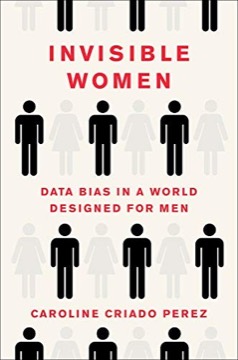
Invisible Women
Caroline Criado Perez's account of the gender data gap: the systematic absence of women from the datasets used to design products, cities, medicine and policy, and the measurable harm that follows.
- First published
- 2019
- Publisher
- Chatto & Windus
- Pages
- 432
- Shelf
- Science
- Level
- Core
- ISBN-13
- 9787513349611
Record checked against
Catalogue note
- Reads as
- ConceptualExplains how something works before what to do about it.
- Level
- Core / BuildingAssumes general familiarity with the subject.
- Approach
- Theoretical
- Written for
- Curious general readers, Readers with some grounding
- Ideas
Saved in this browser only — no account, nothing sent anywhere. My library
Read this if
- You want to think about how gender shapes a life, including your own.
- You want to understand how it works before deciding what to do about it.
- You know roughly how the subject works and want the fuller account.
The core argument
Criado Perez's claim is not that designers intend harm but that the default human in most data is male, and that treating male bodies and male patterns of life as the norm produces predictable failures.
The book is a catalogue of them, heavily cited: car safety tests using dummies based on male anthropometry, protective equipment sized for men, snow-clearing schedules that prioritise roads over pavements, drug trials that under-recruit women.
The argument is not conspiracy. It is a default nobody examined, repeated at scale.
Devmark’s reading — not a quotation from the book
The strongest evidence
The medical chapters are the most consequential: differing presentation of heart attacks, under-representation in trials, and dosages derived from male physiology. These are areas where the data gap has a body count.
The urban planning and transport sections are the most surprising, largely because unpaid care work — which is overwhelmingly done by women — is invisible in the travel data that planning relies on.
How to read it
It is an argument built on citation rather than a balanced survey, and it is relentless by design. Some individual studies it cites have been contested, as is normal for a book covering this much ground.
The central structural claim — that unexamined male defaults are embedded in data infrastructure — is well supported and is the thing to take from it.
Read it for the structural claim, and expect individual studies to be argued over.
Devmark’s reading — not a quotation from the book
The crash test
The most cited finding is about car safety: restraint systems and test protocols developed around a male-sized dummy, with female occupants at materially higher risk of certain serious injuries in comparable collisions. It is the book's emblematic case because the mechanism is so mundane — nobody decided women should be less safe; a default was chosen once and then became the standard.
Snow, buses and trip-chaining
The urban-planning chapters turn on the observation that women's journeys tend to be multi-stop and off-peak — school, shop, care visit, work — while transport systems are optimised for a single commute. The Swedish town that re-sequenced its snow clearing after noticing that pedestrian injuries outnumbered vehicle ones is the book's best example of a cheap fix that followed directly from asking who was being measured.
Standards built around one body
Office temperature formulas derived decades ago from the metabolic rate of an average man, protective equipment sized down from male patterns rather than designed, tools and instruments shaped for larger hands: Criado Perez's point is that these are not separate oversights but the same act repeated wherever a standard had to be set and one body was available as the reference.
Nobody chose to exclude anyone. Somebody chose a default, once, and it became the standard.
Devmark’s reading — not a quotation from the book
How women left clinical trials
The medical chapters have the highest stakes. Regulatory caution after a mid-century drug disaster hardened into the routine exclusion of women of childbearing age from trials, a policy that lasted for decades, and the resulting evidence base was then applied to everyone. Dose adjustments issued long afterwards for drugs metabolised differently by women are the clearest illustration of the cost.
The work that is not counted
A long thread covers unpaid care, which is performed disproportionately by women and excluded from the headline measures of economic activity. Her argument is that what a statistical system omits is not neutral: policy is made against the numbers that exist, so unmeasured work is unfunded work and its absence compounds through pensions, tax and employment design.
Where it is contested
It is a polemic and reads like one. It argues cumulatively rather than weighing counter-evidence, several figures are drawn at second hand from sources that state them more cautiously, and a few individual claims have been challenged on their framing. The pattern it documents is well supported; the strength of particular numbers varies more than the prose suggests.
What to take from it
The transferable habit is a single question applied to any dataset, specification or default: who is the reference case here, and who was in the sample that produced it. That question does not require accepting every statistic in the book, and it is the thing readers report still using afterwards.
What to take away
- 01The default humanMost data treats a male body and a male day as the norm.
- 02Medicine's body countTrial under-recruitment and male-derived dosages have measurable consequences.
- 03Unpaid care is invisibleTravel and planning data misses the trips that care work generates.
- 04Not intent, but defaultThe mechanism is an unexamined assumption repeated at scale.
- 05Relentless by designIt is an argument, not a survey, and should be read as one.