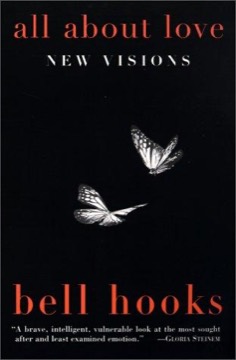
All About Love
bell hooks's argument that love is not a feeling but a practice, and that most of what English-speaking culture calls love is something else. Short, direct, and deliberately unacademic.
- First published
- 1999
- Publisher
- Editorial Planeta, S. A.
- Pages
- 239
- Shelf
- Love
- Level
- Core
- ISBN-13
- 9786075692302
Record checked against
Catalogue note
- Reads as
- ReflectiveChanges how you see rather than what you do.
- Level
- Core / BuildingAssumes general familiarity with the subject.
- Approach
- Theoretical
- Written for
- Anyone thinking about how people attach, Readers with some grounding
Saved in this browser only — no account, nothing sent anywhere. My library
Read this if
- You want to think harder about what is actually right.
- You make things, and want to understand the work rather than wait for inspiration.
- You want a book that changes how you see things rather than what you do tomorrow.
- You know roughly how the subject works and want the fuller account.
The core claim
hooks takes a definition from M. Scott Peck — love as the will to extend oneself for another's spiritual growth — and treats it as a test. On that definition love is something you do, and something that can be done badly or not at all, rather than a state you fall into.
The consequence she draws is blunt: where there is abuse, there is not love. The book spends much of its length on what follows from refusing to call domination affection.
If love is an action, then it can be learned, taught, and withheld — and nobody is simply bad at it.
Devmark’s reading — not a quotation from the book
The argument
hooks locates the confusion in childhood. Many people are first taught that love and punishment arrive together, and carry that arrangement into adulthood as a definition rather than an injury.
From there she works outward through romantic partnership, friendship, community and what she calls a culture of lovelessness — a society organised around competition and acquisition that then wonders why its members are isolated.
Style, and the objection to it
This is not a scholarly book. hooks wrote it for a general reader, in short chapters, with little citation, and that was a decision rather than an oversight: her position was that theory which cannot reach people is not doing its work.
Readers who come expecting argument in the academic sense are often frustrated, and the criticism that it asserts more than it demonstrates is reasonable. It is better read as a sustained ethical proposal than as a piece of evidence.
Its plainness is a choice about audience, and it is the reason the book has lasted.
Devmark’s reading — not a quotation from the book
A definition, insisted upon
hooks takes a working definition from another writer — love as the will to extend oneself for another's spiritual growth — and treats it as a test rather than a sentiment. Her point is that love in this sense is an action and therefore a choice, which makes the common defence that someone loved you and hurt you anyway unavailable.
If love is something you do rather than something you feel, then it cannot also be an excuse.
Devmark’s reading — not a quotation from the book
Abuse and love cannot coexist
The most confronting chapter argues that harming someone is incompatible with loving them, and that the phrase used to explain away a violent parent teaches children that love includes being hurt. She is uncompromising about this and declines the softer position that people love imperfectly.
Honesty
She treats lying — including the small social lies and the withholding that sustains most relationships — as the ordinary mechanism by which intimacy fails, and argues that a culture which trains men in particular to conceal their inner lives makes love structurally difficult for them.
Love as political
hooks connects private relationships to patriarchy, racism and consumer culture directly and without apology, arguing that a society organised around domination and acquisition cannot reliably produce loving relationships as a private exception inside it. The book is a work of cultural criticism wearing the jacket of a self-help title, and readers who bought it for the latter are frequently surprised by how political it becomes.
On community and friendship
A substantial section argues against the modern concentration of all love into the romantic couple, and makes the case for friendship, communal ties, mentorship and love of strangers as equally serious and equally demanding forms. It is the part of the book readers most often report as having changed how they think about their own arrangements, particularly those not in a couple at all.
Writing after loss
The book was written after the end of a long relationship and during a sustained period of grief, and hooks says so directly in the opening pages rather than leaving it to be inferred. The personal register — first person, unhedged, occasionally raw, willing to describe her own failures — is a deliberate departure from the academic voice of her earlier criticism, and it is what makes this the book of hers most people have read.
The objection
It asserts more than it demonstrates. There is no research apparatus, the claims about men and about American culture are broad, and the spiritual vocabulary will lose some readers entirely. Taken as philosophy rather than as evidence, the argument holds; taken as a study, it does not.
What to take away
- 01Love as a verbThe definition is an action, which makes love assessable rather than mysterious.
- 02Abuse is not lovehooks refuses the category that lets domination be described as affection.
- 03Taught earlyMany people learn in childhood that love and punishment belong together.
- 04Beyond the coupleFriendship and community get equal weight; the romantic pair is not the summit.
- 05Deliberately plainThe lack of apparatus is a decision about who the book is for.