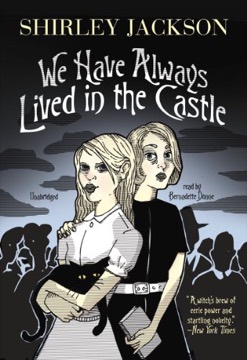
We Have Always Lived in the Castle
Shirley Jackson's last novel, narrated by eighteen-year-old Merricat Blackwood, who lives with her sister and uncle in a house the village hates. A small, strange, very controlled book about being the family everyone has decided about.
- First published
- 1962
- Publisher
- Pages
- 187
- Shelf
- Mystery
- Level
- Core
- ISBN-13
- 9781441734266
Record checked against
Catalogue note
- Reads as
- ReflectiveChanges how you see rather than what you do.
- Level
- Core / BuildingAssumes general familiarity with the subject.
- Approach
- Theoretical
- Written for
- Readers who want to be kept up late, Readers with some grounding
- Ideas
Saved in this browser only — no account, nothing sent anywhere. My library
Read this if
- You want to be kept up late, and made uneasy about who to believe.
- You want a book that changes how you see things rather than what you do tomorrow.
- You know roughly how the subject works and want the fuller account.
The premise
Six years ago most of the Blackwood family died at dinner. The three who remain — Merricat, her older sister Constance, and their disabled uncle Julian — live on in the house, almost entirely apart from the village that is certain it knows what happened.
Merricat narrates. She is eighteen, she buries objects and nails books to trees as protective magic, and she maintains an elaborate private system for keeping the household safe. Then a cousin arrives who wants to be let in.
Merricat is not an unreliable narrator so much as a narrator operating on entirely different rules.
Devmark’s reading — not a quotation from the book
How it is built
The voice carries the whole book. Merricat's sentences are calm, precise and childlike, and they describe hostility, ritual and household routine in exactly the same register. That flatness is what makes the novel unsettling rather than sad.
It is very short and almost without plot for long stretches. Jackson spends her pages on the daily order of the house, so that when the order is threatened the reader feels it as damage rather than as incident.
Themes
The cruelty here is the village's. The children's rhyme, the shopkeepers, the eventual crowd — Jackson is writing about a community that has agreed on a story and enjoys it, which is the same subject as her story The Lottery, at novel length.
Against that, the house is a refuge that is also a cage, and the book is genuinely ambivalent about whether the sisters' withdrawal is a tragedy or a solution. It ends without telling you.
Agoraphobia, in this book, is a reasonable response to the neighbours.
Devmark’s reading — not a quotation from the book
The opening paragraph
Merricat introduces herself, her age, her sister, her preferences and her regret at not having been born a werewolf, all in a few sentences delivered with complete composure. The reader is inside an unusual mind before any plot arrives, and the calm is what makes everything that follows unsettling rather than lurid.
She tells you what she likes and dislikes, quite calmly, and one of the items is not normal.
Devmark’s reading — not a quotation from the book
Sympathetic magic
Merricat protects the house by burying objects, nailing a book to a tree and reserving words that must not be spoken. Jackson never treats this as delusion to be corrected or as magic that works; it is simply how Merricat operates, and the reader is left to decide what the rules are actually doing.
Uncle Julian
The surviving uncle spends his days assembling and reassembling an account of the day the family died, obsessively, with notes he cannot finish. He is the book's only attempt at the truth, and he is unreliable, confused and frequently ignored — which is Jackson's comment on how such an account actually survives.
Charles
The cousin who arrives is the intruder the household has no defence against, because he is entirely ordinary: acquisitive, plausible, interested in the safe. Jackson makes him the closest thing to a villain while giving him no supernatural quality at all, and his reasonable adult manner is what makes him dangerous to the arrangement.
The village
The genuine cruelty in the book belongs to the people in the town: the rhyme children sing, the shopkeepers' hostility, and the eventual collective violence. Jackson, who was treated badly in her own small town, writes communal malice with a precision she does not extend to anything ghostly.
There is nothing supernatural in this book that is half as frightening as the neighbours.
Devmark’s reading — not a quotation from the book
Agoraphobia, written from inside
Jackson was in severe decline when she wrote it and barely able to leave her house. The novel's final arrangement — a shrinking, fortified existence that its occupants experience as happiness rather than as defeat — reads very differently with that knowledge, and she was explicit that the book was close to her.
What to take from it
It is short, very funny in places, and considerably stranger than its reputation as a gothic novel suggests. Read it for the voice, which sustains the whole thing, and for the gradual realisation that the narrator's account is complete and accurate and still not what an ordinary person would have told you.
What to take away
- 01A voice that will not flinchMerricat reports affection and menace in the same untroubled tone.
- 02The village as antagonistThe horror is collective and ordinary: people who have settled on a story and like it.
- 03Ritual as safetyMerricat's magic is a system for controlling a world that has already proved dangerous.
- 04Refuge and cageThe house protects the sisters and shrinks them, and the novel refuses to choose.
- 05Very short, very controlledAlmost nothing happens for long stretches, which is what makes the disruptions land.