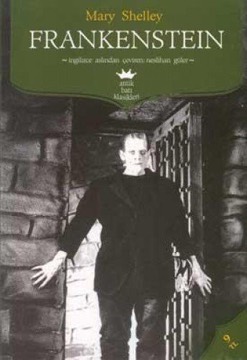
Frankenstein
Mary Shelley's 1818 novel, begun at eighteen during a wet summer on Lake Geneva, about a student who assembles a living creature and abandons it. Generally taken as the first science fiction novel.
- First published
- 1818
- Publisher
- Bobbs-Merrill
- Pages
- 240
- Shelf
- Mystery
- Level
- Core
- ISBN-13
- 9781982146160
Record checked against
Catalogue note
- Reads as
- ReflectiveChanges how you see rather than what you do.
- Level
- Core / BuildingAssumes general familiarity with the subject.
- Approach
- Theoretical
- Written for
- Readers who want to be kept up late, Readers with some grounding
Saved in this browser only — no account, nothing sent anywhere. My library
Read this if
- You want to be kept up late, and made uneasy about who to believe.
- You want a thought experiment you can live inside for a while.
- You want a book that changes how you see things rather than what you do tomorrow.
- You know roughly how the subject works and want the fuller account.
The premise
Victor Frankenstein, a student at Ingolstadt, discovers how to animate dead matter and builds a being from assembled parts. When it opens its eyes he flees the room and leaves it to work out existence alone.
The creature teaches itself language by observing a family through a wall, reads Paradise Lost and Plutarch, and comes looking for its maker with a request rather than a threat.
The creature's crime is asking to be answered for, and the novel is clear whose failure that is.
Devmark’s reading — not a quotation from the book
How it is built
Three nested narrators: Walton's letters from the Arctic enclose Victor's account, which encloses the creature's. The reader reaches the creature's voice only through two men who have reason to frame it.
That structure is the book's most sophisticated feature. The being everyone calls a monster is the most articulate and most reasonable speaker in the novel, and you hear it last and at two removes.
What it is about
Not science overreaching, which is the film version. Shelley's charge is abandonment: Victor's failure is not making the creature but refusing responsibility for it the moment it exists.
The book is also saturated with her own circumstances — a mother who died giving birth to her, her own lost infant, and an intellectual milieu that treated human perfectibility as an open question.
The failure is not the creation. It is the twenty minutes afterwards, when he leaves.
Devmark’s reading — not a quotation from the book
Two versions
The 1818 text and Shelley's revised 1831 edition differ substantially: the later one softens Victor's culpability and adds a more deterministic frame.
Editions vary in which they print. The 1818 is the more radical and the one most scholars now prefer.
The Norton and Oxford critical editions both print the 1818 text with the 1831 variants recorded, which is the arrangement worth seeking out if you want to see what she changed and why.
The creature's education
The novel's centre is the creature hiding by a cottage, watching a family and teaching himself language from their lessons. He then finds three books and forms his understanding of the world from them, including a poem about a creator and an abandoned creation. His eloquence is the point: he argues his case better than Victor does, and the reader is required to hear him.
He is the most articulate character in the book, and that is the argument.
Devmark’s reading — not a quotation from the book
Why the Arctic frame exists
The story reaches us through a sea captain's letters to his sister, enclosing Victor's account, which encloses the creature's. The outermost narrator is himself pursuing a dangerous ambition at others' expense, which means Victor's story arrives as a warning delivered to someone in a position to take it — and the book's final judgement is left with a listener rather than announced.
The request and the refusal
The hinge of the plot is the creature's demand for a companion and Victor's decision, mid-construction, to destroy her. His stated reason is fear of what the pair might produce, which is the first moment he considers consequences at all. Everything catastrophic that follows is a response to a promise made and broken.
Who actually dies
The creature kills almost nobody directly at first; the early deaths are collateral. A child, then a servant tried and executed for that child's murder on planted evidence while Victor stays silent to protect his reputation. The novel is quietly insistent that Victor's cowardice does more damage than the creature's violence.
The science of 1816
Shelley's introduction places the idea in conversations about galvanism and the possibility of reanimating matter by electricity, then declines to explain the method. The refusal is deliberate — the book has no interest in how it was done, only in what was owed afterwards, which is why reading it as a story about science overreaching misses its subject.
Whose hand is in the manuscript
The surviving drafts show Percy Shelley making substantial edits to his wife's text, and scholars disagree about whether these improved it or formalised a plainer, better voice. The debate is worth knowing because it has periodically been used to question her authorship, which the manuscripts do not support.
What to take away
- 01Three nested narratorsWalton frames Victor, who frames the creature.
- 02Abandonment, not hubrisThe moral failure is refusing responsibility, not creating life.
- 03The creature readsSelf-taught from Paradise Lost, and the novel's best reasoner.
- 04Written at eighteenBegun during the 1816 Geneva summer, published at twenty.
- 051818 versus 1831Shelley's revision softens Victor; the earlier text is sharper.