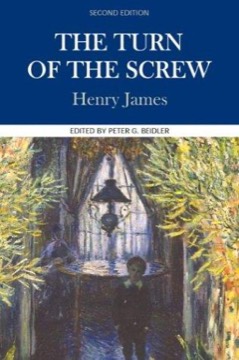
The Turn of the Screw
Henry James's 1898 novella about a governess who becomes convinced that two children in her care are in communication with the dead. The most argued-over ghost story in English.
- First published
- 1898
- Publisher
- Tribeca Books
- Pages
- 160
- Shelf
- Mystery
- Level
- Core
- ISBN-13
- 9798549501805
Record checked against
Catalogue note
- Reads as
- ReflectiveChanges how you see rather than what you do.
- Level
- Core / BuildingAssumes general familiarity with the subject.
- Approach
- Theoretical
- Written for
- Readers who want to be kept up late, Readers with some grounding
- Ideas
Saved in this browser only — no account, nothing sent anywhere. My library
Read this if
- You want to be kept up late, and made uneasy about who to believe.
- You want a book that changes how you see things rather than what you do tomorrow.
- You know roughly how the subject works and want the fuller account.
The premise
A young governess takes sole charge of two children at a remote country house, under an employer's instruction never to contact him about anything. She comes to believe that two former servants, both dead, are appearing to the children.
The story is framed as a manuscript read aloud at a Christmas gathering, which puts two layers between the reader and the events.
An employer forbids her to ever report anything, and then everything happens.
Devmark’s reading — not a quotation from the book
The argument
The novella sustains two complete readings. Either the ghosts are real and the governess is protecting the children, or she is having a breakdown and the harm is hers. Every detail can be assigned to either.
Edmund Wilson's 1934 essay made the psychological reading famous; the debate has continued since without resolution, because James constructed the text so that it cannot be settled.
Both readings account for every detail, which is a construction rather than an ambiguity.
Devmark’s reading — not a quotation from the book
How he does it
The governess narrates, and every apparition is described only by her. The children's behaviour is reported through her interpretation of it. Mrs Grose, the housekeeper, confirms things only after being led.
James's prose is famously convoluted here, and the syntax is part of the method: sentences that defer their meaning enact a mind that cannot quite arrive at what it thinks.
Reading it
Short — a long evening — and best read without a critical introduction, which will usually spoil the balance by advocating one reading.
Britten's opera and several films exist; most resolve the ambiguity, which is precisely what the text refuses to do.
James described it in his notebooks as a potboiler written for money, which is either false modesty or the most successful accident in English fiction, and scholars have never fully agreed which.
A frame that never closes
The story is introduced at a Christmas gathering by a man who produces a dead woman's manuscript and reads it aloud. That outer frame is never returned to: the novella simply stops inside the governess's account. Readers who expect the listeners to comment at the end, resolving what they made of it, are being deliberately abandoned.
The frame opens and is never closed. Nobody comes back to tell you what to think.
Devmark’s reading — not a quotation from the book
Mrs Grose is the test
The housekeeper cannot read, has never seen the apparitions, and knows the household's history the governess does not. Every identification depends on the governess describing a figure and Mrs Grose supplying a name — which is either corroboration or suggestion, and James arranges each exchange so that it can be read confidently as both.
What the boy did
Miles has been expelled from school and the reason is never disclosed. The absence is structural: it gives the governess a blank into which she can read corruption, and it gives the reader the same blank. Any interpretation of the book requires filling it, and the text supplies nothing to fill it with.
Two appearances
The apparitions are seen at a distance and from a fixed position — a figure on a tower, a figure across a lake — and always by one person. James withholds the ordinary confirmations a ghost story supplies: nobody touches anything, nothing is moved, and no second witness ever independently describes what the governess describes.
The reading that started an industry
A twentieth-century critic's argument that the ghosts are hallucinations produced by the governess's repressed desire turned the novella into one of the most contested texts in English, generating a century of scholarship. The argument is not obviously right, and the book's achievement is that it cannot be settled from the text.
James on his own book
He described it dismissively as a piece of entertainment and a deliberate trap for readers who wanted certainty, and declined to adjudicate. Given how carefully the ambiguity is engineered — no detail escapes it — the modesty should be read as a refusal to answer rather than as a lack of intent.
What to take away
- 01Two complete readingsReal ghosts or a breakdown; both fit every detail.
- 02A single filtered witnessEverything uncanny is described only by the governess.
- 03Syntax as methodSentences that defer meaning enact a mind that cannot settle.
- 04Double frameA manuscript read aloud, at two removes from the reader.
- 05Read it unintroducedMost critical prefaces destroy the balance by picking a side.