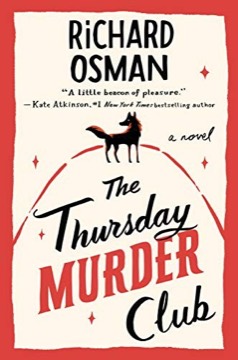
The Thursday Murder Club
Richard Osman's cosy mystery about four residents of a Kent retirement village who meet weekly to review cold cases, and then acquire a live one.
- First published
- 2020
- Publisher
- Penguin Publishing Group
- Pages
- 382
- Shelf
- Mystery
- Level
- Entry
- ISBN-13
- 9781984880963
Record checked against
Catalogue note
- Reads as
- ReflectiveChanges how you see rather than what you do.
- Level
- Accessible / FoundationalNo prior reading assumed.
- Approach
- Theoretical
- Written for
- Readers who want to be kept up late, Newcomers to the subject
Saved in this browser only — no account, nothing sent anywhere. My library
Read this if
- You read for the writing as much as for the argument.
- You want a book that changes how you see things rather than what you do tomorrow.
- You are starting from scratch here and want a way in that assumes no prior reading.
The premise
At Coopers Chase, Elizabeth (formerly something in intelligence she will not discuss), Joyce (a retired nurse who narrates part of the book in diary form), Ron (a former trade union agitator) and Ibrahim (a psychiatrist) meet on Thursdays to examine unsolved police files.
Then a property developer connected to the village is killed, and they insert themselves into the investigation with considerably more success than the police would like.
Four retired people with a filing habit turn out to be better at this than the police.
Devmark’s reading — not a quotation from the book
Why it works
The joke is that the four are consistently underestimated, and Osman uses it structurally rather than as a running gag: their invisibility to everyone under sixty is the investigative advantage.
Joyce's diary sections are the book's best writing — apparently artless, frequently very funny, and doing more emotional work than the plot around them.
What is underneath
For a comic mystery it is direct about ageing, dementia, bereavement and the economics of a care home. Elizabeth's husband Stephen has Alzheimer's and those passages are handled with real seriousness.
That combination — genuinely funny and genuinely sad in the same chapter — is the reason the book outperformed its category.
It is very funny and unsentimentally sad about dementia, frequently on the same page.
Devmark’s reading — not a quotation from the book
What kind of read it is
Cosy crime: low violence, ensemble comedy, a plot that is adequate rather than ingenious. Nobody reads this for the puzzle.
First of a series, and the sales made it one of the fastest-selling debut novels in UK publishing.
Osman was a television producer before writing it, and the book's construction shows that training: the ensemble is balanced like a cast, and every character is given a reliable function.
Four people, four uses
The ensemble is constructed so each member unlocks something the others cannot: institutional memory and contacts, clinical knowledge, a trade unionist's instinct for pressure, and a psychiatrist's reading of people. Osman rotates them deliberately rather than letting one lead, which is also why the investigation stays plausible.
Joyce's diary
Interleaving one member's written account with the third-person narrative is the book's best decision. Her apparent guilelessness lets Osman slip in information and jokes the main narration could not carry, and the gap between how she presents herself and what she actually notices is the running gag with the most substance.
She presents herself as the one keeping up. She is several steps ahead of everybody.
Devmark’s reading — not a quotation from the book
Being underestimated
The group's principal advantage is that nobody — police, suspects, families — takes them seriously. The novel uses this structurally rather than only for comedy: they gain access, ask questions and are told things precisely because they are read as harmless, which is a sharper observation about age than the genre usually attempts.
The property plot
The murders sit inside a story about land, development and the money in retirement communities. It gives the book a real subject and it is where the plotting is most competent — the financial motive is worked out properly even where the mechanics of the crime are not.
The serious material
For a comic novel it is direct about dementia, bereavement, assisted dying and what it is to be the one still healthy. Osman does not resolve any of it and does not use it for sentiment; it sits alongside the jokes, which is why the book is warmer than it is soft.
Why it sold as it did
Its commercial scale surprised publishing, and the explanation is mostly demographic: a large readership that reads constantly and almost never sees itself as the competent centre of a story rather than as a victim, a burden or a joke. Osman wrote the ensemble as the people with agency, and the audience for that turned out to be enormous and underserved.
What to take away
- 01Underestimation as methodInvisibility to everyone younger is the investigative edge.
- 02Joyce's diaryApparently artless and doing the most emotional work.
- 03Serious about ageingDementia and bereavement handled without softening.
- 04Plot is secondaryThe puzzle is adequate; the ensemble is the draw.
- 05Cosy, properlyLow violence, comic register, and a real subject underneath.