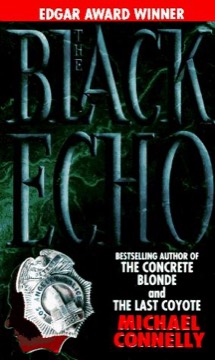
The Black Echo
Michael Connelly's 1992 debut, in which a Los Angeles detective recognises a body found in a drainage pipe as someone he served with in Vietnam.
- First published
- 1992
- Publisher
- St. Martin's Paperbacks
- Pages
- 457
- Shelf
- Thriller
- Level
- Entry
- ISBN-13
- 9780786299843
Record checked against
Catalogue note
- Reads as
- ReflectiveChanges how you see rather than what you do.
- Level
- Accessible / FoundationalNo prior reading assumed.
- Approach
- Theoretical
- Written for
- Readers who mean to stop at one more chapter, Newcomers to the subject
Saved in this browser only — no account, nothing sent anywhere. My library
Read this if
- You want to be kept up late, and made uneasy about who to believe.
- You read for the writing as much as for the argument.
- You want a book that changes how you see things rather than what you do tomorrow.
- You are starting from scratch here and want a way in that assumes no prior reading.
The premise
Harry Bosch, demoted to the Hollywood division after an internal affairs investigation, is called to a body found in a drainage pipe above the Mulholland Dam. It reads as an overdose.
He recognises the dead man as Billy Meadows, who served with him in Vietnam as a tunnel rat, and the case connects to a bank burglary conducted by tunnelling into the vault.
A body in a pipe, and the detective knew him — they used to go into tunnels together.
Devmark’s reading — not a quotation from the book
Tunnels
Bosch and the victim both served clearing Viet Cong tunnel systems, crawling into confined spaces with a torch and a pistol, and the novel returns to that experience repeatedly.
The image organises the whole book: the crime is a tunnel job, the investigation goes underground literally and institutionally, and Bosch's psychology is explained by a job that required going into holes.
Institutional hostility
Internal Affairs is actively pursuing Bosch over a previous shooting, the FBI takes jurisdiction, and his own department would prefer he stopped.
Connelly is consistently interested in an investigator working against his own institution, and the obstruction is procedural rather than melodramatic. Connelly also gives the obstructors coherent reasons, so the friction reads as competing institutional interests rather than as villainy.
Procedure
Connelly covered crime for the Los Angeles Times, and the police work is accurate: chain of custody, warrants, autopsy protocol, the politics of a task force.
The detail is delivered inside the action rather than explained, and the novel assumes a reader who will keep up.
Bosch
He is obsessive, insubordinate, solitary, and operating on a stated principle that everybody counts or nobody counts.
The character is not original in outline and is executed with unusual consistency, and the principle is applied to victims the department would prefer to deprioritise. Connelly also gives him a specific biography — a murdered mother, a childhood in institutions — that accounts for the principle without turning it into a speech.
Los Angeles
The city is rendered through freeways, jurisdictions, and the specific way Hollywood looks from a detective's perspective at four in the morning.
Connelly's LA is procedural rather than mythic, closer to Joseph Wambaugh than to Chandler, and the geography is precise enough to be followed on a map.
Vietnam
The war material is handled without either glamour or therapeutic framing, and the veterans in the book are simply people who did a specific job and came back.
The absence of moralising is notable for a novel published in 1992, and the tunnel material is researched.
Eleanor Wish
The FBI agent assigned to the joint investigation is a genuine partner rather than an obstacle, and the relationship complicates the case in ways the reader can partly anticipate.
Her characterisation is better than the genre standard and her position is independently motivated. Connelly also uses her to supply the federal perspective on a case the LAPD would rather keep, which keeps the jurisdictional conflict grounded in two people.
Structure
It is a conventional procedural in shape: a body, an investigation, a widening conspiracy, a resolution, with the personal history supplying depth.
The construction is confident for a first novel, and the mid-book reversal is properly prepared. Connelly also front-loads the forensic material and lets the conspiracy emerge from it, which keeps the investigation feeling earned rather than delivered.
Prose
Plain, fast and functional, with short chapters and dialogue carrying most of the characterisation.
Connelly writes to be read quickly and does it well, and the style has remained consistent across a very long series. The chapters also end on information rather than on jeopardy, which is a quieter technique than the category standard and suits the procedural register.
The series
It is the first of many Bosch novels, which continue over decades and eventually intersect with Connelly's Mickey Haller books.
The series is unusual in letting its protagonist age in real time, and the later books deal with retirement and with the cold cases of his own career.
Who it is for
Readers who want a police procedural with genuine craft and a protagonist worth following for a long time.
It won the Edgar for best first novel and remains a strong entry point. Readers who want to begin the series should start here rather than with a later book.
What to take away
- 01One image organising everythingTunnel work in Vietnam explains the crime, the investigation and the detective's psychology simultaneously.
- 02Obstruction that is proceduralInternal Affairs, the FBI and his own division impede Bosch through process rather than through melodrama.
- 03Accuracy delivered inside the actionWarrants, chain of custody and task-force politics are conveyed without stopping to explain them.
- 04A principle applied to the deprioritisedEverybody counts or nobody counts is stated and then tested on victims the department would rather not pursue.
- 05Procedural rather than mythic Los AngelesFreeways, jurisdictions and four-in-the-morning Hollywood, closer to Wambaugh than to Chandler.
- 06A protagonist who agesThe series lets Bosch grow old in real time, which is rare and shapes the later books substantially.