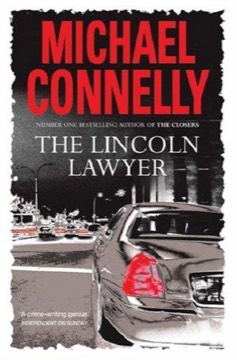
The Lincoln Lawyer
Michael Connelly's 2005 novel about a Los Angeles defence attorney who works from the back of a car and takes a wealthy client whose case is not what it appears.
- First published
- 2005
- Publisher
- Orion (an Imprint of The Orion Publishing Group Ltd )
- Pages
- 472
- Shelf
- Thriller
- Level
- Entry
- ISBN-13
- 9781478938255
Record checked against
Two sources agreed on 2005; a third reported differently (openlibrary 1895, wikidata 2005, wikipedia 2005).
Catalogue note
- Reads as
- ReflectiveChanges how you see rather than what you do.
- Level
- Accessible / FoundationalNo prior reading assumed.
- Approach
- Theoretical
- Written for
- Readers who mean to stop at one more chapter, Newcomers to the subject
Saved in this browser only — no account, nothing sent anywhere. My library
Read this if
- You want to be kept up late, and made uneasy about who to believe.
- You read for the writing as much as for the argument.
- You want to think harder about what is actually right.
- You want a book that changes how you see things rather than what you do tomorrow.
- You are starting from scratch here and want a way in that assumes no prior reading.
The premise
Mickey Haller defends the low end of the Los Angeles criminal docket — bikers, dealers, drunk drivers — from the back seat of a Lincoln Town Car, because an office costs money and he is always moving between courthouses.
A wealthy Beverly Hills client charged with assaulting a woman looks like the franchise case that will finally pay, which is the first sign that it is not.
A defence lawyer whose office is a car, handed the client he has been waiting for.
Devmark’s reading — not a quotation from the book
The defence perspective
Connelly's detective novels are written from the police side; this one inverts it, and the shift is the book's main interest.
Haller's professional problem is that he must not know too much, and the novel is precise about the ethical architecture that makes a defence possible.
A lawyer's guilt
The plot turns on an earlier case in which Haller believes he may have failed a client, and the novel treats that possibility as the worst thing that can happen to a defence attorney.
It gives him a motive that is professional rather than heroic, and it is the most convincing thing about him.
Procedure
Connelly reported on courts for the Los Angeles Times, and the detail on arraignment, discovery, bail, investigators and fee arrangements is precise and used as plot machinery.
The strategy sections — what a defence can and cannot do with a given fact — are the strongest writing in the book.
The car
Working from a Lincoln is not a gimmick but a description of an economics: several courthouses, no fixed clients, and a practice that cannot support overhead.
The image is memorable enough to have named the series, and it does real characterisation work about where Haller sits in the profession.
Structure
The novel runs as a conventional legal thriller for its first half and then executes a significant reversal that changes what Haller is actually defending against.
The second half becomes a duel in which his opponent has access to privileged information, which is an unusually clever use of the attorney–client relationship.
Voice
First person, dry, professionally cynical and unusually self-aware about the compromises the work requires — Haller knows exactly what he is and does not ask the reader to admire it.
He is more likeable than Connelly's Harry Bosch and considerably less driven, and the lighter register suits a book about manoeuvre rather than about obsession.
Los Angeles
The city here is a system of courthouses, jails and freeways, described from the point of view of someone who drives between them all day.
It is a different Los Angeles from Ellroy's or Chandler's — administrative rather than mythic — and it is closely observed.
The supporting cast
Two ex-wives, one a prosecutor and one his case manager, are both still working with him, which tells the reader more about Haller than any description would. An investigator supplies the novel's moral ballast.
The relationships are handled economically and give the book a continuity that the later series builds on without ever pausing to explain.
Its relation to the Bosch novels
Haller and Harry Bosch are half-brothers, a connection established later in the series, and the two sequences intersect repeatedly across Connelly's subsequent books.
None of that is present here. This novel stands alone completely, and no knowledge of Connelly's other work is required or assumed at any point.
The adaptations
A 2011 film with Matthew McConaughey and a later television series have both made the character widely known, and both follow the novel's plot closely enough that readers will recognise most scenes.
The book gives considerably more detail on legal strategy and on the arithmetic of a small practice, which is the element adaptations always compress first.
Who it is for
Readers who want a legal thriller that respects its procedure and still moves quickly, and who like a protagonist who is thoroughly competent without being especially principled.
It is the most purely entertaining book in this group and an excellent entry point to a long series that has not noticeably declined.
What to take away
- 01The defence side, invertedConnelly's police novels are turned inside out: the protagonist's problem is that he must not know too much.
- 02Ethics as architectureThe novel is precise about the rules that make a defence possible, and uses them as plot machinery.
- 03A professional motiveHaller's driver is the fear of having failed a client, not heroism — which makes him credible.
- 04Economics made visibleThe car is a description of a practice that cannot support an office, and does real characterisation work.
- 05Privilege weaponisedThe second half turns on an opponent with access to privileged information, an unusually clever structural use of the relationship.
- 06An administrative Los AngelesThe city is rendered as courthouses, jails and freeways rather than as myth.