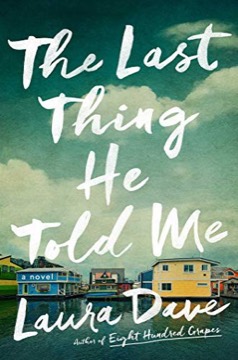
The Last Thing He Told Me
Laura Dave's 2021 novel about a woman whose husband disappears, leaving a note asking her to protect his sixteen-year-old daughter.
- First published
- 2021
- Publisher
- S&S/ Marysue Rucci Books
- Pages
- 320
- Shelf
- Thriller
- Level
- Entry
- ISBN-13
- 9781800817500
Record checked against
Catalogue note
- Reads as
- ReflectiveChanges how you see rather than what you do.
- Level
- Accessible / FoundationalNo prior reading assumed.
- Approach
- Theoretical
- Written for
- Readers who mean to stop at one more chapter, Newcomers to the subject
Saved in this browser only — no account, nothing sent anywhere. My library
Read this if
- You want to be kept up late, and made uneasy about who to believe.
- You want a life told honestly, at full length.
- You read for the writing as much as for the argument.
- You want a book that changes how you see things rather than what you do tomorrow.
- You are starting from scratch here and want a way in that assumes no prior reading.
The premise
Hannah Hall is a woodturner, recently married, living on a houseboat in Sausalito with her husband Owen and his teenage daughter Bailey, who does not like her.
Owen's company collapses in a fraud investigation and he disappears, leaving Hannah a note that says only to protect Bailey.
Her husband vanishes leaving two words, and a stepdaughter who does not want her.
Devmark’s reading — not a quotation from the book
The relationship
The novel's actual subject is the stepmother and stepdaughter, who dislike each other and are the only two people either has left.
The development of that relationship across the book is the reason it works, and the mystery functions as the pressure that forces them together.
Investigation by two amateurs
Hannah and Bailey pursue the truth by going to Austin and checking courthouse records, church registers and a football stadium Bailey half remembers.
The method is genuinely amateur and the novel is honest about their limitations, which is more plausible than the category usually manages.
Memory
Bailey's fragmentary recollection of a wedding, a church and a purple dress is the investigation's only lead, and the novel is careful about how unreliable a four-year-old's memory is.
The gradual verification of individual details is the plot's most satisfying mechanism. Dave also uses the verification of each detail to mark progress, so the reader can measure how far the investigation has come without any summary.
Pace
Short chapters, present tense, and a steady disclosure rate, with the book designed to be read in one or two sittings.
It is efficient and does not linger, and the construction is commercially assured. The chapters are also very short and frequently end on a small disclosure, which keeps the momentum steady without requiring any physical jeopardy.
The husband
Owen is absent throughout and is constructed from Hannah's recollections, which are shown to be a partial account of someone she knew for a relatively short time.
The question of whether she knew him at all is the emotional centre, and the novel's answer is more generous than the setup suggests.
Plausibility
The central conspiracy depends on arrangements that do not entirely survive examination, and a late intervention resolves matters somewhat conveniently.
The book prioritises the relationship over the mechanics, which is a defensible allocation of its attention. Several characters also behave with a discretion the situation would not reliably produce, which is the element most likely to lose a sceptical reader.
Prose
Plain, unobtrusive and heavily reliant on dialogue, with very little description beyond what the settings require.
Dave is a screenwriter as well as a novelist and the construction is scene-based, which accounts for the pace and for the dialogue's efficiency. The woodturning material also gives Hannah a specific competence and a vocabulary, which does characterisation work economically.
The ending
The resolution requires a substantial sacrifice and is delivered in an epilogue jumping several years forward.
It is emotionally effective and is the element most readers remember, and it resolves the relationship rather than the conspiracy. Readers who wanted the conspiracy fully explained will find it incomplete, and readers who came for the relationship will find it fully answered.
Sausalito and Austin
The houseboat community and the Texas sections are both specific, and the contrast between them is used to mark the distance between the life Owen built and the one he left.
The settings are functional rather than atmospheric, which suits a book moving this quickly.
The adaptation
A television series adapted it with Jennifer Garner and expands several elements, particularly the husband's backstory.
The novel keeps him almost entirely offstage, which is a stronger choice and one the screen version was unlikely to preserve. The series also adds sequences from Owen's perspective, which removes the ambiguity about whether Hannah ever knew him.
Who it is for
Readers who want a fast domestic mystery whose real interest is a relationship, and who do not require the conspiracy to withstand scrutiny.
It is among the warmer books in this section and is unusually uninterested in violence. Readers who want a thriller in the harder sense should look elsewhere on this shelf.
What to take away
- 01The mystery as pressureThe disappearance exists to force a stepmother and stepdaughter together, and the relationship is the actual subject.
- 02Genuinely amateur investigationCourthouse records and half-remembered landmarks are the method, and the novel is honest about the two women's limitations.
- 03A four-year-old's memory verified piecemealIndividual details from Bailey's recollection are confirmed one at a time, which is the plot's most satisfying mechanism.
- 04A husband kept offstageOwen is constructed entirely from a partial account by someone who knew him briefly, and the absence is the stronger choice.
- 05Relationship resolved, conspiracy less soThe ending answers the emotional question and handles the mechanics conveniently, which is a defensible allocation.
- 06Unusually uninterested in violenceThe book generates tension without physical threat for almost its entire length, which is rare in the category.