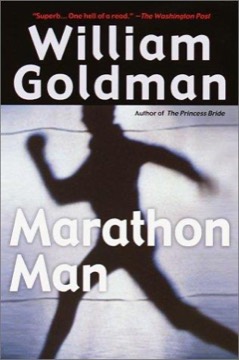
Marathon Man
William Goldman's 1974 novel about a graduate student whose brother's work in intelligence brings a Nazi war criminal to his door.
- First published
- 1974
- Publisher
- Delacorte Press
- Pages
- 266
- Shelf
- Thriller
- Level
- Entry
- ISBN-13
- 9780440053279
Record checked against
Catalogue note
- Reads as
- ReflectiveChanges how you see rather than what you do.
- Level
- Accessible / FoundationalNo prior reading assumed.
- Approach
- Theoretical
- Written for
- Readers who mean to stop at one more chapter, Newcomers to the subject
Saved in this browser only — no account, nothing sent anywhere. My library
Read this if
- You want to be kept up late, and made uneasy about who to believe.
- You read for the writing as much as for the argument.
- You want a book that changes how you see things rather than what you do tomorrow.
- You are starting from scratch here and want a way in that assumes no prior reading.
The premise
Thomas Levy, called Babe, is a history graduate student in New York, a distance runner, and preoccupied with his father's suicide after being destroyed by McCarthyist accusations.
His older brother Doc works in a branch of American intelligence Babe knows nothing about. When Doc is attacked, Babe is left holding information he does not have and cannot supply.
He knows nothing, which is the one thing nobody interrogating him will believe.
Devmark’s reading — not a quotation from the book
The central situation
The novel's most effective idea is that Babe genuinely has no information, and that his ignorance is indistinguishable from resistance.
The interrogation cannot be satisfied because there is nothing to extract, and the horror comes from a question that has no answer being asked repeatedly.
Szell
The antagonist is a former Auschwitz dentist, living in South America, who has come to New York to retrieve diamonds taken from prisoners.
He is elderly, precise, physically unimpressive and entirely without hesitation, and Goldman writes him as a practical man doing a routine errand.
The dental scene
The interrogation conducted with dental instruments and the repeated question is among the most famous sequences in popular fiction and is genuinely difficult to read.
Its power comes from the ordinariness of the equipment and from the antagonist's calm, and Goldman keeps it shorter than its reputation suggests.
Running
Babe's distance training, his admiration for Abebe Bikila, and the physical discipline of it are established throughout and become practically important.
The motif is not decorative: the novel's resolution depends on a capacity built across two hundred pages of apparently incidental material. Goldman also uses it to establish Babe's relationship with his father, since the running is inherited, which does character work while setting up the plot.
History
Babe's academic work concerns political persecution and his father's destruction by anti-communist investigation, and the novel connects American and Nazi material deliberately.
The argument — that the machinery of persecution is transferable — is present throughout and is stated more directly than a thriller usually permits.
Structure
The first third establishes two apparently unconnected narratives, and the convergence is delayed longer than a modern thriller would allow.
The patience pays off, and the moment the two threads meet is among the most effective in this section. Goldman also withholds the connection deliberately, and several readers have described putting the book down during the first third before it resolves.
Goldman
He was a screenwriter as well as a novelist, with Butch Cassidy and All the President's Men among his credits, and he adapted this himself.
His screen background is visible in the construction and in the dialogue, and his book on the film industry is among the best written about it.
Prose
Fast, colloquial and fond of short paragraphs and direct address, with an unusual willingness to break into the second person.
The style is more mannered than the genre standard and is consistently effective, particularly in the sequences from Babe's perspective. He also uses very short chapters and occasional single-line paragraphs, and the rhythm is noticeably faster than the thrillers of its period.
The film
John Schlesinger's 1976 adaptation, with Goldman's screenplay, is very close to the book and is how most people know the story.
The novel's ending differs and is considerably harsher, and Goldman has written about the change. Laurence Olivier's performance as Szell has largely fixed the character publicly, and the film's version of the interrogation is close to the novel's.
The sequel
Goldman wrote a follow-up, Brothers, which is generally regarded as substantially weaker and which revises the first book's ending.
Readers are best served treating this as standalone, which it is entirely adequate as. Goldman wrote it more than a decade later and has said relatively little about it, and it is out of print in most territories.
Who it is for
Readers who want a thriller with a genuine historical argument and a protagonist who is not equipped for the situation.
It is short, extremely tense and among the best-constructed books in this section. Readers who know only the dental scene will find the surrounding novel considerably more substantial than its reputation.
What to take away
- 01Ignorance indistinguishable from resistanceBabe genuinely knows nothing, so the interrogation cannot be satisfied and the question has no available answer.
- 02A routine errandSzell is elderly, precise and without hesitation, written as a practical man completing a task rather than as a monster.
- 03Incidental material made structuralTwo hundred pages of running establish a capacity the resolution depends on entirely.
- 04Persecution treated as transferableThe novel connects the father's destruction by anti-communist investigation to Nazi machinery deliberately and directly.
- 05Convergence delayedTwo unconnected narratives run for a third of the book, and the patience makes the meeting land.
- 06Shorter than its reputationThe famous interrogation is brief, and its force comes from ordinary equipment and a calm operator.