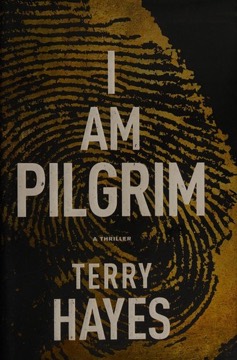
I Am Pilgrim
Terry Hayes's 2013 novel about a retired American intelligence officer drawn back to prevent a biological attack, told across several decades and continents.
- First published
- 2013
- Publisher
- Emily Bestler Books/Atria
- Pages
- 612
- Shelf
- Thriller
- Level
- Entry
- ISBN-13
- 9781439177723
Record checked against
Catalogue note
- Reads as
- ReflectiveChanges how you see rather than what you do.
- Level
- Accessible / FoundationalNo prior reading assumed.
- Approach
- Theoretical
- Written for
- Readers who mean to stop at one more chapter, Newcomers to the subject
Saved in this browser only — no account, nothing sent anywhere. My library
Read this if
- You want to be kept up late, and made uneasy about who to believe.
- You read for the writing as much as for the argument.
- You want a book that changes how you see things rather than what you do tomorrow.
- You are starting from scratch here and want a way in that assumes no prior reading.
The premise
A man who has operated under many names ran a secret American intelligence unit investigating its own agents. He retired, wrote a book on forensic investigation under a pseudonym, and intended to disappear.
A murder in a New York hotel, committed using methods described in his own book, brings him back, and the case connects to a Saudi man planning a biological attack on the United States.
A murder committed by the book he wrote, which is how they find him again.
Devmark’s reading — not a quotation from the book
Structure
The novel is very long and moves between a New York murder investigation, the narrator's intelligence career, and the antagonist's life in Saudi Arabia and Afghanistan.
The threads converge slowly, and the first four hundred pages are largely concerned with establishing two lives in parallel.
The antagonist
The man the narrator calls the Saracen is given a full history: a father executed publicly, a medical education, a radicalisation that the novel traces step by step.
Hayes gives him roughly equal weight and real competence, and the character is considerably more interesting than the genre usually manages.
Procedural set pieces
Several long sequences — a forensic reconstruction in a hotel room, an identification from a mirror, a surveillance operation in Turkey — are constructed with unusual care.
The mirror sequence in particular is the book's most admired passage and is a genuinely clever piece of deductive writing.
Narration
The first-person narrator addresses the reader directly, withholds and promises information, and frequently states that something will matter later.
The technique is divisive. It generates forward pressure and it also constantly reminds the reader that they are being managed by a storyteller. Hayes also uses the device to compress large amounts of backstory, telling the reader directly what would otherwise require scenes to establish.
Length
It runs to around seven hundred pages and contains substantial digression, including extended backstory for characters who appear briefly.
Readers report either being absorbed by the expansiveness or frustrated by it, and there is little middle position. The digressions also contain some of the book's best material, particularly a long sequence in a Turkish resort town that has almost no plot function.
Hayes's background
He was a screenwriter, with credits including Mad Max 2 and Dead Calm, and this is his first novel.
The screen background shows in the set pieces, which are staged visually, and in a structure that reads as several films connected by a throughline. He also wrote Payback and Vertical Limit, and the appetite for large set pieces and clean reversals is consistent across the screen work and the novel.
Politics
The novel is broadly sympathetic to American intelligence work and its treatment of torture, rendition and surveillance is considerably less critical than le Carré's.
Its depiction of Saudi Arabia and of radicalisation has been criticised as reliant on assumption, and the objection is reasonable. Readers who come to it after le Carré will find the moral framework considerably simpler, with the American side broadly assumed to be acting correctly.
Pace
Despite the length it moves quickly, with short chapters and a reliable rate of incident.
Hayes is very good at the sentence-level mechanics of keeping a reader turning pages, which is what carries the book across its digressions. The chapters are also short and frequently end mid-scene, which is a straightforward technique and is deployed relentlessly across seven hundred pages.
Plausibility
The narrator is improbably capable across an improbable range of disciplines, and several developments depend on him being the only person who could have noticed something.
The book is a competence fantasy and does not pretend otherwise, which some readers find exhilarating and others find tiring.
The sequel
A follow-up has been announced and repeatedly delayed for more than a decade, and has not appeared.
The novel stands alone completely and requires nothing, though its ending plainly anticipates a continuation. Hayes has spoken publicly about the delay on several occasions, and the continuation has become something of a standing joke among the book's readers.
Who it is for
Readers who want a very long, very propulsive international thriller and are happy to accept a hyper-competent protagonist.
It is the most purely entertaining book in this section and the least interested in moral complication. Readers who want the espionage novel's ambiguity should read le Carré instead.
What to take away
- 01Found by his own bookA murder committed using methods from the narrator's pseudonymous forensic manual is what brings him back.
- 02An antagonist given equal weightThe Saracen's history is traced step by step and he is granted real competence, which the genre rarely does.
- 03Deduction staged as set pieceThe hotel-room reconstruction and the mirror identification are the book's most admired and most carefully built passages.
- 04A narrator who manages the readerDirect address and explicit promises of later significance generate pressure while constantly announcing the artifice.
- 05Screenwriting visible in the structureHayes's film background shows in visually staged sequences and a shape that reads as several films connected.
- 06A competence fantasy, undisguisedThe protagonist is improbably capable across an improbable range, and the novel makes no claim otherwise.