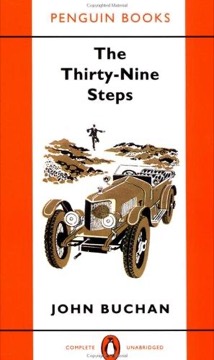
The Thirty-Nine Steps
John Buchan's 1915 adventure in which an ordinary man, wrongly suspected of murder, flees across Scotland while carrying a secret. The founding text of the chase thriller.
- First published
- 1915
- Publisher
- D.R. Godine
- Pages
- 116
- Shelf
- Thriller
- Level
- Entry
- ISBN-13
- 9781974693566
Record checked against
Catalogue note
- Reads as
- ReflectiveChanges how you see rather than what you do.
- Level
- Accessible / FoundationalNo prior reading assumed.
- Approach
- Theoretical
- Written for
- Readers who mean to stop at one more chapter, Newcomers to the subject
- Ideas
Saved in this browser only — no account, nothing sent anywhere. My library
Read this if
- You want to be kept up late, and made uneasy about who to believe.
- You want a book that changes how you see things rather than what you do tomorrow.
- You are starting from scratch here and want a way in that assumes no prior reading.
The premise
Richard Hannay, recently returned from Rhodesia and bored with London, is approached by a neighbour claiming knowledge of a conspiracy against Britain. Days later the man is dead in Hannay's flat.
Wanted by the police for the murder and by the conspirators for what he now knows, Hannay takes a train north and spends the bulk of the novel being hunted across open country.
Pursued by the law for a crime he did not commit, and by the guilty for what he does not yet understand.
Devmark’s reading — not a quotation from the book
The double pursuit
The structural invention is being hunted by both sides at once. Hannay cannot go to the authorities for protection because they want him for murder, and he cannot hide because the conspirators are searching too.
This is now so standard that it reads as obvious. In 1915 it was new, and almost every chase narrative since has used some version of it.
The ordinary man
Hannay is capable but not exceptional: a mining engineer with useful outdoor skills and no training in anything the plot requires.
Buchan's decision to make the hero an amateur is what gives the book its momentum. Every escape is improvised, and the reader is invited to feel that attentiveness and nerve would be enough.
Landscape as antagonist and ally
The Galloway sections are the best writing in the book. Moorland, weather and sightlines are described with real precision, and the terrain determines what is possible in each episode.
Buchan was a serious walker, and the chase works because the geography is consistent — distances, cover and daylight all behave as they would.
Episodic construction
The novel proceeds as a chain of encounters: a roadman, a literary innkeeper, a political candidate, an archaeologist. Each provides a temporary disguise or shelter before the pursuit resumes.
Buchan called this kind of book a shocker, by which he meant an entertainment where improbability is admitted and the pace is asked to cover it.
Coincidence, and how it is handled
The plot turns repeatedly on Hannay meeting exactly the person he needs. The book does not disguise this and occasionally jokes about it.
Whether that is a flaw depends on what is wanted. The declared frivolity buys a great deal of licence, and the pace rarely leaves room to object while reading.
The villain
The antagonist's defining ability is to appear utterly ordinary — a man who can hood his eyes and become someone unremarkable.
That single image is the most durable thing Buchan invented here. An enemy identifiable by nothing visible is a more modern anxiety than the rest of the book's apparatus.
Written from a sickbed, into a war
Buchan wrote it while ill in 1914, and it was published in 1915 with the war under way. The invasion anxiety it trades on was current rather than historical.
It was read widely by soldiers, and its brevity and forward motion are partly a consequence of the audience and moment it was written for.
The prejudices
The novel contains antisemitic passages, delivered in the first chapter through a character and not repudiated, and a general imperial confidence that runs through Hannay's assumptions.
These are not incidental to the period colour and are worth naming plainly. They sit alongside the invention rather than cancelling it, and a reader is entitled to find them ugly.
The adaptations
Hitchcock's 1935 film added a woman, handcuffs and a music-hall ending, none of which are in the book, and several later versions follow the film rather than the novel.
The result is a story most people know in a shape Buchan did not write. The original is shorter, lonelier and almost entirely without romance.
The famous version is the film's. The book is a solitary walk.
Devmark’s reading — not a quotation from the book
What the genre took
The innocent fugitive, the double pursuit, the race against a deadline, the countryside as obstacle course — all of it descends from here through Household, Ambler, Hitchcock and beyond.
Its influence is disproportionate to its length. At well under two hundred pages it established a set of moves the thriller has never stopped using.
Reading it now
It is very short, very fast, and free to read in most territories. The Scots dialect in a few passages is the only real friction.
Approach it as a foundation rather than as a masterpiece. Its pleasures are real but thin, and its interest is substantially in how much of the modern thriller is already present in it.
What to take away
- 01Hunted by both sidesBeing pursued by the police and the conspirators at once removes every safe option and became the genre's default.
- 02The capable amateurHannay has no relevant training, so every escape is improvised and the reader is invited to identify.
- 03Terrain as plotBuchan's walking knowledge makes the geography consistent, so cover, distance and daylight genuinely constrain the chase.
- 04Admitted improbabilityBuchan called it a shocker and did not hide the coincidences, buying licence with declared frivolity.
- 05The unremarkable enemyA villain recognisable by nothing visible is the book's most modern and most durable invention.
- 06Known through its adaptationsMost of the story's famous elements were added by Hitchcock and are not in the novel at all.